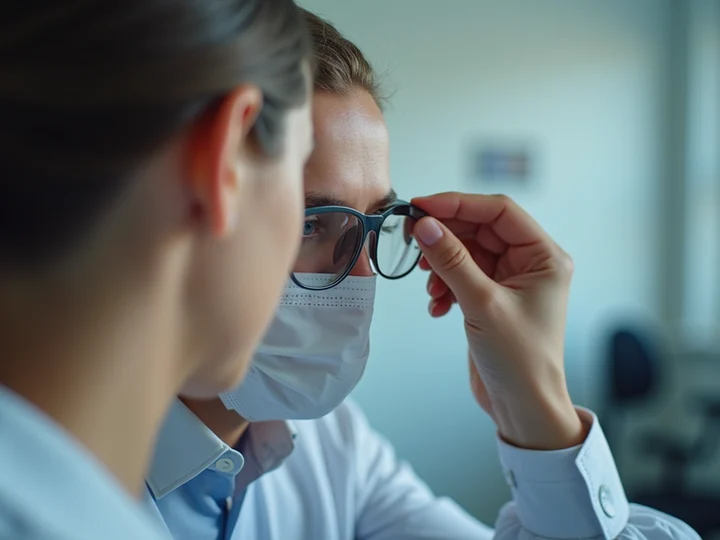
Reading glasses strength is the lens power in diopters, printed on the label as a plus number such as +1.25 or +2.00. Each step up magnifies a little more and brings the distance where print looks sharpest closer to your face. The right strength is the weakest one that makes small print clear and comfortable where you naturally hold it. Most people first notice presbyopia, the age-related loss of close-up focus, around ages 40 to 45, and the power they need usually rises until about 65. Drugstore readers suit many people, but an eye exam gives you the exact power for each eye and checks for problems that readers can hide.
Key takeaways
- You need the weakest plus power that makes small print clear and comfortable at the distance where you naturally hold it.
- Presbyopia, the age-related loss of close-up focus, is usually first noticed around ages 40 to 45, and the power you need tends to rise until about 65.
- Ready-made readers suit many people, and an eye exam adds the exact power for each eye plus a check for problems that readers can hide.
- If straight lines start to look wavy, stronger readers won't help: call us that day, or go to an emergency room when we're closed.
01
What do the numbers on reading glasses mean?
The number is the lens power in diopters, the unit eye doctors use for focusing strength. A diopter is 1 divided by the focusing distance in meters, so a stronger lens focuses closer to your face; our prescription explainer covers how diopters work.
Reading glasses use plus lenses, which add focusing power for close work. Ready-made pairs come in small steps, such as +1.00, +1.25 and +1.50, with the same power in both lenses. In the exam room, a quarter of a diopter is often the difference between glasses you tolerate and glasses you forget you're wearing.
02
Does reading glasses strength depend on age?
Partly. The usual pattern is a low power when close focus first slips in your 40s, then gradual steps up, though no age chart can give you your exact number. Presbyopia can seem to arrive overnight, yet the loss of focus builds over several years, and it usually stops getting worse after 65.
Two other things shape your number. One is reading distance: a phone held close needs more power than a tablet at arm's length. The other is any focusing error you already have, because many people have another refractive error in addition to presbyopia. Farsightedness, which already makes nearby objects look blurry, can mean you need more reading power than friends your age.
That's why two people born the same year can need quite different readers. An exam measures each eye separately and gives you a starting number that fits your eyes.
03
How to choose reading glasses
Pick the weakest pair that makes small print clear at your usual reading distance. A few minutes of testing in the store gets you close:
- Bring what you read most, such as your phone or a paperback, and hold it where it feels natural.
- Start with the lowest strength and go up one step at a time. Stop at the first pair that makes the smallest print sharp.
- Cover one eye, then the other. If one eye sees clearly and the other doesn't, ready-made readers won't fit you well, and an eye exam should find out why.
- Match the pair to the job. A computer screen sits farther away than a book, so it usually needs less power; for long screen days, computer or office lenses give a wider middle zone than progressives.
- Choose the frame for how you'll use it. Half-eye readers let you look over the top at the room, while full frames blur anything far away.
Once you have a pair, these signs tell you whether the strength is right:
| What you notice | What it usually means |
|---|---|
| You still hold the page farther away than you'd like | The strength is too weak |
| You have to bring print closer than is comfortable | The strength is too strong |
| Sharp for a book, blurry for the laptop | Right for reading, too strong for the screen |
| One eye sees noticeably better than the other | Time for an eye exam; you may need prescription readers |
04
Readers vs prescription glasses: which do you need?
Ready-made readers put the same power in both lenses and center them for an average face. They also don't correct astigmatism, a focusing error that can make both near and far objects look blurry or distorted. Prescription reading glasses are made to the measured power of each eye, correct any astigmatism and are centered on your own pupillary distance.
Both count as medical devices. The FDA calls over-the-counter readers magnifying spectacles, and eyeglasses generally must be fitted with impact-resistant lenses.
If you already wear glasses or contacts for distance, adding drugstore readers means juggling pairs. The American Optometric Association (AOA) says those near-vision changes can be corrected by switching to bifocals or multifocal contact lenses instead.
The bigger difference is the exam that comes with a prescription. The AOA's adult exam guideline warns that people who buy over-the-counter readers instead of getting an exam miss the chance to uncover sight-threatening eye or health problems, which is why we treat drugstore readers as a backup pair.
05
Why do I keep needing stronger readers?
Because the lens inside your eye keeps stiffening. With age it gets harder and less flexible and stops focusing light correctly on the retina, so most people step up in strength now and then through their 40s and 50s before the change levels off after 65.
A fast change is different. Needing a new prescription often, especially with headlights that seem too bright or colors that look faded, can be a sign of a cataract, a clouding of the eye's natural lens. If a new pair stops working within months, book an eye exam; it includes a check for a cataract.
06
When are reading glasses not enough?
Readers stop being enough when you need clear vision at more than one distance, or when the blur isn't presbyopia. For the first problem, the usual options are:
- Progressive lenses, with distance, desk and reading zones in one pair
- Computer or office lenses for long days at a screen
- Multifocal contact lenses, which combine distance and near power in one lens
- Monovision, with one contact lens set for near or intermediate vision and, if needed, the other for distance
For the second problem, stronger readers won't help. Straight lines that look wavy, or a blurry area near the center of your vision, can be signs of age-related macular degeneration (AMD), an eye disease that blurs central vision. Our Amsler grid test is a quick check at home. If straight lines start to look wavy, call us that day, or go to an emergency room when we're closed; the National Eye Institute's advice for this warning sign is to see your eye doctor right away.
Blur that comes on suddenly, especially in one eye, needs an emergency room if it doesn't clear; if it clears right away, call us and come in for an exam. Sudden loss of vision in one or both eyes, even if it comes back, sudden double vision, or any vision change with face drooping, arm weakness or trouble speaking means calling 911.
If no strength makes print readable, book an eye exam to find the cause; when vision can't be fully corrected, low vision care uses stronger magnification, task lighting and other tools built around what you want to read.
07
How we check near vision at Cohenmehr Optometry
A comprehensive eye exam with our Los Angeles optometrists measures your distance and near vision and any astigmatism, then checks how your two eyes focus and work together. The same visit covers the eye health questions that start in the same decade as presbyopia: eye pressure, the macula and the clarity of the lens.
What comes next depends on your day. We fit progressive and computer lenses in our optical, ten feet from the exam chair, and trial multifocal or monovision contacts before you commit. Our presbyopia guide compares the options.
08
Questions patients ask
Do nearsighted people need reading glasses?
Not always as a separate pair. Nearsightedness (myopia) means close objects look clear while distant ones blur, so some nearsighted people read comfortably by taking off their distance glasses. Presbyopia still arrives, though, and the AOA notes that nearsighted patients over 40 may need a bifocal or progressive lens, which has different powers for distance and up close. Multifocal contact lenses do the same job in a contact lens.
Can LASIK get rid of reading glasses?
Usually not on its own. LASIK uses a laser to reshape the cornea, the clear front of the eye, while presbyopia comes from the aging lens behind it. The FDA notes that if you used reading glasses before surgery, you may still need them afterward, and that monovision, with one eye set for near, can lower the quality of vision and depth perception, most noticeably in low light. We don't perform LASIK; we assess candidacy and provide care before and after surgery.
Can presbyopia be fixed naturally?
Not in the sense of reversing it. Presbyopia can't be prevented or cured, because it comes from the lens inside the eye hardening with age. Early on, a few habits buy time: hold reading material farther away, choose large print or bigger fonts on screens, and use brighter reading lights. Once those stop working, glasses or contact lenses are the fix.
Why do my eyes get tired when I read?
Tired eyes during close work are one of the signs of presbyopia, along with headaches and blur at your normal reading distance. If your readers are the right strength and your eyes still tire, ask about convergence insufficiency, a problem with how the two eyes work together up close that can make you lose your place or feel the words move on the page. A near-vision evaluation tells the two apart.
09
Sources
- AOA: Comprehensive Adult Eye and Vision Examination guideline, 2023
- National Eye Institute: Presbyopia
- AOA: Presbyopia
- National Eye Institute: Refractive errors
- FDA: Impact-resistant lenses, questions and answers
- AOA: Adult vision, 41 to 60 years of age
- National Eye Institute: Cataracts
- National Eye Institute: Age-related macular degeneration
- American Stroke Association: Stroke symptoms
- AOA: Myopia
- FDA: What is LASIK?
- FDA: LASIK risks
- National Eye Institute: Convergence insufficiency

Written by
Dr. Bijan Cohenmehr, OD
Founder of Cohenmehr Optometry, in practice for over 40 years. He leads the practice’s dry eye care and myopia management. A graduate of SUNY College of Optometry.
About Dr. Bijan →