
Same-day urgent eye care
Mon 10–5 · Tue–Fri 8–5 310-828-2010 Book online Intake form
Cohenmehr Optometry — Vision · Dry Eye · Keratoconus Book appointment
Cohenmehr OptometryVision · Dry Eye · Keratoconus Center
Our Practice
Meet the Doctors TestimonialsShare FeedbackTraveling to See UsAreas We Serve Hours & Directions
Eye Care

Routine care

Comprehensive Eye CareContact Lens ExamsComputer Vision SyndromeGlasses and Contact LensesNeurolensAdvanced Diagnostics

Medical eye care

Glaucoma & Ocular DiseaseDiabetic Eye ExamsMacular Degeneration CareLow VisionStye & Chalazion TreatmentUrgent Care

Children’s vision

Pediatric Eye ExamsMyopia ManagementAtropineOrtho-KEssilor Stellest LensesVision Therapy

Surgery co-management

Surgical Co-ManagementLASIKPRKSMILEEVO ICLRefractive Lens ExchangeCataract SurgeryCorneal TransplantPterygium Surgery
Dry Eye
The Dry Eye CenterOptiLIFTIPL (Intense Pulsed Light)Punctal PlugsBlephExAmniotic MembranesPrescription DropsAutologous Serum DropsMeibomian Gland ProbingIPL for Rosacea

Understand

Types of Dry EyeThe Tear FilmDemodex BlepharitisDry Eye After LASIKMenopause & Dry EyeSjögren’s & Dry EyeContact Lens Discomfort

Cosmetics

Upneeq® · Buy OnlineUpneeq Intake Form
Myopia Control
The Myopia ProgramMyopia Estimator — free toolOrtho-K — $1,500 totalAtropineStellest LensesMultifocal ContactsMiSight 1 Day

For parents

Choosing a TreatmentWhy Myopia MattersOutdoor Time & ScreensFirst Ortho-K NightMeasuring Progression
Keratoconus
The Keratoconus CenterScleral Contact LensesSpecialty Contact LensesScleral Lens UsesEaglet Surface ProfilerScleral Lens Care

Go deeper

Eye Rubbing & KeratoconusKeratoconus in TeensCorneal HydropsTransplant Co-Management
Scleral Lenses

The lenses

Scleral Contact LensesEvery Use, at a GlanceEaglet Surface ProfilerScleral vs RGP vs HybridSpecialty Contact LensesSpecialty Soft & ProstheticLens Care & HandlingTraveling to See Us

Corneal conditions

KeratoconusPost-LASIK EctasiaPellucid Marginal DegenerationCorneal ScarringAfter Corneal TransplantAfter Radial Keratotomy (RK)Post-Surgical ComplicationsOcular Shingles Scarring

Surface disease & more

Severe Dry EyeSjögren’s SyndromeStevens-Johnson SyndromeGraft-vs-Host DiseaseBell’s Palsy & ExposureRare Tear DeficiencyPresbyopia & High RxSports & Active Wear
Library
Start With a SymptomEye Conditions A–ZArticlesFree ToolsFull Site Index

Patients

Patient Intake FormCommon QuestionsAccepted InsurancePaying for Care (FSA/HSA)
Call the office310-828-2010
Book appointment

Medically reviewed by Dr. Brandon Cohenmehr, OD Last reviewed

Higher-Order Aberrations: Symptoms, Causes & Treatment

The blur that survives a perfect prescription.

Sphere and cylinder — the numbers on a prescription — describe only the simplest focusing errors. Irregular corneas add stranger ones: coma that smears lights into comet tails, spherical aberration that halos the night, trefoil that stars every point of light. These are higher-order aberrations (HOAs), and no pair of glasses can cancel them.

Night lights smearing into comet tails through a windshield
What they are
Focusing errors beyond sphere and cylinder
Who has them
Mostly irregular corneas — keratoconus, grafts, post-surgical eyes
The symptom
Ghosting and glare despite a “correct” Rx
The answer
Smooth optics over the cornea — scleral lenses

The physics, kept friendly

Beyond sphere and cylinder.
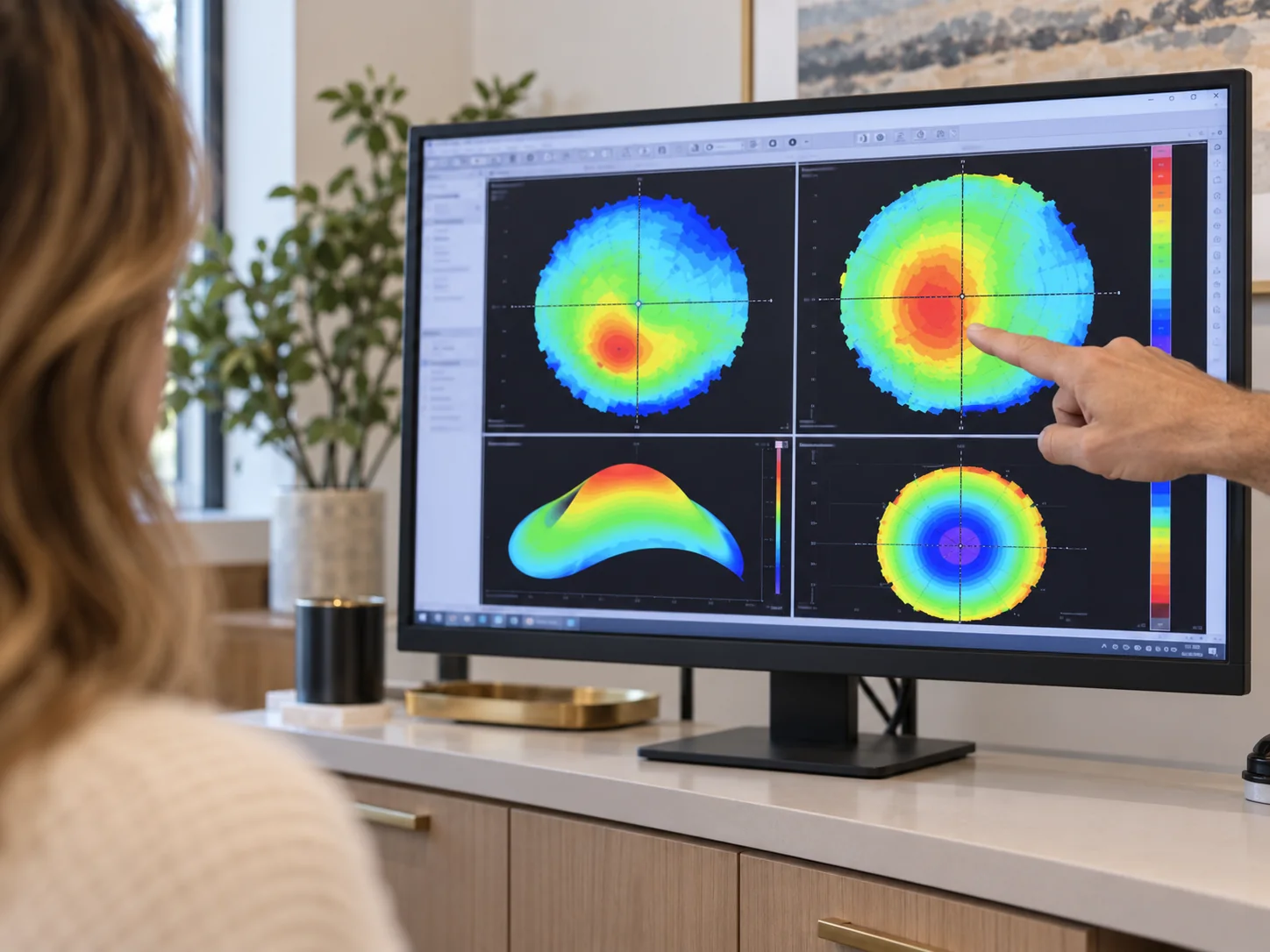
A wavefront map showing irregular optics

Think of light entering the eye as a sheet that should land perfectly flat on the retina. Nearsightedness tilts the sheet; astigmatism curls it evenly. Higher-order aberrations crumple it, so each region of the pupil focuses somewhere slightly different. Instead of simple blur, you get ghosts, tails and halos layered over the image.

Coma

Light smears to one side: the comet-tail headlights classic to keratoconus.

Spherical aberration

Rays through the pupil’s edge focus differently than the center, causing halos that grow as pupils widen at night.

Trefoil and beyond

Three-pointed flare on lights; the higher the order, the stranger the pattern.

Why night is worst

Dim light opens the pupil, admitting the cornea’s most irregular zones into the image.

The fix

Replace the surface, then refine the optics.

  1. 01

    Smooth the front of the eye

    A scleral lens vaults the irregular cornea and fills the gap with fluid. Most HOAs collapse the moment light meets a smooth optical surface instead of the cone.

  2. 02

    Measure what remains

    Some eyes keep residual aberrations even in a well-fit scleral. Over-refraction and careful on-eye testing show what’s left and where it comes from.

  3. 03

    Refine the design

    Free-form lenses built from an Eaglet ESP map center and stabilize precisely, and advanced optics depend on that. Design refinements then chase the residual ghosting case by case.

  4. 04

    Be honest about limits

    Dense scars and extreme cones can leave traces no lens erases; our optometrists in Los Angeles tell you what’s optical, what’s structural, and what each change will buy before you commit.

If you’ve been told your vision is “as good as it gets” with lenses that still ghost, an aberration-aware refit is usually the next move worth making.

Suspect HOAs if

  • New glasses never feel as sharp as the chart said
  • Letters carry faint echoes even with lenses on
  • Night driving blooms with halos and streaks
  • You have keratoconus, a graft, or prior corneal surgery
  • One eye sees “dirtier” than its prescription explains

Why glasses can’t fix them

A spectacle lens applies one smooth correction across the whole pupil. HOAs vary point by point across an irregular cornea, in a pattern no single smooth lens surface can cancel from a distance. The fix has to happen at the eye itself.

Where this happens

HOA care is scleral care done precisely.

Common questions

Higher-order aberrations, answered.

Anything else, call the office at 310-828-2010.

  • Focusing errors more complex than nearsightedness, farsightedness or astigmatism — the crumpled-light errors irregular corneas create, which show up as ghosting, comet tails and halos.

  • Because a prescription only describes the simple errors. HOAs live outside those numbers, which is why sharper glasses never quite arrive for irregular corneas.

  • They eliminate most of them by giving light a smooth surface to enter through. Residual aberrations are then measured and chased with design refinements on a stable, well-centered fit.

  • Advanced optics only help if the lens sits still — a lens that rotates or drops puts the correction in the wrong place. That is exactly what ESP-mapped free-form landings are for.

  • Anyone with keratoconus, a corneal graft, RK or LASIK history whose vision ghosts or flares beyond what their prescription explains — especially at night.

Higher-order aberrations near you

12222 Wilshire Blvd, on the Santa Monica border.

West Los AngelesBrentwoodSanta MonicaWestwoodBeverly HillsCulver CityPacific PalisadesWest HollywoodMarina del ReyNewport Beach

Also consider

Next step

Ghosts your prescription can’t explain?

Bring your current lenses. We’ll map the cornea, measure what the numbers miss, and show you what a smooth optical surface does to the ghosts.

Book a Scleral Lens Evaluation Or call 310-828-2010