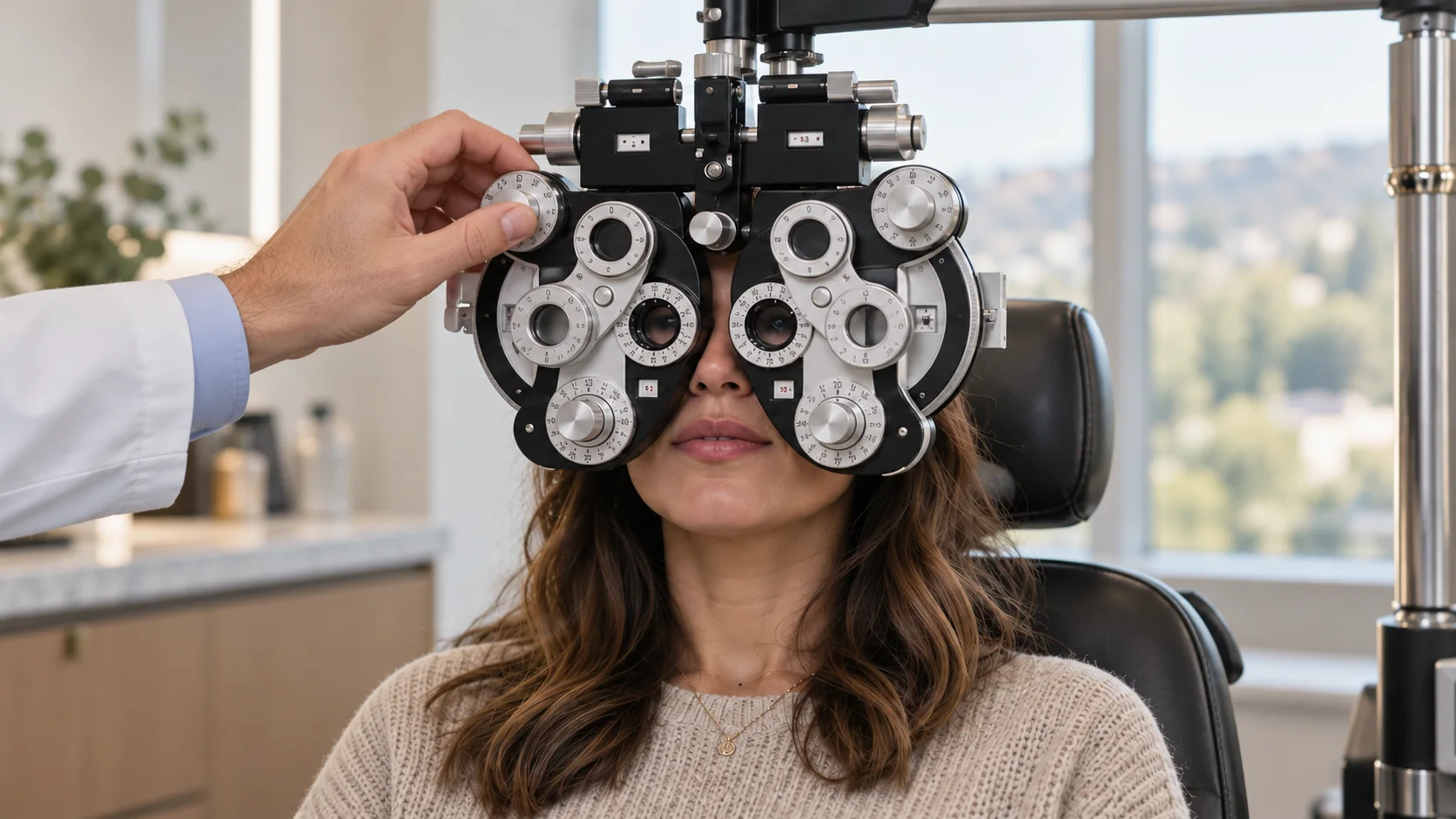
An eye prescription gives each eye its own row of numbers. OD is your right eye and OS your left eye, from the Latin Oculus Dexter and Oculus Sinister, and OU means both eyes. SPH (sphere) is the main lens power, measured in diopters: a minus sign means the lens corrects nearsightedness, and a plus sign farsightedness. CYL (cylinder) and axis only appear if you have astigmatism, and ADD is extra power for reading. Our eye doctors in Los Angeles can go over yours at a comprehensive eye exam, and the sections below explain each box.
Key takeaways
- OD means right eye, OS means left eye and OU means both eyes, from the Latin names eye doctors use.
- SPH is the main lens power in diopters, with a minus sign for nearsightedness and a plus sign for farsightedness.
- CYL and axis appear only when you have astigmatism, and ADD is extra power for reading in bifocals or progressives.
- A contact lens prescription adds the lens maker, base curve and diameter, and you get it only after a fitting.
01
What do OD and OS mean on an eye prescription?
OD means right eye and OS means left eye. The abbreviations are derived from Latin for Oculus Dexter (OD) for right eye and Oculus Sinister (OS) for left eye. You may also see OU, oculus uterque, for both eyes.
Here's how a typical glasses prescription is laid out. The numbers are only an example:
| Eye | SPH | CYL | Axis | ADD |
|---|---|---|---|---|
| OD (right eye) | −2.25 | −0.75 | 180 | +2.00 |
| OS (left eye) | −2.50 | −1.00 | 175 | +2.00 |
Expect the two rows to differ. The Canadian Association of Optometrists notes that it is not uncommon for the numbers for the right eye to be quite different to the number for the left eye.
02
What does SPH mean on an eye prescription?
SPH stands for sphere, the main power of the lens. The first number in a prescription is the spherical correction, often abbreviated as SPH, and it's a measure, in diopters, of how powerful the lens needs to be to correct nearsightedness or farsightedness.
The sign tells you which. A minus number, such as −2.25, corrects nearsightedness, which makes far-away objects look blurry. A plus number, such as +1.50, corrects farsightedness, which makes nearby objects look blurry. The farther the number is from zero, the stronger the lens.
Wondering what a number like −3.50 means for your vision without glasses? Our prescription converter translates the sphere into an approximate 20/20-style score.
03
What do CYL and axis mean on an eye prescription?
CYL (cylinder) and axis correct astigmatism. The second number is the cylindrical correction, and this will only be on a prescription if you have astigmatism. Astigmatism happens when your cornea or lens has a different shape than normal, and it can make far-away and nearby objects look blurry or distorted.
Axis comes right after CYL. It's a number of degrees, from 1 to 180, that tells the lab which direction the cylinder power runs in the lens. It has no meaning on its own: an axis is listed only when there's a CYL value. We refine the axis at every comprehensive eye exam, along with the rest of the prescription.
Our page on astigmatism explains what it does to vision, and our guide to toric contact lenses covers correcting it with contacts.
04
What does ADD mean on a glasses prescription?
ADD is extra magnifying power for close-up work, added to your distance prescription for the reading part of the lens. The Canadian Association of Optometrists calls it a correction factor called ADD, showing how much the distance prescription changes for near vision. An ADD usually shows up once presbyopia starts, which happens to everyone with age, usually after age 45. Some prescriptions write the reading power out instead, as another full listing of SPH, CYL, AXIS on a near-vision row.
An ADD goes into multifocal lenses. Bifocals correct near vision on the bottom and distance vision on the top, and progressive lenses are multifocal lenses that don't have a visible line between the near and distance vision areas. Our comparison of progressive lenses and bifocals helps you choose, and our guide to reading glasses strength covers store-bought readers.
05
What do prism and base mean?
Prism is uncommon. A small percentage of prescriptions incorporate prism as a way to aid the eyes working together. The amount is written in prism diopters and followed by the direction of the base: up, down, base in (toward the nose) or base out (toward the ear).
Prism is prescribed after testing how your eyes work as a team. If you're seeing double, our double vision article explains what to do.
06
Where is PD on an eye prescription?
Often it isn't there. PD on a glasses order means pupillary distance, the distance from the centre of one eye to the centre of the other eye, and it may or may not be included on your written prescription. The FTC notes that a few states require prescribers to include the pupillary distance on the prescription, but most states do not, even though the measurement is needed to fit you for glasses, whether you're buying in a store or online.
Our opticians take a dispensing-grade PD at every glasses fitting, and our pupillary distance guide shows how to measure it at home.
07
How do you read a contact lens prescription?
A contact lens prescription describes a specific lens, so it has more on it than a glasses prescription. Under the FTC's Contact Lens Rule it must include the power, material, and/or manufacturer of the prescribed lens, the base curve or appropriate designation of the lens and the diameter of the lens, when appropriate, along with your name, the exam date, the prescriber's contact details and the issue and expiration dates.
That's why a glasses prescription isn't enough to order contacts. Your prescriber has to give you the contact lens prescription after your fitting is complete, and the FDA lists the same items: base curve or appropriate designation of the prescribed contact lens, diameter, material or manufacturer, and the dates. A contact lens exam is where that fitting happens.
The power can differ from your glasses too, because a contact lens sits on the eye instead of in front of it. Our vertex distance calculator shows the conversion.
08
How we go over your prescription at Cohenmehr Optometry
At a comprehensive eye exam we measure your prescription and talk through the findings with you. Your prescription can then go straight to our on-site optical, where our experienced opticians help you choose frames and take the measurements your lenses need. Contact lens fittings happen in the same chair.
Bring your current glasses or your last prescription. Comparing the old numbers with the new ones shows what changed, and it's how we spot a child's nearsightedness climbing from one year to the next.
09
Questions patients ask
Can I get a copy of my eye prescription?
Yes. The FTC says you're entitled to get a copy of your glasses and contact lens prescriptions, whether you ask for them or not. For glasses, the prescriber must give you a copy immediately after you get an eye exam that includes a refraction, and for contacts, after your fitting is complete. You don't have to buy glasses or contact lenses from the prescriber who performed your refractive examination.
How long is an eye prescription good for?
It depends on your state: state law determines when your prescription for eyeglasses or contact lenses will expire. For contacts, the Contact Lens Rule says that contact lens prescriptions must be good for at least a year, unless your prescriber has a medical reason for making it shorter. You cannot use an expired prescription to purchase glasses or contact lenses.
Will wearing glasses make my eyes worse?
No. The National Eye Institute says wearing glasses doesn't make your eyes weaker or your vision worse. Glasses make your vision clearer while you're wearing them, and they don't change the eye itself. A child's prescription that keeps climbing is a separate question, and our myopia control page explains why it's worth treating.
How do you know if you need a new prescription?
Blur that comes back while you're wearing your glasses is the usual sign. The National Eye Institute says that if you wear glasses or contact lenses and still have these symptoms, you might need a new prescription, and the symptoms it lists include blurry vision, squinting, headaches and eye strain. If you wear glasses, it advises an eye exam as often as your eye doctor recommends.
10
Sources
- Canadian Association of Optometrists: How to read your eyeglass prescription
- National Eye Institute: Eyeglasses for refractive errors
- National Eye Institute: Refractive errors
- National Eye Institute: Astigmatism
- National Eye Institute: Presbyopia
- Federal Trade Commission: Buying prescription glasses or contact lenses, your rights
- FDA: Contact lens prescription

Written by
Dr. Bijan Cohenmehr, OD
Founder of Cohenmehr Optometry, in practice for over 40 years. He leads the practice’s dry eye care and myopia management. A graduate of SUNY College of Optometry.
About Dr. Bijan →