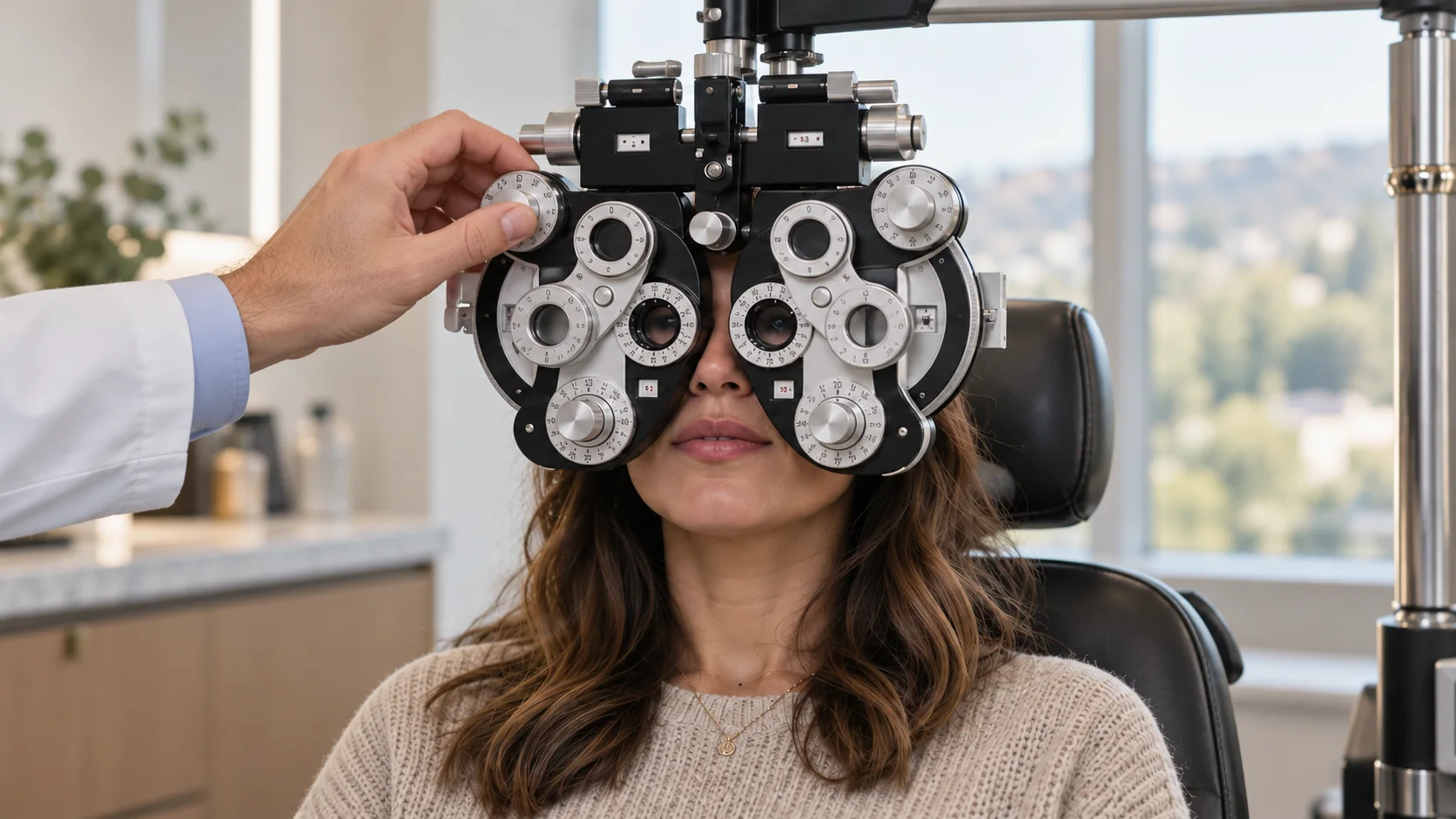
When the eye focuses light into a smear instead of a point.
With astigmatism, the front of the eye is curved more like a football than a basketball, so light focuses at two different points. Vision smears and shadows at every distance, lights streak at night, and eyes tire faster. It is extremely common — and very correctable.
Toric soft contact lenses, fit so they stay oriented on the eye
Ortho-K and gas permeable options in the right candidates
Scleral lenses, when astigmatism is irregular (from keratoconus, scarring or past surgery) and glasses stop helping
Watch for change: astigmatism that keeps increasing, or vision that glasses can’t sharpen, is how keratoconus first shows itself. That calls for corneal imaging, not just a stronger prescription.
No — it’s a shape. Most astigmatism is stable and corrects fully with glasses or toric contacts.
A larger pupil lets light through more of the irregular curve, so point sources stretch into lines and star shapes.
When it keeps increasing, when one eye differs sharply, or when correction never feels crisp — those patterns deserve corneal imaging.
Astigmatism is a common focusing error in which the cornea (or sometimes the lens) is curved more steeply in one direction than the other, so light focuses at two points instead of one. Vision blurs or smears at every distance and lights streak at night. About one in three people in the U.S. has it, usually from birth, and it is corrected with glasses, toric contact lenses or refractive surgery.
Most astigmatism is simply the corneal shape you were born with, and it runs in families. It can also develop after an eye injury or eye surgery, and it is a hallmark of keratoconus, which thins and warps the cornea over time. When astigmatism keeps increasing, we image the cornea before changing the prescription.
Regular astigmatism within the treatable range can be corrected by LASIK and related procedures. Irregular astigmatism from keratoconus or scarring is different: laser surgery on a thin or unstable cornea is unsafe, and the better path is corneal imaging and specialty lenses. Before anyone operates, the cornea should be mapped and any dry eye treated first.
Neither. Nearsightedness and farsightedness describe where the eye focuses overall; astigmatism describes an uneven curve. You can have astigmatism alone or together with either one, and a glasses prescription lists them separately: the sphere for near- or farsightedness, the cylinder and axis for astigmatism.
Also consider
Next step
Get vision that’s actually crisp.
Book an exam with an eye doctor in Los Angeles — and if your astigmatism has been changing, say so when you book.