Blurry vision in one eye can start in the eye's focus, as with nearsightedness or astigmatism; on the surface, as with dry eye; in the lens, as with a cataract; or in the retina and optic nerve at the back of the eye. Cover one eye, then the other, to confirm which eye is blurry. Blur that built up over months needs a comprehensive eye exam. Sudden loss of vision in one eye, even if it comes back, is a stroke warning sign: call 911. A shadow or curtain over part of your vision, new flashes or many new floaters can mean a retinal detachment, a medical emergency: call us right away for a same-day exam, or go to an emergency room when we're closed. Blur with eye pain needs a same-day exam (an emergency room when we're closed).
Key takeaways
- Each eye forms its own image, so a focusing error, dry eye, a cataract, or a retina or optic nerve problem can blur just one eye.
- Cover one eye at a time to confirm which eye is blurry, and get an eye exam for blur that has built up over months.
- Treatment follows the cause: glasses or contacts for a focusing error, artificial tears for mild dry eye, and surgery when a cataract disrupts daily life.
- Sudden loss of vision in one eye, even if it comes back, means calling 911, and sudden blur that doesn't clear needs an emergency room.
01
Why is my vision blurry in one eye?
Each eye forms its own image, so a problem anywhere along one eye's path, from the tear film on the surface to the optic nerve at the back, can blur that eye while the other stays sharp. With both eyes open, the good eye can cover for the weaker one: if your other eye has good vision, you may not notice any symptoms from a macular hole, for example.
| Cause | What the blur is like | Other clues |
|---|---|---|
| Refractive error (nearsightedness, farsightedness, astigmatism) | Blurry or hazy vision | Squinting, headaches, eye strain |
| Dry eye | Blurry vision | Stinging or burning, a scratchy feeling, red eyes |
| Corneal abrasion (a scratch) | Blurry vision after a scratch or injury | Eye pain, red or watery eye, light sensitivity |
| Keratoconus | Blurry, distorted vision | Sensitivity to glare and light; each eye may be affected differently |
| Cataract | Cloudy vision that gets worse over time | Faded colors, glare, halos around lights |
| Macular problem | Blur or distortion in the center; straight lines look wavy | A blurry or blank spot in the middle |
| Retinal detachment | A dark shadow or curtain over part of your vision; things look less clear | A sudden increase in floaters, flashes of light |
| Blocked retinal artery or vein | Sudden blurry vision or vision loss in one eye | Higher risk with high blood pressure, diabetes or glaucoma |
| Optic neuritis | Vision loss | Pain when the eye moves |
02
Could it just be my prescription?
It may be. Nearsightedness, farsightedness and astigmatism are refractive errors, focusing problems that make it hard to see clearly, and blurry vision is their most common symptom. If a refractive error isn't treated, the brain may start to rely more on the eye with stronger vision.
If one eye has never seen as well as the other, the cause may be amblyopia (lazy eye), poor vision that usually happens in just one eye. Amblyopia treatment is usually less effective in adults than in children.
Vision that glasses can no longer sharpen deserves a closer look at the cornea. In keratoconus, the cornea becomes thin and irregular (cone) shaped, which blurs and distorts vision and makes eyes more sensitive to glare and light, and each eye may be affected differently. When astigmatism keeps increasing, we image the cornea before changing the prescription.
03
Why is one eye blurry and irritated?
A scratch on the cornea can blur one eye and irritate it at the same time, and dry eye can blur and irritate the eyes too. Dry eye happens when your eyes don't make enough tears to stay wet, or when your tears don't work correctly, and it can cause stinging or burning, a scratchy feeling, red eyes and blurry vision. Long hours looking at a computer, tablet or smartphone can bring it on.
Our dry eye evaluation looks at the tear film and the oil glands in the lids to find out why your eyes are dry.
A corneal abrasion is a scratch on the cornea, the clear outer layer at the front of the eye. Problems with the cornea can cause eye pain, blurry vision, red or watery eyes and sensitivity to light, and deeper scratches can cause scarring and vision problems. A painful scratch is a same-day visit (an emergency room when we're closed); read more about corneal abrasion.
04
Can a cataract cause blurry vision in one eye?
Yes. A cataract is a cloudy area in the lens of the eye, and you can get cataracts in one eye or both eyes; they can't spread from one eye to the other. Vision turns cloudy or blurry, colors look faded, headlights seem too bright and you may see a halo around lights.
A cataract gets worse over time, and by age 80 most people either have cataracts or have had cataract surgery. Early on, a new prescription for glasses or contact lenses can help you see better. Surgery is the only way to get rid of a cataract, but you may not need it right away.
We track cataracts at your exams and co-manage cataract surgery: a trusted surgeon operates, and your visits before and after the operation happen here.
05
What if the blur is in the center of my vision?
Blur or distortion in the center points to the macula, the part of the eye that controls sharp, straight-ahead vision. Several conditions affect it:
- Age-related macular degeneration (AMD): a blurry area near the center of your vision, straight lines that look wavy or crooked in late AMD, and over time blank spots. People 55 and older are more likely to have it, and wet AMD usually causes faster vision loss.
- Macular pucker: a membrane that forms on the surface of the retina and creates wrinkles, making vision blurry or wavy. It usually affects one eye.
- Macular hole: an opening in the macula that makes things look distorted or blurry when you look straight ahead, more likely at age 60 or older.
- Diabetic macular edema: blood vessels in the retina leak fluid into the macula in people with diabetes.
An Amsler grid, tested one eye at a time, can show wavy or missing lines between visits. It doesn't replace an exam, since early disease can show on an OCT scan before it distorts the grid, and we follow macular degeneration with OCT imaging.
06
When is blurry vision in one eye an emergency?
Call 911 right away for:
- Sudden loss of vision in one eye, even if it comes back. Vision loss is one of the stroke warning signs, and sudden, painless vision loss in one eye may be a stroke in the eye.
- Sudden double vision, which is also a stroke warning sign, or double vision or a droopy eyelid together with a pupil that looks different, eye pain or a severe headache
Call us right away for a same-day exam, or go to an emergency room when we're closed, for:
- A dark shadow or curtain over part of your vision, a lot of new floaters or new flashes of light, which can mean a retinal detachment, a medical emergency
- Severe eye pain with blurred vision and nausea, a headache or halos around lights, which can be acute angle-closure glaucoma, an eye emergency
- Straight lines that suddenly look wavy, a warning sign for late AMD
- Blurry vision with intense eye pain or a very red, watery eye
A blocked artery in the retina, a stroke in the eye, can cause sudden vision loss in one eye, and it is a strong predictor of future heart attacks and strokes. A clot that blocks the main vein of the retina can also cause blurry vision or sudden vision loss, usually in one eye, and the risk is higher with high blood pressure, diabetes or glaucoma. Optic neuritis, inflammation of the optic nerve, causes pain with eye movement and vision loss.
Call 911 if vision changes come with face drooping, arm weakness or speech difficulty, and call even if the symptoms go away. For a chemical splash, rinse first: let room-temperature water run into the eye for at least 15 to 20 minutes, then call Poison Control at 1-800-222-1222. If symptoms are severe, go straight to an emergency room after rinsing.
Our office hours are Monday 10 to 5 and Tuesday through Friday 8 to 5; call 310-828-2010 for a same-day urgent visit, or go to an emergency room when we're closed. Sudden blur on its own: if it clears right away, call us and come in for an exam; if it doesn't clear, go to an emergency room.
07
How do you fix blurry vision in one eye?
You treat the cause, so the first step is an exam that checks each eye on its own.
- Refractive error: glasses or contact lenses correct it, and surgery can fix it.
- Dry eye: artificial tears are the most common treatment for mild dry eye, and prescription eye drops or punctal plugs (tiny plugs in the tear ducts) are next steps.
- Cataract: a new prescription early on, and surgery when the cataract gets in the way of daily life.
- Amblyopia: glasses first, then an eye patch or atropine drops on the stronger eye so the brain has to use the weaker one.
- Wet AMD: medicines called anti-VEGF drugs, injected into the eye. We refer you to a retina specialist for that treatment.
- Macular hole: usually a surgery called vitrectomy.
08
How we find the cause at Cohenmehr Optometry
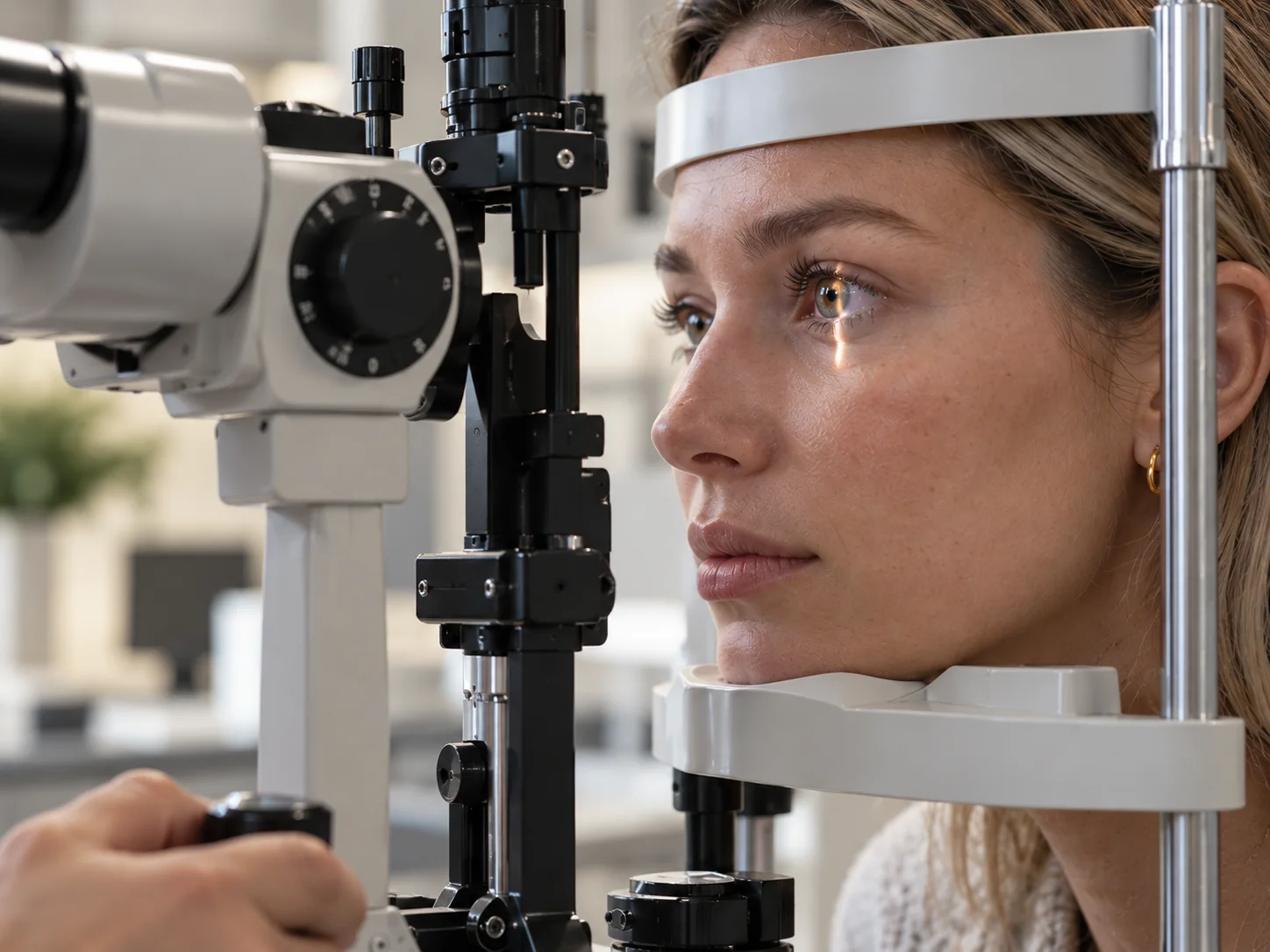
A comprehensive eye exam with our Los Angeles eye doctors checks each eye on its own: the prescription, the front of the eye at the slit lamp, eye pressure, and the retina and optic nerve through dilation or wide-field imaging. OCT scans give cross-sections of the retina and optic nerve, and visual field testing maps your side vision when needed.
Dr. Kevin Cohenmehr leads medical eye care here, including glaucoma, diabetic eye exams and macular degeneration. When the cause needs a surgeon or a retina specialist, the referral and records move the same day, and after a surgery we co-manage, your follow-up visits happen here.
Not sure where your symptom fits? Our symptom guide matches common eye complaints to the right page and urgency.
09
Questions patients ask
Does high blood pressure cause blurry vision?
It can. High blood pressure can harm the many tiny blood vessels in your eyes, and blurred vision or complete loss of sight can happen without blood flow to the retina. If your blood pressure is higher than 180/120 and you have a change in vision, call 911, and don't wait to see whether it comes down on its own.
Does pink eye cause blurry vision?
It can. Along with a pink or red eye, pink eye (conjunctivitis) may cause blurry vision and sensitivity to bright light. See a provider if the blur doesn't improve when you wipe discharge from the eye, or if you have eye pain, light sensitivity, intense redness or symptoms that get worse.
Can allergies cause blurry vision?
It isn't one of the usual signs. Allergies are one cause of pink eye, and allergic pink eye usually affects both eyes and can bring intense itching and teary, swollen eyes. See a healthcare provider if you have blurred vision, eye pain, light sensitivity or intense eye redness.
What does blurry vision look like?
Blurry vision makes it hard to see clearly, so print and faces look soft and out of focus. Other changes can feel like blur: cloudy vision, as with a cataract, or straight lines that look wavy and blank spots, as with macular degeneration. Note which one you see, and in which eye. That detail helps your eye doctor narrow down the cause.
10
Sources
- National Eye Institute: Macular hole
- National Eye Institute: Refractive errors
- National Eye Institute: Amblyopia (lazy eye)
- American Optometric Association: Keratoconus
- National Eye Institute: Dry eye
- National Eye Institute: Corneal conditions
- National Eye Institute: Cataracts
- National Eye Institute: Age-related macular degeneration
- National Eye Institute: Macular pucker
- National Eye Institute: Diabetic retinopathy
- National Eye Institute: Retinal detachment
- American Stroke Association: Stroke symptoms
- American Heart Association News: The brain isn't the only place a stroke can occur
- StatPearls: Acute angle-closure glaucoma
- National Eye Institute: Central retinal vein occlusion
- National Institute of Neurological Disorders and Stroke: Multiple sclerosis
- Poison Control: Splashed a poison in your eye?
- American Heart Association: How high blood pressure can lead to vision loss
- American Heart Association: When to call 911 about high blood pressure
- National Eye Institute: Pink eye
- CDC: How to treat pink eye
- National Eye Institute: Causes of pink eye
- CDC: Symptoms of pink eye

Written by
Dr. Kevin Cohenmehr, OD
Medical eye care: glaucoma, diabetic eye exams, macular degeneration and eye infections, plus vision therapy for children. A graduate of UCLA and SUNY College of Optometry.
About Dr. Kevin →