Tryptyr is a prescription eye drop for dry eye disease that the FDA approved on May 28, 2025. Its medicine, acoltremon 0.003%, is thought to act on temperature-sensing nerve endings, and that signal prompts the eye to make more of its own tears. In two studies, 42.6% and 53.2% of people using it gained 10 mm or more on the Schirmer test of tear production by day 14, against 8.2% and 14.4% of people on an inactive drop. The most common side effect is a sting or burn as the drop goes in, reported by about half of people. Tryptyr comes in single-dose vials and is used twice a day. It's one of the prescription dry eye drops our eye doctors in Los Angeles choose from after a dry eye exam.
Key takeaways
- Tryptyr is a prescription acoltremon 0.003% eye drop for dry eye disease that is thought to prompt the eye to make more of its own tears.
- In two studies, 42.6% and 53.2% of people on Tryptyr gained 10 mm or more on the Schirmer test by day 14, against 8.2% and 14.4% with an inactive drop.
- A sting or burn as the drop goes in was the most common side effect, reported by about half of people, and fewer than 1% stopped because of it.
- If a drop leaves your eye painful, increasingly red or blurry for more than a short while, call us right away, or go to an emergency room when we're closed.
01
What is Tryptyr?
Tryptyr is acoltremon ophthalmic solution 0.003%, made by Alcon Laboratories. Its label says it treats the signs and symptoms of dry eye disease, and the FDA's trial summary describes it as a treatment for dry eye disease in adults with a history of the condition.
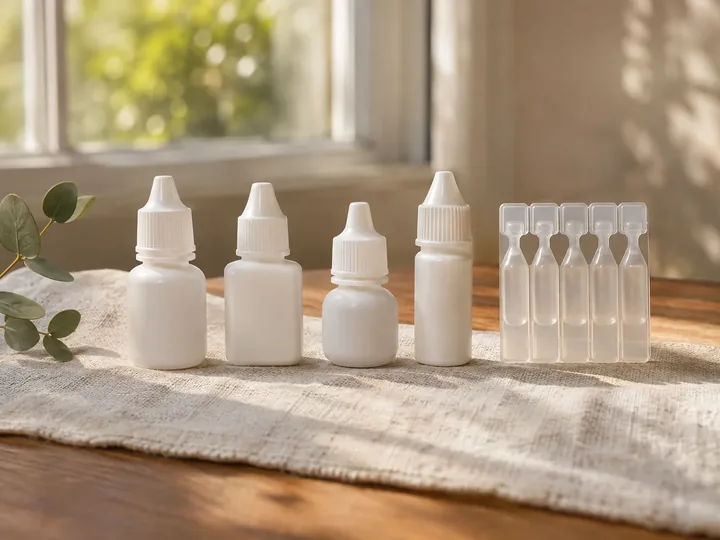
Each dose comes in a single-dose vial of a clear to slightly opalescent, colorless solution containing 0.003% acoltremon. Tryptyr does not contain an anti-microbial preservative, and each vial is opened, used for both eyes and then thrown away.
Dry eye has several causes, and treatment for dry eye usually depends on what's causing your symptoms. Our dry eye center explains the testing we use to find the cause.
02
How does Tryptyr work?
Tryptyr is thought to work through nerves: studies in animals suggest that acoltremon is an agonist of transient receptor potential melastatin 8 (TRPM8) thermoreceptors, meaning it switches on nerve endings that sense temperature.
According to the label, stimulating TRPM8 has been shown to activate signals in the trigeminal nerve that increase basal tear production. Basal tears are the steady film of tears your eyes make all day, the ones that keep the surface moist between blinks.
The label adds that the exact mechanism of action for Tryptyr in dry eye disease is unknown, so the nerve explanation comes from animal research.
That route differs from the other prescription dry eye drops. Restasis, Cequa and Vevye contain cyclosporine, which increases tear production when inflammation is presumed to be holding it back. Xiidra's lifitegrast binds to LFA-1, a protein on white blood cells, and Miebo forms a thin layer on the tear film that can be expected to reduce evaporation.
03
How well does Tryptyr work, and how long does it take?
The FDA approved Tryptyr based on two clinical trials, COMET-2 and COMET-3, of 931 patients with dry eye disease. 462 of them received Tryptyr, and the rest used the vehicle, the same drop without acoltremon.
The trials measured tear production with the Schirmer test, and the goal was a gain of 10 mm or more by day 14. In COMET-2, 42.6% of people on Tryptyr reached it, and 53.2% did in COMET-3, compared with 8.2% and 14.4% of people on the vehicle.
The label reports consistent results at all timepoints through day 90. For a sense of timing, the Restasis label reports its tear production result at six months. The studies were designed differently, so those numbers can't rank one drop against another.
Beyond the tear test, at follow-up visits we also look at the surface of your eye and ask how your eyes feel.
04
What are the side effects of Tryptyr?
The common one is a sting or burn as the drop goes in. In the controlled studies, the most common eye reaction was instillation site pain (discomfort where the drop goes in), in 50% of people. The FDA's summary gives 49.7% in the Tryptyr group and 4.1% in the vehicle group and describes it as burning or stinging.
Few people stopped because of it: fewer than 1 in 100 quit the drop over burning or stinging.
Keep the vial tip away from your eye and from every other surface. The label warns that touching it risks eye injury and contamination.
If a drop leaves your eye painful, increasingly red or blurry for more than a short while, take out any contact lenses and call us at 310-828-2010 right away, or go to an emergency room when we're closed.
05
How do you use Tryptyr? Dosage and tips
The label dose is one drop in each eye twice daily, approximately 12 hours apart. Use it exactly as prescribed.
- Wash your hands before use.
- Open a new vial for each dose. Use it right away, and one vial can dose both eyes. It goes in the trash afterward, along with any liquid left in it.
- Take contact lenses out first, and wait 15 minutes before putting them back in.
- Tryptyr can be used with other eye drops, including artificial tears. Leave at least five minutes between different drops.
- If you miss a dose, continue with the next dose.
- Keep unopened vials in their foil pouch until you're ready to use them.
06
Tryptyr vs. Restasis, Xiidra and Miebo: what's the difference?
The main difference is the target. Tryptyr is thought to act on the nerves that drive tear production, cyclosporine and lifitegrast act on inflammation, and Miebo slows evaporation. They also differ in how often you use them and in when their studies measured results.
| Drop | Medicine | How it works | How often | When studies measured results |
|---|---|---|---|---|
| Tryptyr | Acoltremon 0.003% | Stimulates nerves linked to tear production | Twice daily | Day 14, tear production |
| Restasis | Cyclosporine 0.05% | Raises tear production held back by inflammation | Twice a day | Six months, tear production |
| Xiidra | Lifitegrast 5% | Blocks LFA-1, a protein on white blood cells | Twice daily | Days 42 and 84, eye dryness score |
| Miebo | Perfluorohexyloctane | Forms a layer that slows evaporation | Four times daily | Days 15 and 57, surface staining |
Our comparison of prescription dry eye drops adds Cequa, Vevye and Tyrvaya, with the side effects of each, and we have separate guides to Restasis, Xiidra and Miebo.
Some people use more than one. A tear-stimulating drop can sit alongside an anti-inflammatory drop in the same plan, with the five-minute gap between them.
07
How we use Tryptyr at Cohenmehr Optometry
Tryptyr is one of the tear-stimulating options on our prescription dry eye drops page, along with Tyrvaya, a nasal spray. We consider it when testing shows the glands that make the watery part of the tear film are under-producing, one of the patterns in our guide to types of dry eye.
We choose a medicine from your exam findings and your type of dryness. With a newer drop like Tryptyr, we usually recheck in 2 to 4 weeks, looking at tear volume, staining on the eye's surface and your symptoms, and then adjust the rest of the plan.
A drop is rarely the whole plan. Care for the eyelids and oil glands, punctal plugs that keep tears on the eye longer, and anti-inflammatory drops can all be part of it.
If your plan needs approval before it covers a prescription drop, our office handles the prior authorization, and the appeal if the plan says no.
08
Questions patients ask
Does Tryptyr need to be refrigerated?
Until you open the carton, yes: the label says to store it refrigerated at 2°C to 8°C (36°F to 46°F). After you open the carton, you can keep it in the refrigerator or at room temperature up to 77°F, and at room temperature it should be used within 30 days. Once a foil pouch is open, use its vials within 7 days, and never past the expiration date printed on the vial.
Do you need a prescription for Tryptyr?
Yes. Tryptyr's label marks it Rx only, so an eye doctor has to prescribe it, and it isn't sold over the counter the way artificial tears are. The most common treatment for mild dry eye is a type of eye drops called artificial tears, so an exam helps sort out whether your eyes need a prescription drop at all.
How much does Tryptyr cost, and does Medicare cover it?
What you pay depends on your prescription plan, its list of covered drugs and its rules. A plan, including a Medicare drug plan, may ask for prior authorization, approval based on its specific requirements, before it covers a drop, and you or your prescriber can contact your plan to ask for an exception if a rule blocks it. Our office sends the prior authorization for prescription eye drops and files the appeal when a plan says no.
Can teenagers use Tryptyr?
The label doesn't cover them: it says the safety and effectiveness of Tryptyr have not been established in pediatric patients, and the trials enrolled adults. Dry, irritated eyes in a teenager still deserve an exam, and our guide to dry eye in children and teens explains what we check first in younger patients.
Can you use Tryptyr while pregnant or breastfeeding?
Ask your eye doctor and your obstetrician first, because there's little data. The label says there are no adequate and well-controlled studies on Tryptyr in pregnant women, and there are no data on the presence of acoltremon in human milk or on its effects on a breastfed baby. Our article on dry eyes during pregnancy covers other ways to ease dryness.
09
Sources
- DailyMed: Tryptyr (acoltremon ophthalmic solution) prescribing information
- FDA: Drug Trials Snapshot, Tryptyr
- DailyMed: Restasis prescribing information
- FDA label: Restasis (cyclosporine ophthalmic emulsion) 0.05%
- DailyMed: Xiidra prescribing information
- Xiidra (lifitegrast ophthalmic solution) 5%: prescribing information (FDA label)
- DailyMed: Miebo prescribing information
- National Eye Institute: Dry eye
- Medicare: Drug plan rules

Written by
Dr. Bijan Cohenmehr, OD
Founder of Cohenmehr Optometry, in practice for over 40 years. He leads the practice’s dry eye care and myopia management. A graduate of SUNY College of Optometry.
About Dr. Bijan →