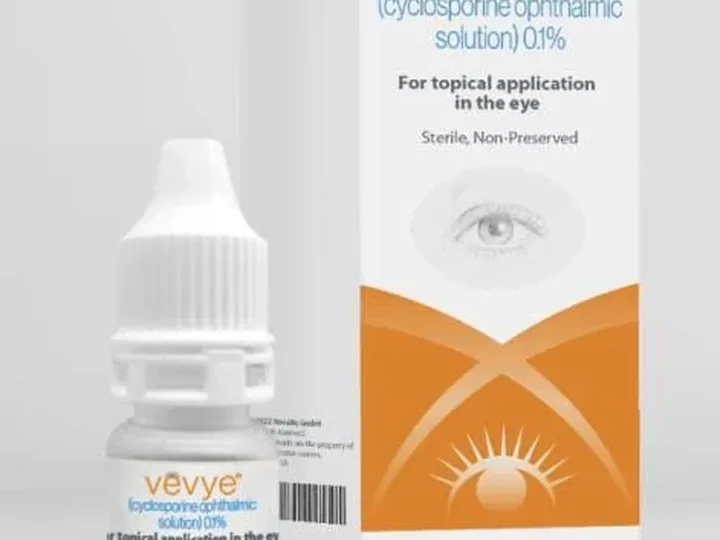
Xiidra and Restasis both target the inflammation of dry eye, but with different medicines and different approved jobs. Xiidra (lifitegrast 5%) is approved for the signs and symptoms of dry eye disease; Restasis (cyclosporine 0.05%) is approved to increase tear production when inflammation has suppressed it. Both are used twice a day. Their common side effects differ: ocular burning (17%) with Restasis, and irritation, an unusual taste or less sharp vision, each in 5% to 25% of patients, with Xiidra. Five more prescription options work in other ways, from Miebo, which forms a layer expected to reduce evaporation, to Tyrvaya, a nasal spray. The tables below set out what each label says.
Key takeaways
- Xiidra treats the signs and symptoms of dry eye, while Restasis helps the eye make more tears when inflammation has reduced them.
- Most prescription dry eye drops are used twice a day, and Miebo is used four times a day.
- Studies measured results at different times, from day 14 for Tryptyr to six months for Restasis, so the numbers are not a ranking.
- If a drop leaves your eye painful, increasingly red or blurry for more than a short while, call us right away, or go to an emergency room when we're closed.
01
Xiidra vs. Restasis: what's the difference?
They work on the same problem from different angles. Restasis contains cyclosporine, a calcineurin inhibitor immunosuppressant. Xiidra contains lifitegrast, which binds to the integrin LFA-1, a cell surface protein found on leukocytes and blocks one of the signals inflammation relies on.
Their labels also describe different results. Restasis studies measured tear production, which rose by 10 mm or more in approximately 15% of RESTASIS ophthalmic emulsion-treated patients versus approximately 5% of those on an inactive drop at six months. Xiidra studies measured symptoms: a larger reduction in EDS favoring Xiidra was observed in all studies at Day 42 and Day 84, EDS being an eye dryness score.
Beyond the most common reactions, the labels list a longer tail. For Restasis, other reactions reported in 1% to 5% of patients included conjunctival hyperemia, discharge, epiphora, eye pain, foreign body sensation, pruritus, stinging, and visual disturbance, meaning redness, discharge, watering, pain, a gritty feeling, itching, stinging and blur. For Xiidra, other adverse reactions reported in 1%-5% of the patients were blurred vision, conjunctival hyperemia, eye irritation, headache, along with tearing, discharge, itching and sinusitis.
Both come in single-use containers and both are used twice a day. Restasis should not be administered while wearing contact lenses, and with Xiidra lenses may be reinserted 15 minutes following administration. Our articles on Vevye, Miebo, Tryptyr and Tyrvaya cover four of the other options in depth.
02
How do the prescription dry eye treatments compare?
Here is what each label says, side by side:
| Treatment | Medicine | What the label says it does | How often | Most common side effect in studies |
|---|---|---|---|---|
| Restasis | Cyclosporine 0.05% emulsion | Increases tear production when inflammation has suppressed it | Twice a day | Ocular burning (17%) |
| Cequa | Cyclosporine 0.09% solution | Increases tear production in dry eye | Twice daily | Pain on instillation (22%) |
| Vevye | Cyclosporine 0.1%, water-free | Treats the signs and symptoms of dry eye disease | Twice a day | Instillation site reactions (8%) |
| Xiidra | Lifitegrast 5% | Treats the signs and symptoms of dry eye disease | Twice daily | Irritation, an unusual taste or less sharp vision, each in 5% to 25% |
| Miebo | Perfluorohexyloctane | Forms a layer expected to reduce evaporation | Four times daily | Blurred vision and redness, each in 1% to 3% |
| Tryptyr | Acoltremon | Treats the signs and symptoms of dry eye disease | Twice daily | Instillation site pain (50%) |
| Tyrvaya (nasal spray) | Varenicline | Treats the signs and symptoms of dry eye disease | Once in each nostril twice daily | Sneezing (82%) |
The approaches differ. Cyclosporine and lifitegrast act on inflammation. Miebo works on evaporation. Tryptyr is an agonist of transient receptor potential melastatin 8 (TRPM8) thermoreceptors, the cold-sensing nerves of the eye's surface, and Tyrvaya activates the trigeminal parasympathetic pathway resulting in increased production of basal tear film from inside the nose.
03
When did each treatment show results in its studies?
Each was tested its own way, so read these as what each study found, not as a ranking:
| Treatment | What the studies measured | When | Result |
|---|---|---|---|
| Tryptyr | Tear production (Schirmer, 10 mm or more) | Day 14 | 42.6% and 53.2% in two studies, vs. 8.2% and 14.4% on an inactive drop |
| Miebo | Damage on the eye's surface (corneal staining) | Days 15 and 57 | A statistically significant reduction favoring MIEBO in both studies |
| Tyrvaya | Tear production (Schirmer, 10 mm or more) | Day 28 | 52% in the first study, vs. 14% on an inactive spray |
| Vevye | Tear production (Schirmer, 10 mm or more) | Day 29 | About 10% vs. about 6% |
| Xiidra | Eye dryness score | Days 42 and 84 | Larger reduction favoring Xiidra in all four studies |
| Cequa | Tear production (Schirmer, 10 mm or more) | Day 84 | About 17% vs. about 9% |
| Restasis | Tear production (Schirmer, 10 mm or more) | Six months | About 15% vs. about 5% |
A Schirmer test measures tear production with a thin paper strip placed at the edge of the lower lid. Whichever drop you start, give it the time its studies took before judging it, and keep using it on schedule.
04
Which dry eye drops are preservative-free?
Several of them. Preservatives matter most for people who use drops many times a day, and the labels say this:
- Restasis: packaged in sterile, preservative-free single-use vials.
- Cequa: packaged in sterile, preservative-free, single-use vials.
- Vevye: the solution does not contain water or anti-microbial preservatives, even in its multiple-dose bottle.
- Tryptyr: does not contain an anti-microbial preservative; it comes in single-dose vials.
- Miebo: a sterile, clear and colorless liquid containing 100% perfluorohexyloctane, with nothing else added.
- Xiidra: single-use containers, and its listed inactive ingredients are sodium chloride, sodium phosphate dibasic anhydrous, sodium thiosulfate pentahydrate, and water for injection.
05
Can you wear contact lenses with these drops?
Take your lenses out first with every one of them. The labels differ on when they can go back in:
- Restasis, Cequa and Tryptyr: not while wearing lenses.
- Xiidra: lenses may be reinserted 15 minutes following administration.
- Vevye: lenses may be reinserted 15 minutes following administration.
- Miebo: contact lenses should be removed prior to and for at least 30 minutes after each dose.
If you wear lenses because of keratoconus or another corneal problem, tell us, because the schedule has to fit around them.
06
Do these drops need prior authorization?
Often, depending on your plan. Every plan keeps its own drug list and rules. Prior authorization is approval based on a plan's specific requirements, and step therapy is a type of prior authorization that requires you first to try a certain, less expensive drug. When a rule blocks the drop your eye doctor chose, you or your prescriber can contact your plan to ask for an exception. Medicare defines an exception as when a drug plan decides to cover a drug that's not on its drug list, or to waive a coverage rule.
Our office handles this for patients: we submit prior authorizations for prescription dry eye drops and file appeals when a plan says no. Our accepted insurance page lists the plans we work with.
07
How we choose a prescription dry eye treatment at Cohenmehr Optometry
We start with testing, because the right drop depends on why your eyes are dry. Our eye doctors in Los Angeles look at tear volume, how fast the tears break up, the oil glands in the eyelids and any damage on the eye's surface, and the National Eye Institute notes that the most common treatment for mild dry eye is a type of eye drops called artificial tears.
When artificial tears aren't enough, the choice between these treatments comes down to your test results, how your eyes responded to drops before and what your plan covers. Our page on prescription dry eye drops explains how each fits, and dry eye care covers the treatments beyond drops. A drop is often one part of the plan, and when the eyelids' oil glands are involved we treat them at the same time.
08
Questions patients ask
Is Xiidra better than Restasis?
Neither is better for everyone. Their studies measured different things: Restasis raised tear production at six months, and Xiidra eased eye dryness scores at Day 42 and Day 84. Some people tolerate one better than the other, since Restasis most often causes burning and Xiidra an unusual taste or irritation. Your eye doctor's choice depends on your tests and your history with drops.
Is Tyrvaya an eye drop?
No. Tyrvaya is a nasal spray: the label's dose is to spray TYRVAYA once in each nostril twice daily (approximately 12 hours apart). It is indicated for the treatment of the signs and symptoms of dry eye disease, and it works through a nerve pathway in the nose that leads to more tears. Sneezing was its most common side effect.
Can teenagers use prescription dry eye drops?
Most labels don't cover them. Xiidra's label says safety and efficacy are not established below the age of 17, Restasis's below the age of 16, Cequa's below the age of 18, and Tryptyr's in pediatric patients. Our guide to dry eye in children and teens explains what we check first in younger patients.
Which dry eye drop do you use four times a day?
Miebo. Its label says to instill one drop of MIEBO four times daily into affected eye(s). The other prescription drops here are twice a day, about 12 hours apart, and Tyrvaya is two sprays a day, one in each nostril. If four doses are hard to fit into your day, tell your eye doctor.
09
Sources
- Xiidra (lifitegrast ophthalmic solution) 5%: prescribing information (FDA label)
- DailyMed: Xiidra prescribing information
- DailyMed: Restasis prescribing information
- FDA label: Restasis (cyclosporine ophthalmic emulsion) 0.05%
- FDA label: Cequa (cyclosporine ophthalmic solution) 0.09%
- DailyMed: Cequa prescribing information
- DailyMed: Vevye prescribing information
- DailyMed: Miebo prescribing information
- FDA label: Tryptyr (acoltremon ophthalmic solution)
- FDA label: Tyrvaya (varenicline solution) nasal spray
- National Eye Institute: Dry eye
- Medicare: Drug plan rules

Written by
Dr. Bijan Cohenmehr, OD
Founder of Cohenmehr Optometry, in practice for over 40 years. He leads the practice’s dry eye care and myopia management. A graduate of SUNY College of Optometry.
About Dr. Bijan →