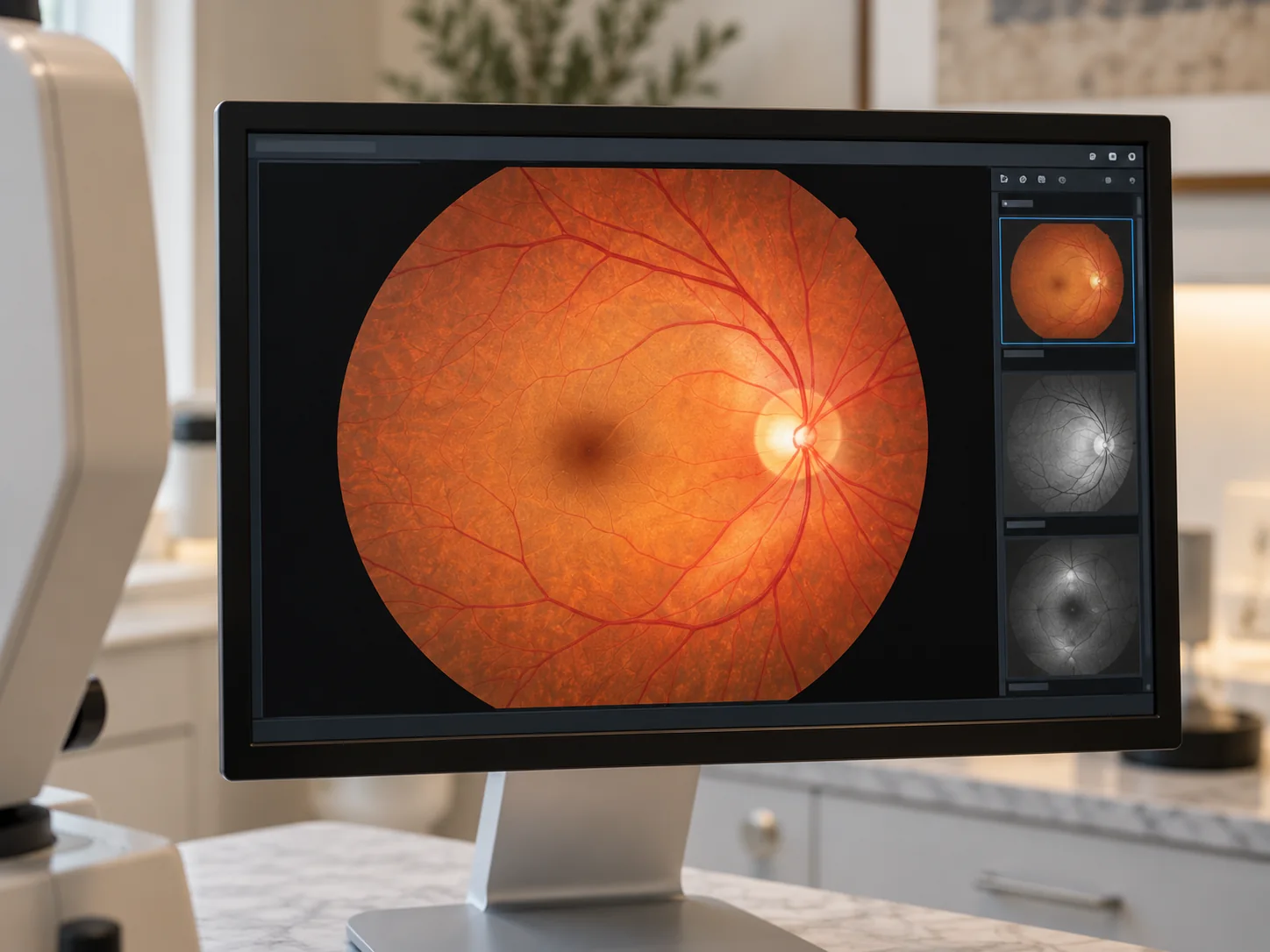
The main retinal detachment symptoms are a sudden burst of new floaters (dark specks, squiggly lines or cobwebs that drift across your vision), flashes of light in one or both eyes, and a dark shadow or curtain over part of your vision. Your sight may also turn blurry. Retinal detachment is a medical emergency, and getting treatment right away can help protect your vision. Don't wait: call us right away for a same-day exam during office hours, and go to an emergency room when we're closed. Our guide to floaters and flashes covers the everyday, harmless causes.
Key takeaways
- Many new floaters at once, sudden flashes of light, a shadow or curtain across part of your sight, or blurring can each signal a detaching retina.
- Any of these signs means calling us right away for a same-day exam, or going to an emergency room when the office is closed.
- A tear can be sealed with a laser or freezing probe, a detachment needs surgery, and treatment ultimately succeeds for about 9 out of 10 people.
- Call 911 right away for sudden vision loss in one or both eyes, even if it comes back or the office is open.
01
What are the first signs of a retinal detachment?
The first signs are changes in what you see, and they often come on quickly. Watch for:
- A lot of new floaters at once: small dark spots, squiggly lines or cobwebs that drift as your eyes move
- Sudden flashes of light in one eye or both eyes
- A dark shadow or curtain at the side or in the middle of your vision
- Blurred vision, or simply not seeing as clearly as usual
Any one of these means calling us right away for a same-day exam, or going to an emergency room if we're closed. Without prompt treatment, more of the retina can detach, which raises the risk of permanent vision loss or blindness.
A small detachment can cause no symptoms at all. A dilated eye exam can find a small tear or detachment before it affects your vision, which is one reason regular dilated exams are worth keeping up.
02
What are the symptoms of a retinal tear?
A retinal tear gives the same early warning signs as a detachment: a lot of new floaters that appear suddenly, sometimes with flashes of light. In the most common type of detachment, the tear comes first.
Aging is the most common cause of this type: as you get older, the vitreous, the clear gel that fills the eye, can shrink, and sometimes it pulls on the retina hard enough to tear it. The vitreous can then get behind the retina through the tear and push it away from the back of the eye.
Bleeding inside the eye is one of the more serious causes of new floaters.
A tear found before the retina detaches can be sealed with a laser or a freezing probe to keep the retina in place, and a retina specialist can do both in the office.
03
Is a sudden increase in floaters an emergency?
Yes, treat it as one. A few floaters are normal, but if you suddenly see a lot more than usual, get your eyes checked right away, or go to an emergency room when we're closed.
MedlinePlus calls a retinal detachment a medical emergency and says to see an eye care professional immediately if you have any symptoms.
We see a sudden new floater, a shower of many, or floaters after a blow to the eye the same day; when we're closed, go to an emergency room. Most of the time the cause turns out to be a posterior vitreous detachment, the gel separating from the retina as a normal part of aging, and the visit ends with reassurance and a follow-up plan. When it is a tear, catching it the same day is what protects your sight.
04
Who is more likely to get a retinal detachment?
Anyone can have a retinal detachment, but some people are at higher risk. Your risk is higher if you:
- Are very nearsighted; see our guide to why high myopia matters
- Have had cataract surgery or another eye surgery
- Have had a serious eye injury
- Have had a retinal detachment in the other eye, or have a family history of retinal detachment
- Have a posterior vitreous detachment, lattice degeneration (thin areas of the retina) or retinoschisis (the retina splitting into 2 layers)
- Have diabetic retinopathy, which damages blood vessels in the retina
Pilocarpine, an eye drop used for glaucoma, carries a label warning: rare retinal detachments have been reported in some susceptible people and in people with existing retinal disease. If you use it, don't stop or change it without talking to your eye doctor.
Aging and eye injuries are the most common causes overall.
Retinal detachment comes in three types, and rhegmatogenous detachment is the most common.
| Type | What happens | Most common cause |
|---|---|---|
| Rhegmatogenous | A tear or break lets fluid get behind the retina and push it away | Aging, as the vitreous gel shrinks and pulls on the retina |
| Tractional | Scar tissue on the retina pulls it away from the back of the eye | Diabetic retinopathy |
| Exudative | Fluid builds up behind the retina without any tear | Leaking blood vessels or swelling at the back of the eye |
05
Should you go to the ER for new floaters or flashes?
Yes, if our office is closed. During office hours, call us at 310-828-2010 and we'll see you the same day. For signs of a tear or detachment, the National Eye Institute's advice is to go to your eye doctor or the emergency room right away.
We're open Monday 10 to 5 and Tuesday through Friday 8 to 5, and closed on weekends. If new floaters or flashes start while we're closed, go to an emergency room instead of waiting for us to reopen.
| What you notice | What to do |
|---|---|
| A few floaters you've had for a long time, unchanged | Mention them at your next routine eye exam |
| New floaters or flashes during office hours | Call 310-828-2010 for a same-day visit |
| New floaters or flashes when we're closed | Go to an emergency room |
| A dark shadow or curtain over part of your vision | Call us immediately if we're open; otherwise go to an emergency room |
| Sudden loss of vision in one or both eyes, even if it comes back | Call 911 right away, even if we're open |
| Flashes or floaters after a blow to the eye or face | Same-day exam, or an emergency room if we're closed |
Sudden loss of vision in one or both eyes, even if it comes back, can be a warning sign of a stroke or a TIA (a temporary blockage of blood flow to the brain), so call 911; the American Stroke Association's advice is to get help immediately, even if the symptoms go away.
If trouble seeing comes with face drooping, numbness or weakness on one side, confusion, trouble speaking, loss of balance or a sudden severe headache, those are stroke signs too: call 911, and don't drive to the hospital.
06
How is a retinal tear or detachment treated?
If a retinal tear needs treatment, a retina specialist seals it with a laser or a freezing probe (cryopexy), and both can be done in the specialist's office. A detachment is treated with surgery, which may need to happen within a few days.
Surgeons use three main operations, and some people need more than one at once:
- Pneumatic retinopexy: a small air bubble injected into the eye pushes the retina back into place, then the tear is sealed. You hold your head in a set position for several days afterward.
- Scleral buckle: a tiny, flexible band around the white of the eye pushes the eye wall gently inward so the retina can reattach. The band stays on permanently.
- Vitrectomy: the surgeon removes most of the vitreous gel and may put in a bubble of air or gas, or silicone oil, to hold the retina in place; oil may need a second surgery to remove.
While an air or gas bubble is in your eye, you'll need to avoid flying in an airplane or traveling to high altitudes.
Treatment works well, especially when a detachment is caught early. Some people need a second procedure, and treatment is ultimately successful for about 9 out of 10 people. It might take a few weeks before your vision starts getting better after surgery.
07
What happens at a same-day exam for floaters and flashes?
Our optometrists in Los Angeles dilate your pupils and examine the whole retina, looking for a tear, a detachment, bleeding, or a vitreous detachment without a tear. We also photograph the retina, and because our OCT scanner is in the office, a scan can happen at the same visit. OCT (optical coherence tomography) is a painless scan that shows the exact position of the retina.
To check for retinal tears, the doctor may press gently on your eyelid. The exam is usually painless, though that pressure can feel uncomfortable.
Dilating drops leave your vision blurry and your eyes sensitive to light for a few hours, so plan on someone to drive you home.
If we find a tear or detachment, we coordinate an urgent referral to a retina specialist, send your records the same day, and continue your care afterward. We don't perform surgery ourselves. Our page on same-day urgent eye care explains how calling ahead works.
08
Questions patients ask
Why am I seeing stars?
Flashes, or "stars", can come from the eye or from a migraine. In the eye, they can be a symptom of a vitreous detachment, the gel inside the eye pulling away from the retina, which sometimes tears it. A migraine aura can bring sparks, dots or zigzags, usually for no more than an hour, sometimes without a headache. New flashes, or a curtain or shadow over your vision, mean calling us right away for a same-day exam, or an emergency room when we're closed.
Why is there a black spot in my vision?
If the spot drifts when your eyes move and seems to slide away when you try to look at it, it's a floater: tiny strands of the vitreous gel stuck together and casting a shadow on the retina. Almost everyone develops some floaters with age. A spot that appears suddenly, especially with flashes or a shadow at the side of your vision, can be a sign of a retinal tear: call us right away for a same-day exam, or go to an emergency room when we're closed.
Is a blind spot in vision serious?
It can be. A blind spot (scotoma) is an area where you can't see anything, and unlike a floater, it doesn't drift. A dark patch that suddenly appears in your vision can be a sign of a retinal detachment, a medical emergency: call us right away for a same-day exam, or go to an emergency room if we're closed. If you suddenly lose vision in one or both eyes, even if it comes back, call 911. An older, unchanged blind spot still needs an eye exam.
Can children have eye floaters?
They can, though floaters are mostly an age-related change. Floaters can also have more serious causes, including eye injuries, eye infections, inflammation inside the eye (uveitis), bleeding in the eye, and a retinal tear or detachment. If your child mentions new spots, call us for an exam the same day, or go to an emergency room when we're closed, and tell us about any recent bump to the head or eye.
09
Sources
- National Eye Institute: Retinal detachment
- National Eye Institute: Floaters
- National Eye Institute: Vitreous detachment
- National Eye Institute: Types and causes of retinal detachment
- National Eye Institute: Laser and freeze treatment for retinal tears
- National Eye Institute: Surgery for retinal detachment
- National Eye Institute: Vitrectomy
- National Eye Institute: Dilated eye exam
- MedlinePlus: Retinal detachment
- National Institute of Neurological Disorders and Stroke: Migraine
- American Stroke Association: TIA
- DailyMed: Pilocarpine hydrochloride eye drops
- CDC: Signs and symptoms of stroke

Written by
Dr. Kevin Cohenmehr, OD
Medical eye care: glaucoma, diabetic eye exams, macular degeneration and eye infections, plus vision therapy for children. A graduate of UCLA and SUNY College of Optometry.
About Dr. Kevin →