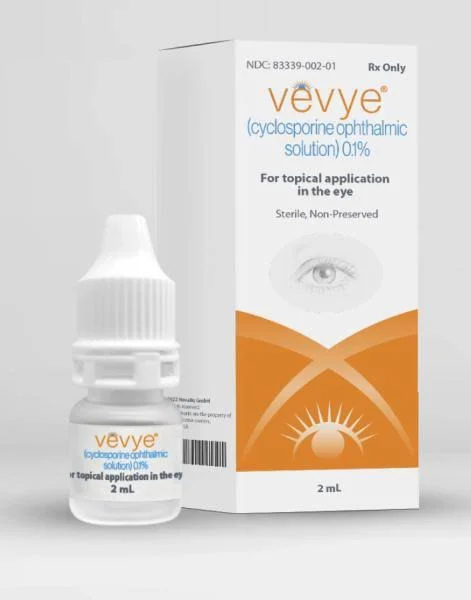
Vevye is a prescription eye drop for dry eye disease. It contains cyclosporine 0.1%, the same medicine as Restasis (0.05%) and Cequa (0.09%) at a higher strength, in a clear liquid with no water and no preservatives. The FDA approved it in May 2023. Cyclosporine acts on the immune response in the eye, which can help your eyes make more tears, and its effect builds over weeks to months. The results on Vevye's label are for tear production, measured at day 29. The most common side effect was a reaction where the drop goes in, reported by 8% of people. We prescribe it as one of several prescription dry eye drops when an exam shows that inflammation is part of your dry eye.
Key takeaways
- Vevye, a prescription drop, uses cyclosporine 0.1% to adjust the immune response in the eye, which can help your eyes make more tears over weeks to months.
- Vevye has the same medicine as Restasis and Cequa at a higher strength, in a clear, water-free liquid with no preservatives, used twice a day.
- In trials, 8% of people had a reaction where the drop goes in and 3% had temporarily less sharp vision, the most common side effects.
- If a drop leaves your eye painful, increasingly red or blurry for more than a short while, call us right away, or go to an emergency room when we're closed.
01
What is Vevye?
Vevye is cyclosporine ophthalmic solution 0.1%. Its label describes it as a calcineurin inhibitor immunosuppressant (a drug that turns down part of the immune response) for the treatment of the signs and symptoms of dry eye disease. The FDA approved it on May 30, 2023.
Vevye isn't a steroid; calcineurin inhibitors are a separate class of drug. Steroid drops such as loteprednol are a different tool, which we use in short courses; see our page on prescription dry eye drops.
In Vevye, the cyclosporine is dissolved in perfluorobutylpentane, a semifluorinated alkane. The solution contains no water and no antimicrobial preservatives.
It comes in a multiple-dose bottle holding 2 mL, which releases drops of about 0.01 mL each. The label notes that you may not feel the drop land in your eye.
02
How does Vevye work?
Cyclosporine adjusts the immune response, and Vevye's label calls it a relatively selective immunomodulatory drug.
In dry eye, inflammation on the surface of the eye can hold tear production down. Restasis, another cyclosporine drop, is approved to increase tear production in that situation. The National Eye Institute describes cyclosporine eye drops as medicines that can help your eyes make more tears.
In our office, cyclosporine drops are part of the plan when dry eye is driven by inflammation or low tear production. Our guide to types of dry eye explains how that differs from evaporative dry eye, where clogged oil glands are the main problem.
03
How is Vevye different from Restasis and Cequa?
All three contain cyclosporine, at different strengths and in different liquids, and their labels word the approved use differently.
| What differs | Restasis | Cequa | Vevye |
|---|---|---|---|
| Cyclosporine strength | 0.05% | 0.09% | 0.1% |
| Form | Milky emulsion | Clear solution | Clear, water-free solution |
| Packaging | Preservative-free single-use vials | Preservative-free single-use vials | Multiple-dose bottle with no preservatives |
| Labeled use | To increase tear production when it is presumed to be suppressed by inflammation from dry eye | To increase tear production in dry eye | To treat the signs and symptoms of dry eye disease |
| Most common side effect named on its label | Burning | Pain when the drop goes in | Reactions where the drop goes in |
Each label names the most common side effect seen in that drug's own studies. The studies were run separately, and each label groups side effects under its own terms, so how often each one happened can't be compared from drug to drug. Sources: the Restasis, Cequa and Vevye labels.
Which one we choose depends on your exam and on how your eyes handle the drop.
You may also hear Vevye mentioned alongside Miebo. Vevye's liquid, perfluorobutylpentane, comes from the same chemical family as perfluorohexyloctane, the only ingredient in Miebo. The two drops have different jobs, though: Miebo contains no cyclosporine and forms a layer on the tear film that is expected to slow evaporation.
04
How long does Vevye take to work?
Expect weeks to months: cyclosporine drops calm inflammation gradually, so their effect builds with steady use. Vevye's label reports one result, from two studies in which 460 people used Vevye and 446 used the vehicle (the same liquid without cyclosporine): tear production at day 29.
The measure was the Schirmer test, which tells your eye doctor whether your eyes are making enough tears. After numbing drops, a small piece of paper sits on the edge of your eyelid while you keep your eyes closed for 5 minutes.
At day 29, about 10% of people using Vevye had a gain of at least 10 mm on that test, compared with about 6% of people using the vehicle.
Restasis and Cequa report the same kind of tear-production result later, at six months and at day 84 (about 12 weeks), because their studies ran longer. The studies were separate, so they don't show which drop works faster.
We treat cyclosporine as a long-term medicine. When eyes are badly flared at the start, a short course of a steroid drop can bridge the first weeks while the cyclosporine takes hold.
05
How do you use Vevye?
Use it exactly as prescribed. The schedule on the label is twice a day, about 12 hours apart.
- Wash your hands first, and keep the bottle tip from touching your eye or any other surface.
- Turn the bottle upside down over your eye and let a drop fall on its own. If nothing comes out after a few seconds, press gently on the sides of the bottle.
- Take out contact lenses before the drop and wait 15 minutes before putting them back in.
- Leave 15 minutes between Vevye and any other eye drop, including artificial tears.
- Store it between 59°F and 77°F, and don't refrigerate or freeze it.
06
What are the side effects of Vevye?
In clinical trials with 738 people using Vevye, the most common side effects were reactions where the drop goes in (8%) and temporary decreases in visual acuity, the sharpness of your vision (3%).
Its safety and effectiveness haven't been established in people under 18. There are no adequate and well-controlled studies of Vevye in pregnancy. Cyclosporine taken by mouth or by injection passes into breast milk. Whether it does after use in the eye hasn't been studied; Vevye's dose is about 4,700 times lower than oral doses, and cyclosporine was undetectable in the blood after use in the eye. Tell us if you're pregnant or breastfeeding.
If a drop leaves your eye painful, increasingly red or blurry for more than a short while, call us right away for a same-day exam, or go to an emergency room when we're closed. Sudden loss of vision in one or both eyes, even if it comes back, is an emergency at any hour: call 911.
07
How we use Vevye at Cohenmehr Optometry
Vevye is one of the cyclosporine drops we prescribe at Cohenmehr Optometry, along with Restasis and Cequa, and Xiidra is another anti-inflammatory option.
We consider it when testing points to inflammation on the eye's surface, low tear volume, irritation that lubricating drops haven't settled or surface damage from dry eye. Our article on dry eye testing and treatment walks through those tests.
A drop is rarely the whole plan. We usually calm inflammation first, then add punctal plugs if tears need to stay on the eye longer, and we treat the oil glands with IPL or lid care when they're involved.
At follow-up we recheck your symptoms and the surface of your eye to see whether it's working, and adjust from there.
08
Questions patients ask
What are the side effects of Restasis?
Burning is the most common. In the clinical trials, 17% of people using Restasis reported ocular burning. Reactions reported by 1% to 5% included eye redness, discharge, watering, eye pain, a feeling that something is in the eye, itching, stinging and changes in vision, most often blurring. Allergic reactions have also been reported since approval, including swelling of the eye, face, tongue or throat, hives and shortness of breath; for throat or tongue swelling or trouble breathing, call 911. If burning keeps you from using it, tell us; there are other options.
Xiidra vs. Restasis: what is the difference?
Both are prescription anti-inflammatory drops for dry eye, and the National Eye Institute describes both as drops that can help your eyes make more tears. They act on the immune response in different ways. Restasis contains cyclosporine. Xiidra contains lifitegrast, which binds to LFA-1, a protein on white blood cells, and blocks a step that helps those cells become active. In its studies, Xiidra's most common side effects included irritation where the drop goes in, an unusual taste and reduced sharpness of vision.
How does Restasis work?
Restasis contains cyclosporine 0.05%. Its label says that when tear production is presumed to be suppressed by inflammation from dry eye, cyclosporine is thought to act as a partial immunomodulator, adjusting the immune response, and that the exact mechanism isn't known. In the studies behind it, about 15% of people using Restasis gained at least 10 mm on the Schirmer tear test at six months, compared with about 5% using the vehicle. In those studies, tear production didn't increase in people already using anti-inflammatory eye drops or punctal plugs.
Can thyroid problems cause dry eyes?
Yes. The National Eye Institute lists thyroid problems among the health conditions that can cause dry eye, along with diabetes and autoimmune disorders such as lupus and Sjögren syndrome. If you have a thyroid condition and your eyes feel scratchy or burn, a dry eye exam can show which part of the tear film is struggling. Our page on Sjögren's and autoimmune dry eye covers dryness tied to other health conditions.
09
Sources
- DailyMed: Vevye prescribing information
- Drugs@FDA: Vevye (NDA 217469)
- DailyMed: Restasis prescribing information
- DailyMed: Cequa prescribing information
- National Eye Institute: Dry eye
- National Eye Institute: Testing for dry eye
- DailyMed: Xiidra prescribing information
- National Eye Institute: Causes of dry eye
- DailyMed: Miebo prescribing information
- American Stroke Association: Stroke symptoms
- MedlinePlus: Anaphylaxis

Written by
Dr. Bijan Cohenmehr, OD
Founder of Cohenmehr Optometry, in practice for over 40 years. He leads the practice’s dry eye care and myopia management. A graduate of SUNY College of Optometry.
About Dr. Bijan →