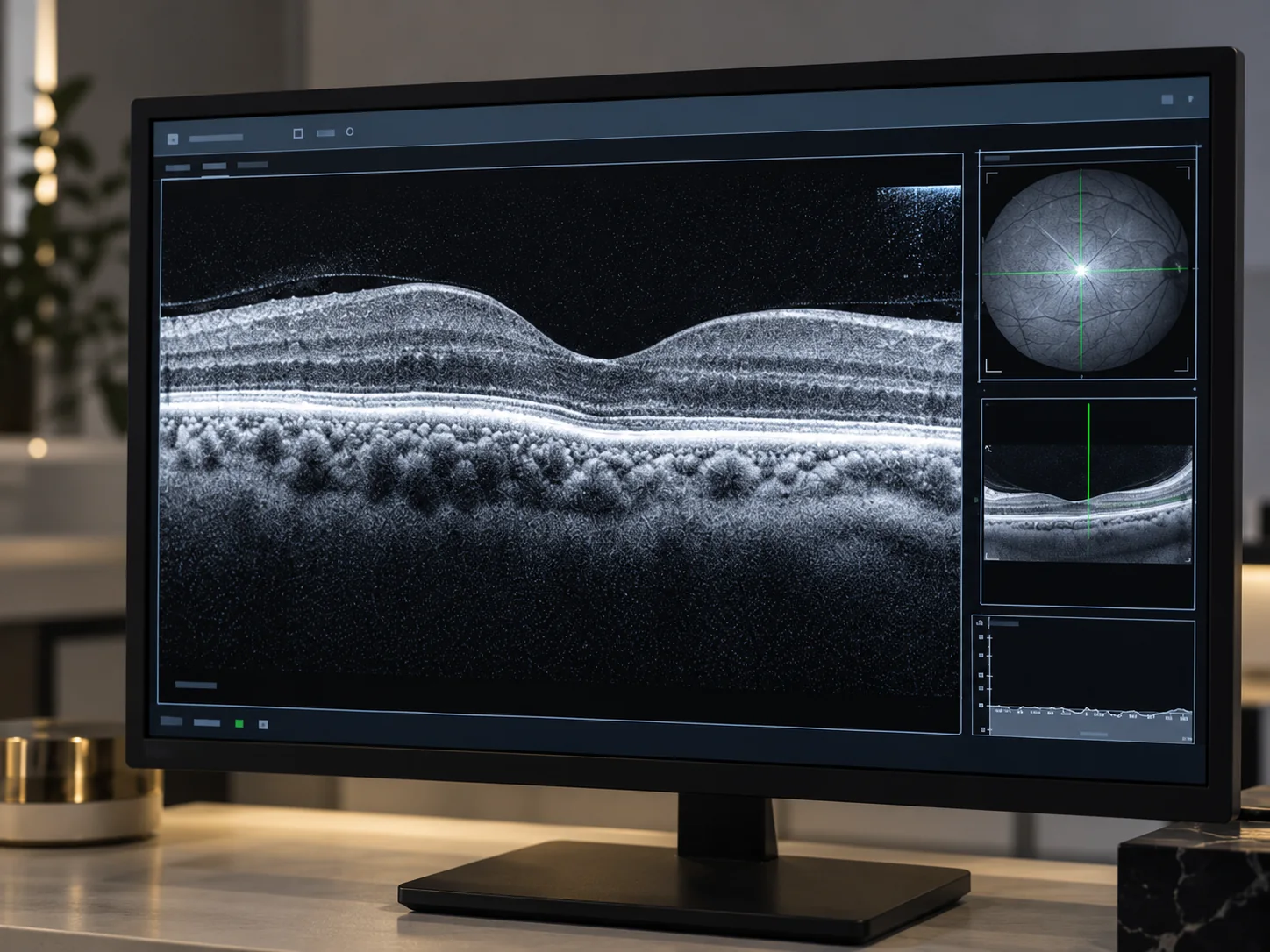
A posterior vitreous detachment (PVD) is when the vitreous, the clear gel that fills the middle of the eye, pulls away from the retina at the back of the eye. It usually happens after age 50 and is very common in people over 80. The most common symptom is a sudden increase in floaters, sometimes with flashes of light in your side vision, though some people never notice it. A PVD on its own usually needs no treatment. Sometimes, though, the gel's fibers tear a hole in the retina as they pull away, so new symptoms call for a dilated eye exam the same day, or an emergency room when we're closed. Our guide to floaters and flashes lists the changes we see right away.
Key takeaways
- With age, the eye's clear inner gel can shrink and separate from the retina, and this posterior vitreous detachment (PVD) usually happens after age 50.
- A PVD most often shows up as a sudden increase in floaters, sometimes with flashes in your side vision, and on its own usually needs no treatment.
- Because the pulling gel can tear the retina, new floaters or flashes call for a dilated eye exam the same day, or an emergency room when we're closed.
- A dark shadow or curtain over your vision can mean a retinal tear or detachment: call us right away for a same-day exam, or an emergency room when we're closed.
01
What happens in a posterior vitreous detachment?
As you get older, the vitreous can change in texture and shrink. Its fibers pull away from the retina, and that separation is called a vitreous detachment.
You may not notice when your vitreous detaches. When symptoms do come, it's often because strands of the vitreous cast new shadows on the retina, which you see as new floaters.
02
What are PVD symptoms?
The most common PVD symptom is a sudden increase in floaters, and you may also notice flashes of light in your side vision. Some people notice nothing at all.
- Floaters: spots, threads, squiggly lines or little cobwebs that move as your eyes move
- Flashes of light in your side (peripheral) vision
A dark shadow like a curtain, or a blurry area in your side or central vision, can mean a retinal tear or detachment, which can be a medical emergency: call us right away for a same-day exam, or go to an emergency room if we're closed.
If the PVD doesn't cause a more serious problem, you'll probably stop noticing the floaters and flashes as much after a few months.
03
Who gets a posterior vitreous detachment, and when?
It's common with age: a PVD usually happens after age 50, and it's very common in people over 80.
You're also at higher risk if you're nearsighted, and a PVD in one eye raises the risk of one in the other eye. Floaters of any cause are more likely if you have diabetes or have had cataract surgery, and inflammation inside the eye, such as uveitis, is one of their more serious causes.
Because a PVD usually happens after 50, new floaters or flashes in a teenager or young adult need a dilated exam the same day, or an emergency room when we're closed, to find the cause.
04
Can a PVD cause a retinal tear?
Sometimes. As the vitreous fibers pull away, they can tear a hole in the retina, and sometimes a PVD pulls the whole retina away from its normal position at the back of the eye. Retinal detachment can cause permanent vision loss, but getting treatment right away can help protect your vision.
A PVD can also lead to a macular hole, a hole in the macula (the part of the retina that controls your central vision), or a macular pucker, a thin layer of scar tissue that grows over the macula, usually slowly in the months or years afterward. These conditions can cause vision loss, but treatment may help preserve your vision.
05
Why is a dilated exam recommended when PVD symptoms start?
The only way to tell whether a PVD has caused a tear or detachment is a dilated eye exam, which is why new symptoms get one.
Drops widen your pupils so the doctor can check your eyes for floaters and other problems, and the doctor may press gently on your eyelid to check for retinal tears. The exam is usually painless, though that pressure can feel uncomfortable.
Most visits end with reassurance and a follow-up plan. If your floaters or flashes increase before that follow-up, call us the same day, or go to an emergency room when we're closed.
Expect blurry vision and light sensitivity for a few hours after dilation, and plan on someone to drive you home.
06
How is posterior vitreous detachment treated?
If a PVD doesn't cause a more serious problem, you probably won't need any treatment. If it has torn the retina, a retina specialist can seal the tear with a laser or a freezing treatment (cryopexy) to keep the retina from detaching.
If floaters still bother you after a few months and make it hard to see clearly, your eye doctor might suggest a vitrectomy, surgery to remove them. Talk with your doctor about the risks and benefits of this surgery.
Ask your eye doctor whether you need to limit any activities while a PVD settles. If a tear is treated with a laser or freezing, you may need to avoid some activities, like vigorous exercise or heavy lifting, while your eye heals.
07
When should you call about PVD symptoms?
Call the same day whenever floaters or flashes are new, and again if they increase after your first exam, because a lot of new floaters, sometimes with flashes, can be a sign of a retinal tear or detachment.
- During office hours (Monday 10 to 5, Tuesday through Friday 8 to 5): call 310-828-2010 for a same-day visit.
- When we're closed: go to an emergency room instead of waiting for us to reopen.
- A shadow or curtain over part of your vision: call us immediately if we're open, or go to an emergency room.
- Sudden loss of vision in one or both eyes, even if it comes back: call 911 right away, even if we're open.
- Trouble seeing along with face drooping, weakness on one side, slurred speech, confusion, loss of balance or a sudden severe headache: call 911, because these are signs of a stroke.
At Cohenmehr Optometry, flashes and new floaters are among the problems we always see the same day through urgent eye care. The visit with our eye doctors in Los Angeles includes a dilated retinal exam and retinal imaging, and our retinal photography and OCT are in the office. Most of the time the finding is a PVD. If we suspect a tear or another retinal problem, we refer you promptly to a retina specialist and continue your care afterward.
08
Questions patients ask
What do floaters in one eye mean?
New floaters in one eye can be the start of a PVD, whose most common symptom is a sudden increase in floaters, but they can also come from a retinal tear, and only a dilated eye exam can tell the difference. Get one the same day, or go to an emergency room when we're closed. Having a PVD in one eye also raises your risk of one in the other eye, so treat new floaters there the same way.
What are flashes of light in the eye?
Flashes of light in your side vision can be a symptom of a vitreous detachment, the gel inside the eye pulling away from the retina, which sometimes tears the retina as it separates. Sparks, dots or zigzags that usually last no more than an hour may instead be a migraine aura, and some migraines come without a headache. New flashes need a dilated exam the same day, or an emergency room when we're closed.
Why am I seeing spots?
Small dark spots that float across your vision and move as your eyes move are floaters, and they usually come from normal changes in the eye with age. Dots, sparks or zigzags that usually last no more than an hour can instead be a migraine aura. A lot of new floaters at once, especially with flashes, can be a sign of a retinal tear or detachment and needs a same-day exam, or an emergency room when we're closed.
How can you tell floaters from a retinal detachment?
By symptoms alone you can't always tell, and a small detachment may cause no symptoms at all. A few floaters are normal. A detachment typically brings a lot of new floaters at once, flashes of light, a dark shadow or curtain over part of your vision, or blurring. If you notice those, call us right away for a same-day exam, or go to an emergency room when we're closed.
09
Sources
- National Eye Institute: Vitreous detachment
- National Eye Institute: Floaters
- National Eye Institute: Retinal detachment
- National Eye Institute: Types and causes of retinal detachment
- National Eye Institute: Laser and freeze treatment for retinal tears
- National Eye Institute: Dilated eye exam
- National Institute of Neurological Disorders and Stroke: Migraine
- American Stroke Association: TIA
- CDC: Signs and symptoms of stroke

Written by
Dr. Kevin Cohenmehr, OD
Medical eye care: glaucoma, diabetic eye exams, macular degeneration and eye infections, plus vision therapy for children. A graduate of UCLA and SUNY College of Optometry.
About Dr. Kevin →