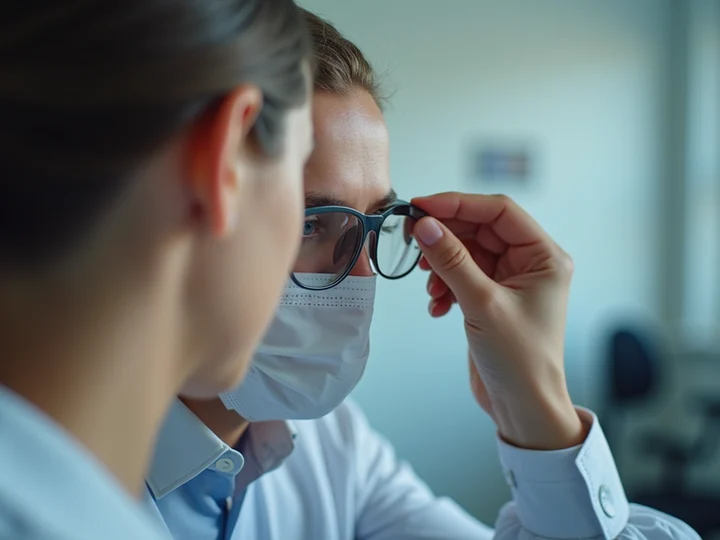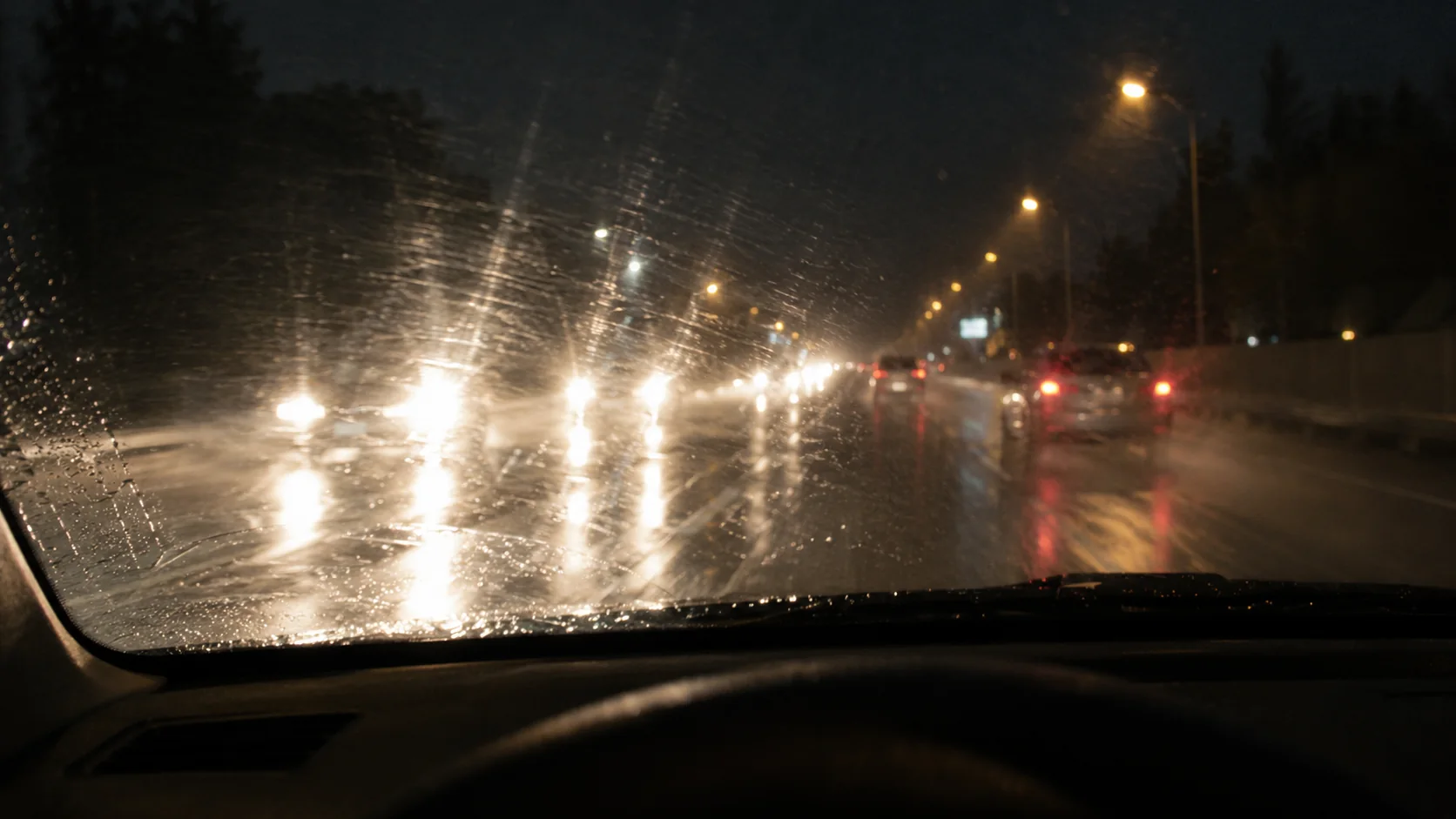
Yellow-tinted night driving glasses can't help you see more at night. A tint only takes light away, and after dark your eyes need all the light they can get, which is why we don't recommend tinted lenses for driving at night. What helps is a clear pair in your current prescription, often with an anti-reflective coating, plus an exam that finds why headlights bother you. The usual causes are a small uncorrected prescription, dry eye, an early cataract or an irregular cornea, and each one has a different fix; see our page on night vision and glare.
Key takeaways
- Yellow or amber night driving lenses can't improve your night vision, since any tint filters out part of the light your eyes need after dark.
- A clear pair in your current prescription, often with an anti-reflective coating and clean, unscratched lenses, is the starting point for night driving.
- Headlight glare usually traces to a small uncorrected prescription, dry eye, an early cataract or an irregular cornea, and each one has a different fix.
- Gradual night vision changes can wait for a routine exam, while flashes, many new floaters or a curtain need a same-day exam, or an emergency room when we're closed.
01
What are night driving glasses, and do they work?
Night driving glasses are glasses with yellow or amber lenses, sold to reduce the glare of oncoming headlights; some also carry an anti-reflective coating. The tint is the catch: every colored lens filters out part of the light passing through it.
Your pupils already open wide in the dark to gather what light there is. A tinted lens can only reduce it further, and at night that is light you need for spotting a pedestrian or the edge of the lane.
Eye doctors sometimes mean something else by the phrase: a clear pair of prescription glasses made for driving after dark. That kind can help, because it corrects the small focusing errors that dim light makes more noticeable.
02
Why is driving at night harder as you get older?
Changes inside the eye make night driving harder with age. From your 40s on, you may notice more glare from headlights at night, partly because changes in the eye's lens scatter incoming light instead of focusing it precisely on the retina.
After 60, the American Optometric Association lists problems seeing in low light, trouble with glare from headlights and difficulty judging distances and speed among the vision changes that affect driving, and these changes can affect your driving before you notice any symptoms. Cataracts are one reason, and the risk of them goes up as you get older. They can lower contrast, make it harder to see in low light such as when driving at night, and increase sensitivity to glare.
Dim light adds to it. The iris controls how much light the pupil lets in, and at night it opens wide, so light passes through more of the eye's optics and small flaws that stay hidden at noon show up as halos and smeared lights.
03
What causes glare and halos at night, and can glasses fix it?
Glasses fix some causes of night glare and not others, so finding the cause matters more than the lens color:
| Cause | What you may notice | Do glasses help? |
|---|---|---|
| An outdated or uncorrected prescription, including mild astigmatism | Blur, plus glare or halos around bright lights | Yes, an updated prescription is the fix |
| Dry eye | Blurry vision and sensitivity to light | No; it needs dry eye treatment |
| Cataract, a clouding of the eye's lens | Headlights that seem too bright, halos, poor night vision | A new prescription can help early on; surgery once it gets in the way of daily life |
| Keratoconus, a thin, cone-shaped cornea | Blurred, distorted vision and more sensitivity to glare | In early stages; later, specialty contact lenses |
| Macular degeneration | Blurry central vision or trouble seeing in low light | No; it needs monitoring and treatment |
| Changes after LASIK | Glare, halos or double vision at night | Depends on the cause; an exam sorts it out |
A few patterns help sort them out. Glare that builds over months, with colors that look faded and a prescription that keeps changing, fits a cataract. Burning, a scratchy feeling and blurry vision point toward dry eye, especially when the blur clears for a moment each time you blink. Only an exam can confirm the cause, and more than one can be at work at once.
04
What glasses help with night driving?
A clear pair in your current prescription is the starting point. Eyeglasses are the simplest and safest way to correct refractive errors, and a prescription that's slightly off, or a mild astigmatism that was never corrected, often shows up first as smeared lights after dark.
A few details make that pair work better at night:
- An anti-reflective coating, which cuts the reflections that bounce off the front and back surfaces of the lenses
- Clean lenses, and a new pair if the old one is badly scratched
- Thin temples, since glasses with wide side arms can restrict your side vision
- No tint at all after dark: save sunglasses for daytime, leave yellow lenses off at night, and wear photochromic lenses only once they have cleared completely
Anti-reflective coatings are often sold as anti-glare, which makes them easy to confuse with yellow night driving lenses. The coating is clear and leaves the lens untinted; a yellow lens filters everything you look at.
05
Tips for safer driving at night
Glasses are only one part of it. For drivers over 60 who find nights getting harder, the American Optometric Association suggests:
- Slowing down, and avoiding night driving if you have trouble seeing at night or your eyes are slow to recover from the glare of oncoming headlights
- Turning your head often to make up for any loss of side vision
- Taking extra care at intersections, where many collisions involving older drivers happen, especially on left turns
- Having an eye exam every year after 60
California's driver handbook adds one for drivers of any age: don't look directly into oncoming headlights; look toward the right edge of your lane and watch the oncoming vehicle out of the corner of your eye.
06
When should night vision problems be checked?
A gradual change can wait for a routine exam. That exam also looks for changes you may not notice yourself, such as loss of side vision, a possible sign of glaucoma.
Some symptoms can't wait. A lot of new floaters, flashes of light, or a dark shadow or curtain over part of your vision can mean a retinal detachment, which is a medical emergency. Call us immediately for a same-day exam, or go to an emergency room when we're closed.
Severe eye pain with a headache, nausea or halos needs the same speed: sudden intense eye pain and nausea can be signs of angle-closure glaucoma, which is a medical emergency. Call us immediately or go straight to an emergency room; when we're closed, go to the emergency room.
Sudden loss of vision in one or both eyes, even if it comes back, sudden double vision, or any vision change with face drooping, arm weakness or trouble speaking means calling 911. Other eye pain and red eyes are reasons to call us the same day; we offer same-day urgent appointments Monday 10 a.m. to 5 p.m. and Tuesday through Friday 8 a.m. to 5 p.m. When we're closed, eye pain belongs in an emergency room.
07
How we evaluate night driving vision at Cohenmehr Optometry
At Cohenmehr Optometry, one visit can usually tell these causes apart. We refine your prescription down to small amounts of astigmatism, check the tear film, grade the lens for early cataract and examine the retina; when ghosting suggests an irregular cornea, we map its shape. If you've been squinting at night, the refraction usually explains why. Bring your current glasses, including any pair you use for night driving.
The fix follows the cause: precise correction, sometimes in a pair of night driving glasses with anti-reflective lenses; dry eye care; cataract monitoring and, when it's time, surgery co-management; or scleral lenses for an irregular cornea.
08
Questions patients ask
Can you wear polarized sunglasses at night?
No. Polarized lenses are sunglasses: they cut daytime glare reflected off water, wet roads and windshields, and they're tinted dark as well. The American Optometric Association's standard is for sunglasses to screen out 75 to 90% of visible light, far too much for driving after dark. Keep them for daytime and switch to clear lenses at night.
Can LASIK cause night driving problems?
It can. The FDA lists glare, halos and double vision that can seriously affect nighttime vision among the possible risks, and notes that some people see less well in low-contrast situations such as night or fog. Dry eye, another possible after-effect, can blur vision too. If your night vision changed after LASIK, we evaluate glare and halos and treat dry eye after LASIK.
Does bilberry improve night vision?
Probably not. Bilberry has a long reputation for night vision, but studies of it have had conflicting results, much of the research was of poor quality, and the most rigorous studies have not found it effective in healthy people. The fruit is considered safe in amounts found in food, while bilberry leaves may be unsafe in high doses or over long periods. Mention any supplement you take at your eye exam.
Do eye vitamins improve night vision?
Not for most people. The eye supplements with evidence behind them are for one group, people with intermediate age-related macular degeneration (AMD), where they may keep it from turning into late AMD. Vitamin A matters for vision, and a deficiency causes trouble seeing in low light, but deficiency is rare in the United States and high intakes of some forms can be harmful. Our nutrition and eye health guide covers what the evidence supports.
09
Sources
- AOA: Adult vision, 41 to 60 years of age
- AOA: Senior vision, over 60
- National Eye Institute: Cataracts
- National Eye Institute: How the eyes work
- National Eye Institute: Refractive errors
- National Eye Institute: Dry eye
- AOA: Keratoconus
- National Eye Institute: Age-related macular degeneration
- FDA: LASIK risks
- California DMV: Driver handbook, safe driving
- National Eye Institute: Retinal detachment
- National Eye Institute: Types of glaucoma
- American Stroke Association: Stroke symptoms
- AOA: UV protection
- NIH (NCCIH): Bilberry
- NIH Office of Dietary Supplements: Vitamin A

Written by
Dr. Bijan Cohenmehr, OD
Founder of Cohenmehr Optometry, in practice for over 40 years. He leads the practice’s dry eye care and myopia management. A graduate of SUNY College of Optometry.
About Dr. Bijan →