Glasses can correct vision in early keratoconus, when the change in the cornea (the clear front window of the eye) causes mild nearsightedness and astigmatism. As the cornea thins and bulges into a cone, it can develop irregular astigmatism, a blur that glasses can't fix. From then on, rigid gas permeable lenses correct vision adequately in most cases, and cross-linking is what slows or halts the disease itself. For moderate to advanced keratoconus, the lens we fit most is a custom scleral lens. Glasses keep a place as a backup pair, as readers and after surgery.
Key takeaways
- In early keratoconus, glasses can be enough, but as the cornea thins and bulges into a cone, it can develop irregular astigmatism, a blur glasses can't fix.
- Contact lenses with a rigid optical surface smooth over the irregular cornea and correct vision adequately in most cases once glasses fall short.
- A prescription that keeps climbing is a reason to map the cornea, and cross-linking, done to stabilize it, can slow or halt the disease.
- A sudden white or gray haze on the cornea with aching and light sensitivity needs a same-day exam right away, or an emergency room when the office is closed.
01
Can glasses correct keratoconus?
Yes, early on. Eyeglasses or soft contact lenses may be used to correct the mild nearsightedness and astigmatism of early keratoconus. For astigmatism, glasses carry a cylindrical prescription that adds power in specific parts of the lens, and while the cornea is only mildly misshapen, that can be enough.
Keratoconus can keep changing, though. Symptoms usually appear in the late teens or early 20s, and the condition may progress for 10 to 20 years before it slows. Glasses that are sharp this year may not be sharp next year.
A prescription that keeps climbing is a reason to image the cornea. AOA notes that cross-linking is indicated if, later in the disease, the glasses prescription is still increasing, so when astigmatism keeps rising, we map the cornea before writing a stronger prescription. If you're unsure whether your history fits, our keratoconus risk checker weighs the known risk factors in six questions.
02
Why do glasses stop working as keratoconus progresses?
Because the cornea's shape becomes irregular, and a glasses lens can't follow it. In keratoconus, the abnormal shape keeps light entering the eye from focusing correctly on the retina, and as the cornea bulges more, vision may become more distorted.
Ordinary astigmatism comes from a cornea shaped more like a football than a basketball. Its curve is steeper in one direction, but evenly so, which a cylindrical glasses prescription can correct. A keratoconus cornea is steeper in some spots than in others, so different parts of the pupil focus light differently. The result is irregular astigmatism, a blur that glasses can't correct. Our page on higher-order aberrations shows how that turns into ghost images and halos.
Keratoconus may affect only one eye at first, and each eye may be affected differently. If one eye seems much weaker than the other through your glasses, mention it at your exam.
03
How do you know your glasses aren't enough anymore?
The clearest sign is a new prescription that still doesn't make things sharp. Others we ask about:
- Your prescription changes often, and each new pair still doesn't feel right.
- Letters and lights have a faint shadow or second image that stays when you cover the other eye.
- Glare and halos around lights make night driving harder.
- One eye sees noticeably worse than the other.
In its earliest stages, keratoconus causes slight blurring and distortion of vision and more sensitivity to glare and light. Our guide to what keratoconus vision looks like describes the ghosting and halos in detail.
A sudden change needs faster care. In a small number of cases, the stretched cornea develops a tiny crack and swells, which can show as a white or gray haze on the cornea with aching and light sensitivity; our page on corneal hydrops explains it. Call us at 310-828-2010 right away for a same-day exam, or go to an emergency room when we're closed. Sudden loss of vision in one or both eyes, even if it comes back, and sudden double vision are 911 calls at any hour.
If you wear contact lenses and the eye turns red, painful, light-sensitive or suddenly blurry, or you see a white spot on the cornea, take the lenses out and call us right away for a same-day urgent exam, or go to an emergency room when we're closed. The CDC lists red eyes, worsening pain, light sensitivity and sudden blurry vision among the symptoms of a lens-related eye infection and advises calling your eye doctor immediately.
04
Which keratoconus contact lenses work better than glasses?
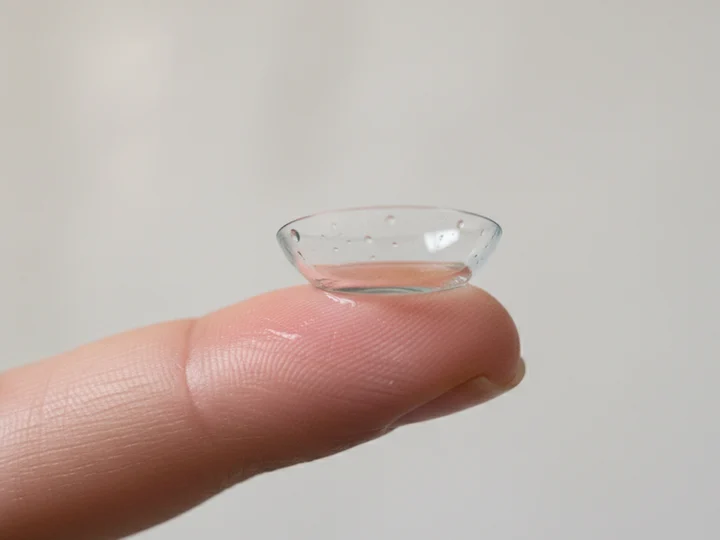
Lenses with a rigid optical surface, which smooth over the irregular cornea. As keratoconus progresses and the cornea keeps changing shape, rigid gas permeable (RGP) lenses can be prescribed to correct vision adequately, and in most cases that is enough.
An RGP lens keeps its regular shape on the eye, so it can compensate for the cornea's irregular shape. These lenses must be carefully fitted, and frequent checkups and lens changes may be needed to keep vision good.
RGPs are one of several designs we fit for keratoconus:
| Lens | How it works | Often a fit for |
|---|---|---|
| Custom soft | A specially profiled soft lens with extra stability | Mild or early cones, when you want soft-lens comfort |
| RGP | A small rigid lens; the tear layer under it smooths out the cornea's optics | Experienced wearers and milder, centered cones |
| Hybrid | A rigid center with a soft outer skirt | Eyes where an RGP won't stay put |
| Piggyback | A soft lens worn under a rigid lens | Sensitive corneas that still need rigid-lens clarity |
| Scleral | A large lens that rests on the white of the eye and vaults the cornea on a layer of saline | Most moderate to advanced keratoconus |
The choice depends on your cornea's shape, stage and sensitivity, so your corneal map decides, and diagnostic lenses go on your eye at the evaluation so you see the difference before anything is ordered. Our comparison of scleral, RGP and hybrid lenses covers the trade-offs, and our page on scleral lenses for keratoconus explains how sclerals are designed and fitted.
05
Do you still need glasses if you wear contact lenses for keratoconus?
Yes, keep a current pair. The CDC advises carrying backup glasses with a current prescription in case you have to take out your contact lenses.
With keratoconus, the backup pair may not be as sharp as your lenses, because glasses can't correct irregular astigmatism. It covers the times a lens has to stay out, such as a lens being remade or one lost on a trip.
Reading glasses are the other common pair. Everyone gets presbyopia, a refractive error that makes it hard to see up close, as they get older, usually after age 45. As it gets worse, you'll probably need glasses or contact lenses to help you read. Readers can go on over scleral lenses that correct your distance vision, or reading power can be designed into the scleral lens itself; our page on scleral lenses for presbyopia explains both.
06
Can cross-linking or surgery get you back into glasses?
Sometimes, depending on the procedure. Cross-linking is done to stabilize the cornea and slow progression. Its goal is a stable cornea, and most of our patients still wear specialty lenses afterward; our corneal cross-linking page explains when we refer.
Once progression has stopped, whether on its own or after cross-linking, an implantable Collamer lens (a lens a surgeon places inside the eye) can correct higher prescriptions so that glasses or ordinary soft contact lenses can be used. The FDA approved the EVO ICL for nearsighted adults 21 to 45. Its labeling asks for a stable prescription and says safety and effectiveness haven't been established in eyes with unstable or worsening myopia, previous eye surgery or a progressive sight-threatening disease other than myopia, so whether it suits a keratoconus eye is your surgeon's call.
A corneal transplant is necessary in a few cases, and even after one, glasses or contact lenses are often still needed to correct vision. The prescription tends to wander while stitches come and go, so glasses bridge that period until the final lens is designed; see our guide to corneal transplant co-management.
07
How we fit glasses and lenses for keratoconus at Cohenmehr Optometry
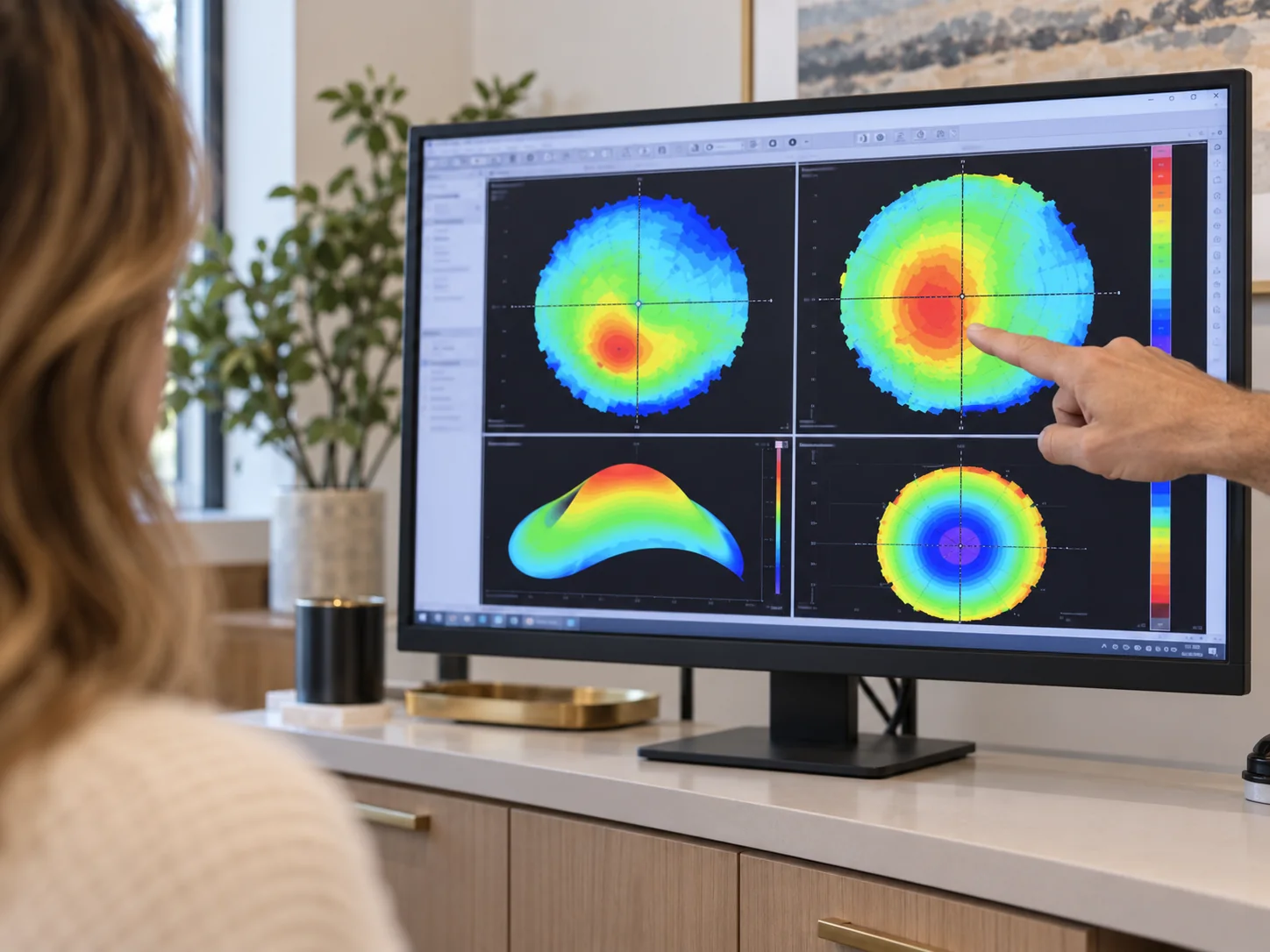
Our optometrists in Los Angeles measure what glasses can and can't do for your eyes before recommending anything. A keratoconus evaluation here records how clearly you see with correction, the amount and axis of your astigmatism and how much your prescription has moved over the last few years. Then we map the cornea with topography, tomography and pachymetry (thickness mapping).
The map points to the lens. We fit custom soft, RGP, hybrid, piggyback and scleral designs, and every scleral lens we fit is free-form, designed from an Eaglet Eye Surface Profiler scan of your eye. When glasses are part of the plan, as a backup or for reading, our opticians fit them at the on-site optical boutique in the same office.
We also keep watching. Each visit's maps are compared with your first ones, and if the cornea is changing, we start the conversation about cross-linking before more vision is lost.
08
Questions patients ask
What does keratoconus look like?
For the person who has it, keratoconus shows up as vision changes such as blur, ghosting and halos. For an eye doctor, it shows up on corneal maps and during the exam. Signs that can be seen in an exam include the Fleischer ring, iron deposits in the cornea that form a yellow-to-brownish ring around the iris, and Vogt's striae, thin vertical white lines at the back of the cornea. As keratoconus worsens, the cornea thins and bulges outward until it resembles a cone.
Is keratoconus a disease?
It's a progressive eye condition. In keratoconus, the cornea, the clear outer covering of the eye, thins and bulges outward into a cone shape, and these changes worsen over time. They can lead to nearsightedness, blurred vision that glasses can't improve (irregular astigmatism) and vision loss. The changes typically begin in adolescence and slowly worsen until mid-adulthood, when the shape of the cornea becomes stable.
How do you pronounce keratoconus?
KER-uh-toh-KOH-nus, with the main stress on KOH. The name describes what the condition does to the cornea, the clear outer covering of the eye: it thins and bulges outward until it resembles a cone, which is why you'll hear eye doctors talk about the cone and how steep it has become.
Are keratoconus and allergies linked?
Yes, though how isn't fully understood. About one-third of people with keratoconus have an allergic disorder, and a tendency to allergies is one of the environmental factors that may contribute to the condition. Rubbing may be part of the connection: allergies might trigger eye rubbing, and excessive, vigorous rubbing can injure the cornea and may thin it. If your eyes itch, treat the itch instead of rubbing; our page on eye rubbing and keratoconus has ways to do that.
09
Sources
- American Optometric Association: Keratoconus
- MedlinePlus Genetics: Keratoconus
- American Optometric Association: Astigmatism
- CDC: Contact lens-related eye infections
- CDC: Preventing eye infections when wearing contacts
- National Eye Institute: Presbyopia
- FDA: EVO/EVO+ Visian implantable Collamer lens
- FDA: EVO ICL directions for use

Written by
Dr. Brandon Cohenmehr, OD
Specialty contact lenses, with a focus on Ortho-K, scleral lenses, and co-managing patients with keratoconus and other corneal disease. A graduate of SUNY College of Optometry.
About Dr. Brandon →