Wet macular degeneration is a late form of age-related macular degeneration (AMD) in which abnormal blood vessels grow in the back of the eye and damage the macula, the part of the retina that controls sharp, straight-ahead vision. It is less common than dry AMD and usually takes vision faster. Anti-VEGF injections into the eye can slow down or stop vision loss from wet AMD, and we refer patients to a retina specialist for them. If straight lines start to look wavy, or a blurry or blank spot appears in the center of your vision, call us right away at 310-828-2010 for a same-day exam, or go to an emergency room when we're closed. Sudden loss of vision or a sudden dark area in your central vision means calling 911, even if it comes back.
Key takeaways
- In wet macular degeneration, a late stage of the age-related disease, abnormal blood vessels grow under the macula, which controls sharp, straight-ahead vision, and damage it.
- Anti-VEGF injections from a retina specialist help stop leaking blood vessels and can slow or stop vision loss, and most people need one a month at first.
- New wavy lines or a new blurry or blank spot in your central vision need a same-day exam, or an emergency room when we're closed.
- Sudden vision loss, including a sudden dark area in your central vision, means calling 911, even if it comes back.
01
What is the difference between wet and dry macular degeneration?
Dry AMD slowly thins the macula, while in wet AMD abnormal blood vessels grow and damage it, usually taking vision faster. Most people with AMD have dry AMD (also called atrophic AMD); wet AMD (also called advanced neovascular AMD) is a less common type of late AMD.
In wet AMD, a protein called vascular endothelial growth factor (VEGF) makes abnormal blood vessels grow in the wrong place in the back of the eye. These vessels grow under the macula and often leak blood and fluid, and wet AMD damages the macula quickly.
| What to know | Dry AMD | Wet AMD |
|---|---|---|
| How common | Most people with AMD have this type | A less common type of late AMD |
| What happens | The macula gets thinner with age | Abnormal blood vessels grow under the macula and leak blood and fluid |
| How fast | Usually progresses slowly over several years | Usually causes faster vision loss |
| Stages | Early, intermediate and late | Always late stage |
| Main treatment | AREDS 2 supplements for intermediate AMD; injections for geographic atrophy, the late stage | Anti-VEGF injections into the eye |
02
What are the symptoms of wet macular degeneration?
Blurred vision is a common early symptom of wet AMD. In late AMD, wet or dry, many people notice that straight lines start to look wavy or crooked, or see a blurry area near the center of their vision. Over time the blurry area may get bigger or you may see blank spots, colors may seem less bright, and seeing in low lighting may get harder.
AMD is painless. It can also start in one eye: late AMD can happen in one or both eyes, and having late AMD in one eye puts you at higher risk of developing it in the other.
Losing central vision makes it harder to see faces, read, drive or do close-up work like cooking, although AMD doesn't cause complete blindness.
03
When should you get help right away?
New wavy lines, or a new blurry or blank spot in your central vision, need an exam the same day: here during office hours, or at an emergency room when we're closed. The National Eye Institute calls straight lines that look wavy a warning sign for late AMD and says to see your eye doctor right away. A dark area that suddenly appears in your central vision counts as sudden vision loss, so call 911.
Call 911 for:
- Sudden loss of vision in one or both eyes, including a dark area that suddenly appears in your central vision, even if it comes back
- Sudden double vision, or double vision or a droopy eyelid that comes with a pupil that looks different, eye pain or a severe headache
- Any change in vision that comes with face drooping, arm weakness or trouble speaking
The American Stroke Association counts sudden changes in vision, including loss of sight in one or both eyes, as stroke warning signs. Call 911 for the signs above even if they go away.
Call us right away for a same-day exam, or go to an emergency room when we're closed, for:
- Straight lines that start to look wavy or crooked, or a new blurry or blank spot in the center of your vision
- A dark curtain or shadow over part of your vision, new flashes of light or a shower of new floaters
Our office hours are Monday 10 to 5 and Tuesday through Friday 8 to 5 (closed Saturday and Sunday); call 310-828-2010 for a same-day urgent visit.
If you're getting injections, report eye pain, redness, light sensitivity or blurred vision after an injection to the retina specialist who gave it without delay, or go to an emergency room if you can't reach them. The Eylea label lists these as possible signs of an infection inside the eye (endophthalmitis) or a retinal detachment.
04
How is wet macular degeneration treated?
Anti-VEGF injections are the most common treatment, and most people with wet AMD get them as their only treatment. These medicines help stop bleeding and leaking from blood vessels in the back of the eye, and they can slow down or stop vision loss.
When we find wet AMD, we refer you to a retina specialist for treatment. For each injection, the retina specialist puts numbing medicine in your eye, cleans the eye to keep it from getting infected and then puts the medicine in with a very small needle. The injections usually work for only a short time, so most people need them many times: at first most people need one a month, and after that the retina specialist tells you how often.
These are the anti-VEGF medicines used for wet AMD:
| Medicine | What to know |
|---|---|
| Lucentis (ranibizumab) | Approved for wet AMD. Byooviz (ranibizumab-nuna) is a biosimilar of it: highly similar, with no clinically meaningful differences. |
| Eylea (aflibercept) | Approved for wet AMD. Pavblu (aflibercept-ayyh) is a biosimilar of it. |
| Vabysmo (faricimab) | Approved for wet AMD; it also blocks a second protein, angiopoietin-2. |
| Lytenava (bevacizumab-vikg) | Approved by the FDA for wet AMD in July 2026. |
| Avastin (bevacizumab) | Approved to treat some cancers and commonly used off-label (outside its FDA approval) for AMD; in the first year of an NEI-funded trial, it worked as well as Lucentis. |
On the Eylea label, the most common side effects were conjunctival hemorrhage (a red patch of blood on the white of the eye), eye pain, cataract, vitreous detachment (the gel inside the eye pulling away from the retina), floaters and a rise in eye pressure.
Photodynamic therapy (PDT) is a much less common option that doctors sometimes use along with injections. You get a shot of a light-sensitive medicine called verteporfin in your arm, and the retina specialist shines a laser on a small area in the back of your eye, which makes the verteporfin break down the blood vessels causing the vision loss.
05
Can dry macular degeneration turn into wet?
Yes. Any stage of dry AMD can turn into wet AMD, and early dry AMD doesn't cause any symptoms.
Between exams, check each eye on its own with an Amsler grid, a simple take-home screening test a doctor of optometry can give you. Our online Amsler grid test walks you through it. New distortion on the grid means calling us right away for a same-day exam, or going to an emergency room when we're closed.
Do AREDS 2 vitamins help?
They can at certain stages. If you have intermediate AMD in one or both eyes, AREDS 2 supplements may be able to stop it from turning into late AMD, and if you have late AMD in only one eye, they may slow down AMD in the other eye. They can't keep early AMD from becoming intermediate AMD, and they probably won't help if you already have late AMD in both eyes. Supplements also can't prevent AMD.
The formula combines vitamin C, vitamin E, zinc, copper, lutein and zeaxanthin in large amounts that you can't get from food or a regular multivitamin. The older AREDS formula contains beta-carotene, which can increase the risk of lung cancer in people who smoke or used to smoke, so smokers and former smokers should choose AREDS 2. Because the doses are large, talk with your doctor before you start, and mention every other medicine, vitamin and supplement you take. See also our page on nutrition and eye health.
06
Is there a treatment for dry macular degeneration?
There's no cure for dry AMD, and central vision it has already taken can't be restored. Early AMD has no treatment yet, so your eye doctor keeps track of it with regular exams.
Geographic atrophy (GA) is the late stage of dry AMD. The FDA has approved two medicines that are injected into the eye to treat it: pegcetacoplan (Syfovre) and avacincaptad pegol (Izervay). In studies, both slowed the rate at which GA progressed, and both labels list wet AMD among the most common side effects.
If vision loss is minor, brighter lighting, a magnifying lens for reading, and larger text and higher contrast on your phone and computer can help; when it gets in the way of everyday activities, a vision rehabilitation specialist can train you to use a magnifying device and other tools. Our low vision care works on the same goals with magnification, lighting and contrast strategies for reading and daily tasks.
07
How we monitor macular degeneration at Cohenmehr Optometry
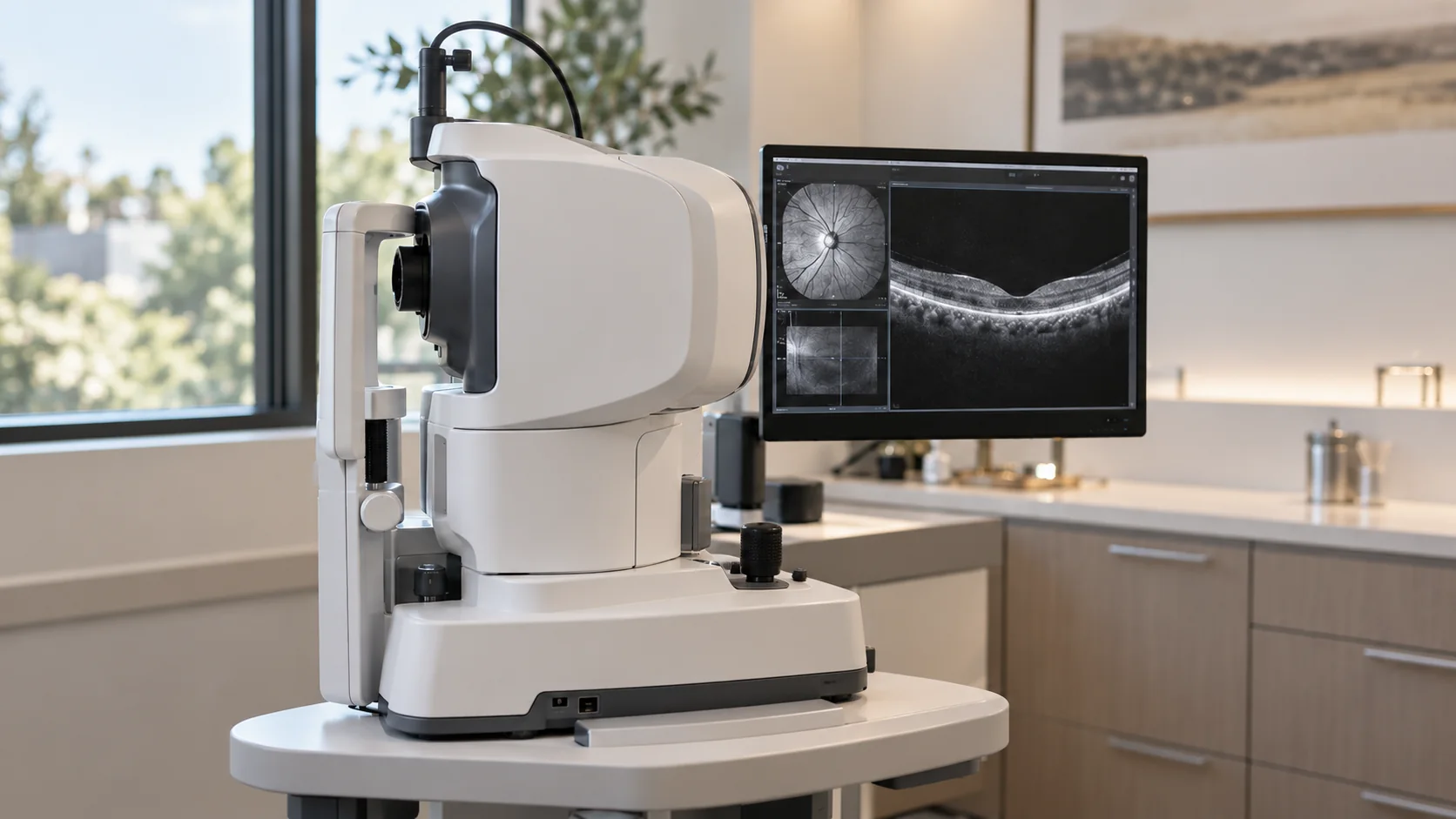
Dr. Kevin Cohenmehr leads medical eye care at our office, including macular degeneration. Eye doctors check for AMD as part of a comprehensive dilated eye exam and may add optical coherence tomography (OCT), which takes pictures of the inside of the eye with a special machine. We use OCT imaging to assess the structure of the macula and look for fluid, and retinal photography to track change between visits.
Our eye doctors in Los Angeles monitor both dry and wet AMD and refer you promptly to a retina specialist when wet changes appear. At your visits we also talk through lifestyle changes and supplements.
Our advanced diagnostics page explains what each scan shows.
08
Questions patients ask
Can macular degeneration be reversed?
The disease itself can't be reversed, but treatment can slow vision loss from AMD. For wet AMD, anti-VEGF injections can slow down or stop further vision loss, and in the Lucentis studies 31% to 37% of treated patients gained 15 or more letters on the eye chart at 12 months. Central vision lost to dry AMD can't be restored, but low vision devices, such as telescopic and microscopic lenses, can make the most of the vision you have.
Does omega-3 help macular degeneration?
Not as a supplement, going by the National Eye Institute's AREDS2 trial: adding omega-3s to the AREDS formula had no additional overall effect on the risk of advanced AMD. Eating fish is still on the NEI's list of healthy choices that may lower your risk of AMD or slow vision loss, along with leafy green vegetables, regular physical activity and not smoking.
Can an optometrist diagnose macular degeneration?
Yes. If you notice signs of AMD, the American Optometric Association advises contacting a doctor of optometry immediately for a comprehensive eye exam, whose tests show whether you have macular degeneration or another eye problem, and an optometrist can give you an Amsler grid to use at home. At our office we monitor AMD with OCT imaging and retinal photography, and we refer wet AMD to a retina specialist for treatment.
Can sun damage cause macular degeneration?
It may add to the risk. The American Optometric Association lists UV light exposure among the risk factors for AMD and recommends UV-protective glasses. The risk factors the National Eye Institute lists are age (people 55 and older are more likely to have AMD), a family history of AMD, being Caucasian and smoking. Our guide to choosing sunglasses with full UV protection explains what to look for.
09
Sources
- National Eye Institute: Age-related macular degeneration
- National Eye Institute: Treatments for wet AMD
- National Eye Institute: AREDS 2 supplements for AMD
- National Eye Institute: AREDS/AREDS2 frequently asked questions
- National Eye Institute: Low vision
- MedlinePlus: Macular degeneration
- American Optometric Association: Macular degeneration
- DailyMed: Eylea (aflibercept) label
- DailyMed: Lucentis (ranibizumab) label
- DailyMed: Vabysmo (faricimab) label
- DailyMed: Syfovre (pegcetacoplan) label
- DailyMed: Izervay (avacincaptad pegol) label
- American Stroke Association: Stroke symptoms
- National Eye Institute: Research behind the new dry AMD drugs
- National Eye Institute: Avastin and Lucentis study
- DailyMed: Byooviz (ranibizumab-nuna) label
- DailyMed: Pavblu (aflibercept-ayyh) label
- FDA: Novel drug approvals for 2026

Written by
Dr. Kevin Cohenmehr, OD
Medical eye care: glaucoma, diabetic eye exams, macular degeneration and eye infections, plus vision therapy for children. A graduate of UCLA and SUNY College of Optometry.
About Dr. Kevin →