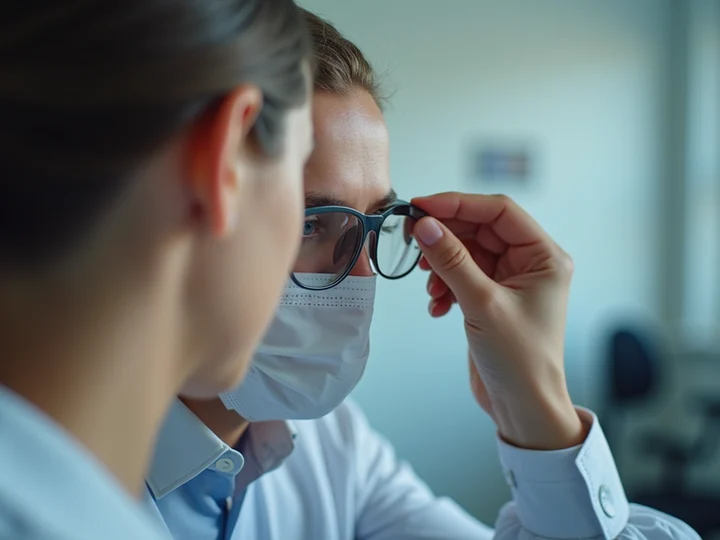
To get something out of your eye, don't rub it, because rubbing can scratch the cornea, the clear outer layer at the front of the eye. Blink several times, rinse the eye with clean water or saline (salt) solution, or try pulling your upper eyelid down over the lower one. If something is stuck in the eye, or the speck won't rinse out, don't try to remove it yourself: call us at 310-828-2010 and come straight in for a same-day urgent eye visit, since our doctors remove these in the office. When the office is closed, go to an emergency room instead. A cut to the eye or an object that has pierced it goes straight to the emergency room: don't rinse it or remove anything, and protect the eye without pressing on it.
Key takeaways
- Instead of rubbing the eye, blink several times, then rinse it with clean water or saline (salt) solution, or pull the upper lid down over the lower one.
- If something is stuck in your eye, don't try to remove it: call us and come straight in, or go to an emergency room when we're closed.
- For a cut or an object that has pierced the eye, don't rinse or remove anything, protect the eye without pressing, and go to the emergency room.
- Call 911 for sudden loss of vision in one or both eyes, even if it comes back, or sudden double vision.
01
How do you get something out of your eye?
- Blink several times. Blinking spreads tears across the eye and helps wash away dirt or dust.
- If you wear contact lenses, wash and dry your hands and take the lenses out. A speck trapped between a lens and the cornea can scratch it.
- Rinse the eye with clean water or saline (salt) solution, or try pulling your upper eyelid down over your lower eyelid.
- If the speck is stuck in the eye, stop. Don't try to remove it yourself; call us and come straight in, or go to an emergency room if the office is closed.
An over-the-counter eyewash is made for this job. Its label says it relieves irritation by removing loose foreign material, tells you to take out contact lenses before using it, and warns against touching the tip to your eye.
02
What should you never do when something is in your eye?
- Don't rub the eye. Rubbing can scratch the cornea.
- Don't touch the eye itself with a fingertip, tissue or cotton swab. Many corneal scratches are self-inflicted, from fingernails, mascara brushes and other everyday objects.
- Don't point tweezers or anything sharp at the eye.
- Don't try to remove anything stuck in the eye.
- Don't rinse or remove anything from an eye that has been cut or pierced, and don't press on it; protect the eye and go to the emergency room. Even an eyewash label warns against use on open wounds in or near the eyes and says to get medical help right away.
- Don't keep treating it yourself if you have eye pain, a change in vision, or redness or irritation that continues or gets worse; for pain or a change in vision, call us and come straight in, or go to an emergency room when the office is closed.
03
What if something is stuck in your eye?
Don't rub it or try to remove it yourself. Call us at 310-828-2010 and come straight in: our doctors remove these in the office. When the office is closed, go to an emergency room.
A speck that hit your eye at high speed, from hammering, grinding, drilling or a power tool, needs the same prompt care. An impact strong enough to penetrate can reach the deeper layers of the cornea, and a serious eye injury, such as getting hit hard in the eye, is a reason to see an eye doctor or go to an emergency room right away. If you think the speck may have gone into the eye, treat it as an object that has pierced the eye and go to the emergency room.
A cut to the eye, or an object that has pierced it, is different: go to the emergency room. Don't rinse it or remove anything, and protect the eye without pressing on it.
04
Why does it still feel like something is in my eye?
The speck may have scratched the cornea. A corneal abrasion can cause anything from mild discomfort to intense, stabbing pain, along with blurred vision, light sensitivity and uncontrolled watering. The surface layer of the cornea heals very quickly, many times within 24 to 48 hours. Our corneal abrasion guide covers treatment.
The particle may also still be there. A speck can lodge on the inside of the upper eyelid, where it scratches the cornea with every blink.
If you wear contacts and the eye stays uncomfortable, leave the lenses out and see your eye doctor.
If the gritty feeling came on with nothing getting into your eye, dry eye can cause the same scratchy sensation, and a dry eye evaluation can find the cause.
05
When does something in your eye need a doctor today?
Call 911 for sudden loss of vision in one or both eyes, even if it comes back, sudden double vision, or any change in vision with signs of a stroke.
Go to an emergency room
- A cut to the eye, or an object that has pierced it. Don't rinse it or remove anything, and protect the eye without pressing on it.
Call us and come straight in (emergency room when the office is closed)
- Something stuck in the eye, a speck that won't rinse out, or the feeling that something is still there after rinsing
- A speck that hit the eye at high speed, or any hard hit to the eye
- Intense pain, blurry vision or any other change in vision, or a very red, watery eye
- An injury that seemed to heal but starts hurting again
- A chemical splash, after you rinse with running water for at least 15 to 20 minutes and call Poison Control at 1-800-222-1222; if symptoms are severe, go straight to an emergency room after rinsing
Call us for a same-day visit
- Redness or irritation that continues after rinsing
- Discomfort while you wear contact lenses: take the lenses out first
We see urgent eye problems the same day during office hours, Monday 10 to 5 and Tuesday to Friday 8 to 5; call 310-828-2010. When the office is closed, go to an emergency room for everything listed above except lingering redness or irritation and discomfort with contact lenses; for those, call us first thing in the morning.
06
What happens when we remove something from your eye?
Call 310-828-2010 first. A person answers and asks what happened, and something stuck in the eye goes straight into a doctor's chair. Hours and directions are on our contact page.
Our eye doctors in Los Angeles stain the cornea with fluorescein dye at the slit lamp to see the scratch, remove any foreign body, and rule out a deeper injury or infection. With the stain and a blue light at the slit lamp, the doctor can see the size and depth of the injury and whether anything is still in the eye.
What happens next depends on the exam. For a scratch, we may place a bandage contact lens to speed healing and make the eye more comfortable. For a surface that won't heal, we use amniotic membranes, which treat non-healing corneal damage.
Most urgent problems are treated on the spot. When a surgeon is needed, the referral and records go out the same day.
07
How can you keep things out of your eyes?
Wear protective eyewear when you play sports that use a ball or puck, do yardwork such as mowing or using a weed trimmer, make repairs such as painting or hammering, use machines such as sanders or drills, or work with chemicals such as bleach or pesticides.
The most common eye injury happens when something irritates the outer surface of the eye. Industrial jobs, hobbies such as carpentry and contact lens wear all make it more likely, and most eye injuries can be prevented.
Sports goggles belong in contact sports and in sports with fast-moving objects, such as baseball, racquetball, badminton and soccer, and tree branches along walkways are worth trimming above eye level. For ball and racket sports, see our guide to sports eye protection.
08
Questions patients ask
Can a scratched eye heal on its own?
Small scratches on the cornea usually heal on their own. Deeper scratches and other injuries can scar the cornea and cause vision problems, so we see any scratch on the eye the same day (an emergency room when we're closed); fluorescein dye drops make scratches on the cornea easier to see. Go to an eye doctor or an emergency room right away for intense pain, a change in vision, or a very red, watery eye. More in our corneal abrasion guide.
Can something in your eye lead to an eye infection?
Yes. A scratch on the cornea carries a chance of infection. A scratch from living tissue, such as a fingernail or a tree branch, adds a risk of fungal infection, which is extremely serious and doesn't show up right away. If an injury that seemed to heal becomes painful again, seek care immediately. More on corneal infections in our keratitis guide.
Do I need antibiotic eye drops after getting something in my eye?
If the speck scratched your cornea, usually yes. After a corneal abrasion, an antibiotic drop or ointment is usually prescribed to help prevent infection, and artificial tears and keeping your hands off the eye help it heal. The doctor usually wants to see the eye again within 24 hours. When we find a scratch, we use antibiotic drops to prevent infection while the surface closes; use them only as prescribed.
Can an eye injury raise eye pressure?
It can. Severe trauma, such as being hit in the eye, can raise the pressure inside the eye right away, and internal damage from the injury can also cause the pressure to rise later. An injury can even dislocate the lens, closing the drainage angle and increasing pressure. Over time, higher pressure can damage the optic nerve. Eye pressure testing is part of our urgent work-up, and we check for glaucoma at every comprehensive exam; see glaucoma testing.
09
Sources
- National Eye Institute: Corneal conditions
- MedlinePlus: Eyelid disorders
- National Eye Institute: Contact lenses
- American Optometric Association: Corneal abrasion
- DailyMed: Advanced Eye Relief Eye Wash label
- Poison Control: Eye injuries, what you need to know
- National Eye Institute: Dry eye
- Poison Control: Splashed a poison in your eye?
- MedlinePlus: Eye injuries
- American Optometric Association: Glaucoma

Written by
Dr. Kevin Cohenmehr, OD
Medical eye care: glaucoma, diabetic eye exams, macular degeneration and eye infections, plus vision therapy for children. A graduate of UCLA and SUNY College of Optometry.
About Dr. Kevin →