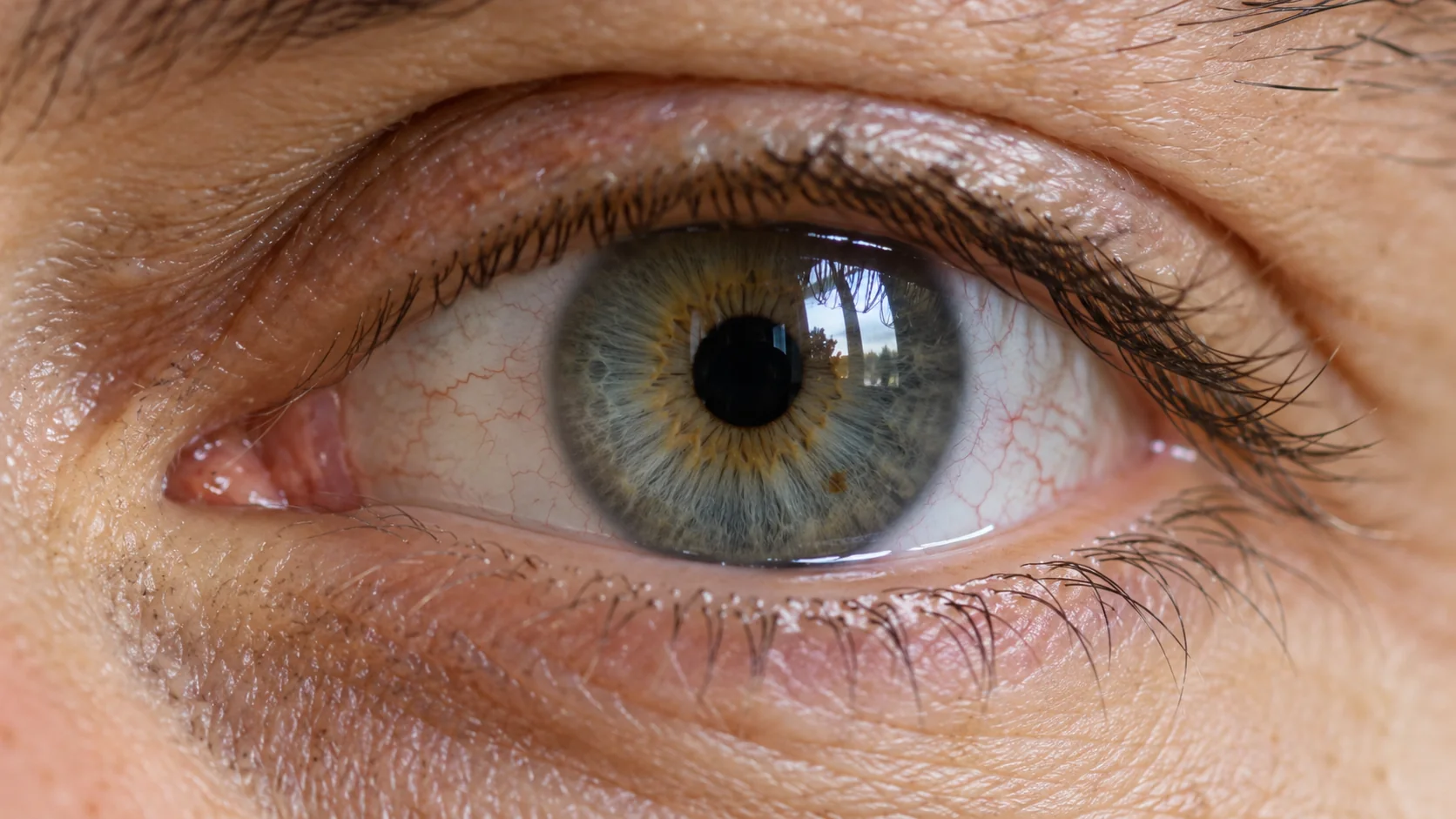
Heterochromia means a difference between the color of the two irises, the colored parts of the eyes, and it can involve the whole iris or only part of it. Two different colored eyes are rare: a study of 11,111 cadet yearbook portraits found 7 cases, a prevalence of 0.063%, about 6 in 10,000 people. A ring of another shade around the pupil, often called central heterochromia, is part of the normal range of eye color. Heterochromia present since early childhood can be inherited and may be harmless. A color change that starts later can come from glaucoma drops, inflammation, an injury or a spot on the iris, so it needs an eye exam. Our eye doctors in Los Angeles compare both irises at every comprehensive eye exam.
Key takeaways
- Heterochromia means the two irises differ in color, or part of one iris differs, and two different colored eyes appear in about 6 in 10,000 people.
- Heterochromia present from early childhood can be inherited and may be harmless, but it can come with conditions such as Waardenburg syndrome or Horner syndrome.
- A color change later in life can come from glaucoma drops, inflammation, an injury, a metal fragment or a spot on the iris, and needs an eye exam.
- A color change with eye pain, redness, light sensitivity or blurred vision needs a same-day exam, or an emergency room when the office is closed.
01
What are the types of heterochromia?
There are three patterns, depending on how much of the iris differs. Heterochromia can involve the whole iris or only part of the iris:
- Complete heterochromia: one eye is a different color from the other, such as one blue eye and one brown eye.
- Sectoral (segmental) heterochromia: a wedge or patch of one iris is a different color from the rest of it.
- Central heterochromia: a ring of another color circles the pupil, such as brown near the pupil and green or blue toward the edge.
Eye color researchers treat central heterochromia as ordinary eye color. One classification lists blue with a brown ring around the pupil and green with a brown iris ring among its nine standard categories, and the gene variant that mainly decides blue versus brown eyes is also linked to central heterochromia.
02
What causes two different colored eyes?
Eye color comes from melanin, the pigment that also colors skin and hair. Pigment cells sit in the front layer of the iris, and the number of pigment granules and the amount of pigment in each determines eye color. When one iris, or part of one, holds more or less pigment than the other, the colors differ.
Heterochromia you're born with can be inherited, or it can come from genetic mosaicism, a gene change in only some of the body's cells. It can also be part of a wider condition:
- Waardenburg syndrome, which affects an estimated 1 in 40,000 people. People with it often have very pale blue eyes or different colored eyes, and hearing loss can come with it.
- Horner syndrome present from birth. A lack of nerve supply to the eye causes a lighter-colored iris on that side, with a smaller pupil in dim light.
03
Can heterochromia develop later in life?
Yes. When an iris changes color in a child or an adult, something is acting on that eye, and an eye exam looks for the cause. Causes include:
| Cause | What happens to the color | What to do |
|---|---|---|
| Prostaglandin glaucoma drops, such as latanoprost | The treated iris can darken: in one year of treatment, 12% of patients in the USA showed it, mostly people with mixed eyes such as green-brown | Keep using your drops as prescribed and tell your eye doctor |
| Fuchs uveitis syndrome, a mild, long-lasting inflammation inside the eye | Heterochromia is considered an important feature; the eye may also have floaters or blur | An eye exam, then checks for cataract and glaucoma |
| An injury, eye surgery or thinning of the iris | Iris damage such as caused by surgery or injury, or loss of iris tissue, can change its color | An eye exam; after a blow to the eye, see the routes below |
| A metal fragment left inside the eye (ocular siderosis) | Iron from the fragment, usually after hammering, can cause iris heterochromia weeks to years later | An eye exam; a surgeon may need to remove the fragment |
| A spot on the iris (a nevus, a flat freckle-like spot, or rarely melanoma) | Growths on the iris, such as a nevus, can cause heterochromia, and a dark spot on the iris can be a sign of melanoma | An eye exam; a new or growing spot is followed closely |
Some differences only look like heterochromia. Different pupil sizes can create the impression of heterochromia, and so can a scar or swelling on the cornea. Our article on unequal pupils explains when a size difference matters.
04
Is heterochromia dangerous, and when should you worry?
Heterochromia you've had since early childhood that never changes may be benign and present no real medical risk, though its links to other conditions make a first eye exam worth having.
Book an eye exam soon for a new color difference between your eyes, a spot on the iris that is new or growing, or a change in the size or shape of the pupil. Eye melanoma may not cause early signs or symptoms, which is one more reason for regular exams.
Call us at 310-828-2010 for a same-day exam during office hours, or go to an emergency room when we're closed, if a color change comes with eye pain, redness, light sensitivity or blurred vision, or after a blow to the eye that leaves pain or changed vision.
Call 911 for sudden loss of vision in one or both eyes, even if it comes back; sudden double vision; double vision or a droopy eyelid with a pupil that looks different, eye pain or a severe headache; or any change in vision with face drooping, arm weakness or trouble speaking.
05
Heterochromia in babies and children
A baby's eye color changes from lighter tints to darker during the first year of life, mostly between 3 and 6 months, and eye color tends to stabilize by 6 years of age. Our article on baby eye color changes walks through the usual timeline.
A baby or child with two different colored eyes should have an eye exam, and a child whose eyes are changing color should be seen soon. In a review of 23 infants with Horner syndrome, testing found a tumor in two, one of them a neuroblastoma, and the authors advise further investigation when Horner syndrome comes with signs such as increasing heterochromia. Our pediatric eye exams check the eyes of children of every age.
06
Can colored contact lenses even out two eye colors?
Yes, if they are prescribed and fitted. Colored and costume lenses are not cosmetics: the FDA says they are medical devices regulated by the U.S. Food and Drug Administration, and a poor fit can cause scratches on the cornea, corneal infection and blindness.
Don't buy them from street vendors, salons, boutiques or Halloween stores. We fit decorative lenses at a contact lens exam, and our article on costume contact lenses covers safe wear.
07
How we check heterochromia at Cohenmehr Optometry
We compare both irises at the slit lamp, a microscope for the front of the eye, check how each pupil reacts to light and measure your eye pressure. When a cause needs to be ruled out, a dilated exam lets us look inside the eye.
If a spot or a change needs a specialist, we coordinate the referral and send your records. Children are examined the same way, with tests suited to their age.
08
Questions patients ask
Is heterochromia genetic?
It can be. Heterochromia present from birth can be inherited, and autosomal dominant inheritance has been reported, which means one parent can pass it on. In many people it comes instead from genetic mosaicism, a gene change in only some cells, so it may not run in the family. Heterochromia that appears later in life has a cause in that eye and needs an exam.
How rare is central heterochromia?
It isn't rare in the way two different colored eyes are. Eye color researchers treat a ring around the pupil as ordinary eye color, with categories such as green with a brown iris ring in their classification. The study that found two different colored eyes in about 6 in 10,000 people counted only that complete form, so it gives no figure for central heterochromia.
Can heterochromia go away?
Heterochromia you're born with usually stays, since eye color tends to stabilize by 6 years of age. Darkening from prostaglandin glaucoma drops hasn't been seen to fade either: after cessation of latanoprost, no change of the induced pigmentation was seen in patients followed for two years. When heterochromia has a cause, such as a metal fragment, treating that cause is what protects the eye.
How do you care for eyes with heterochromia?
The same way as any eyes: an eye exam to confirm the cause, then regular exams so any new change is caught early. Wear safety glasses for hammering or metalwork, because a metal fragment in the eye is one way a color change starts, and protective glasses are recommended to prevent it. Tell your eye doctor if the color, a spot or the pupil changes.
09
Sources
- StatPearls: Heterochromia
- Journal of Optometry, 2022
- Clinical & Experimental Ophthalmology, 2011
- Pigment Cell & Melanoma Research, 2016
- MedlinePlus Genetics: Waardenburg syndrome
- Survey of Ophthalmology, 1997
- Seminars in Ophthalmology, 2005
- Documenta Ophthalmologica, 2021
- British Journal of Ophthalmology, 1998
- National Cancer Institute: Intraocular (Uveal) Melanoma Treatment, Patient Version
- FDA: Colored and Decorative Contact Lenses: A Prescription Is a Must

Written by
Dr. Kevin Cohenmehr, OD
Medical eye care: glaucoma, diabetic eye exams, macular degeneration and eye infections, plus vision therapy for children. A graduate of UCLA and SUNY College of Optometry.
About Dr. Kevin →