Most glaucoma has no early signs you can notice. Open-angle glaucoma, the most common type, develops slowly and painlessly, and the side vision it takes first is easy to miss, which is why half of people with glaucoma don't know they have it. An eye exam can find what you can't feel: raised eye pressure, damage to the optic nerve and changes in side vision on a visual field test. Angle-closure glaucoma is the exception. Sudden, intense eye pain, often with nausea, a headache, blurry vision or halos around lights, is an emergency: call us immediately at 310-828-2010 for a same-day exam, or go to an emergency room when we're closed. Our glaucoma testing page explains how we look for it.
Key takeaways
- Glaucoma usually gives no early warning you'd notice, since open-angle glaucoma, the most common type, is slow and painless and takes side vision first.
- Half of people with glaucoma don't know it, and the National Eye Institute recommends a dilated exam every 1 to 2 years for people at higher risk.
- Sudden intense eye pain, often with nausea, blurry vision or halos, can be angle-closure glaucoma: call us immediately, or go to an emergency room when we're closed.
- Call 911 for sudden loss of vision in one or both eyes, even if it comes back.
01
What are the first signs of glaucoma?
For open-angle glaucoma, the most common type in the United States, there usually aren't any. Many people don't have any symptoms until they start to lose their vision.
When the loss begins, it usually starts with side (peripheral) vision, especially the part closest to your nose. Because it happens so slowly, many people can't tell that their vision is changing at first.
As the disease gets worse, you may notice that you can't see things off to the side anymore. Without treatment, side vision keeps shrinking until it may seem like you're looking through a tunnel, and glaucoma can eventually cause blindness.
Glaucoma can also reach central vision over time. Treatment can stop the damage from getting worse, but it won't undo vision that's already been lost.
02
What are the symptoms of angle-closure glaucoma?
Angle-closure glaucoma, also called narrow-angle or acute glaucoma, happens when the outer edge of the iris (the colored part of the eye) blocks fluid from draining out of the front of the eye. The fluid builds up quickly and eye pressure rises suddenly. Any of these can be a sign when they come on suddenly:
- Intense eye pain
- Nausea
- A red eye
- Blurry vision
- Halos or colored rings around lights
- A headache, sometimes with vomiting
This is a medical emergency. If it's not treated, angle-closure glaucoma can cause blindness in just a few days. During office hours (Monday 10 to 5, Tuesday through Friday 8 to 5), call us immediately at 310-828-2010 for a same-day urgent eye care exam. When we're closed, go to an emergency room. Going straight to an emergency room is also right.
Another form, slow or chronic angle-closure glaucoma, develops more gradually and might not have any symptoms. If you've been told your drainage angles are narrow, our page on narrow angles explains how we watch them.
Sudden loss of vision in one or both eyes, even if it comes back, is a different emergency: call 911. It can be a sign of a stroke, and the American Stroke Association's advice is to call 911 even if the symptoms go away.
03
Can other types of glaucoma cause early symptoms?
A few less common types can, and congenital glaucoma shows signs a parent can see in a baby:
| Type | What you might notice | What to do |
|---|---|---|
| Open-angle | Usually nothing until side vision starts to go | Dilated eye exams on the schedule your eye doctor sets |
| Normal-tension (open-angle glaucoma in people with normal eye pressure) | Usually nothing early, as with other open-angle glaucoma | Dilated eye exams on the schedule your eye doctor sets |
| Acute angle-closure | Sudden intense eye pain, nausea, a red eye, blurry vision or halos | Call us immediately; go to an emergency room when we're closed |
| Pigmentary | Blurry vision or rainbow-colored rings around lights, especially when you exercise | New blurry vision or halos: call us for a same-day exam, or go to an emergency room when we're closed; with eye pain, a headache or nausea, follow the angle-closure row |
| Neovascular (usually from diabetes or high blood pressure) | Pain or redness in the eye, vision loss | Call us for a same-day exam, or go to an emergency room when we're closed; sudden loss of vision is a 911 call |
| Congenital (present at birth) | Cloudy eyes, sensitivity to light, extra tears, eyes larger than normal | Call your pediatrician or an eye doctor right away, or go to an emergency room if you can't reach one |
Congenital glaucoma is rare: about 1 in 10,000 babies born in the United States has it. Surgery works very well to treat it, and babies who have surgery early enough usually won't have any permanent vision loss.
04
Who is at higher risk for glaucoma?
Your risk is higher if you:
- Are over age 60, especially if you're Hispanic/Latino
- Are African American and over age 40
- Have a family history of glaucoma
- Have diabetes or high blood pressure, which raise the risk of open-angle glaucoma
- Have had an eye injury
- Have thinner corneas, or have used corticosteroids such as prednisone for a long time
- Are of Asian descent or a Native Alaskan, which raises the risk of angle-closure glaucoma
If you're at higher risk, the National Eye Institute recommends a comprehensive dilated eye exam every 1 to 2 years, and the American Optometric Association recommends a yearly dilated exam for people at risk. If you have diabetes or high blood pressure, MedlinePlus advises a dilated eye exam at least once a year. Ask your eye doctor which schedule fits you.
If you've been told your eye pressure runs high, our OHTS glaucoma risk calculator shows how five measurements from an exam add up to an estimated five-year risk.
05
What happens during a glaucoma test?
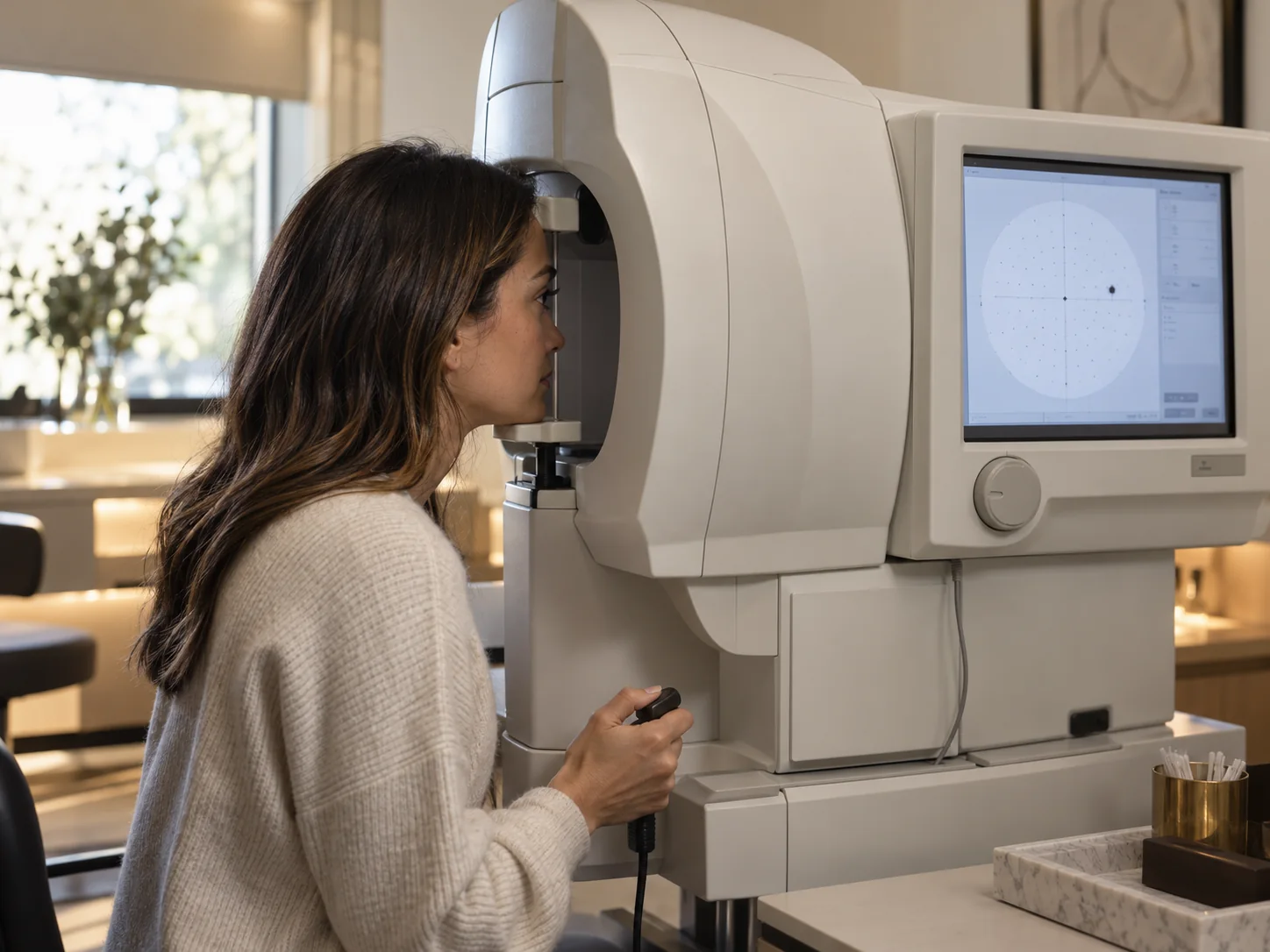
A glaucoma check is part of a comprehensive dilated eye exam, and it's simple and painless. Eye drops dilate (widen) your pupils, and the exam includes a visual field test to check your side vision. The tests eye doctors use include:
- Tonometry, which measures the pressure inside the eye
- Pachymetry, which measures the thickness of the cornea (the clear front of the eye)
- Visual field testing (perimetry), which checks whether glaucoma has affected your field of vision
- An exam of the retina, which may include photographs or scans of the optic nerve
- Gonioscopy, a view of the drainage angle, where fluid leaves the eye
- Serial tonometry, several pressure measurements taken over time
Eye pressure alone doesn't decide it. Not everyone with high eye pressure will develop glaucoma, and some people with normal eye pressure will, so doctors judge the optic nerve and the visual field along with the pressure reading.
06
How is early glaucoma treated?
Usually with prescription eye drops, the most common treatment, which lower the pressure in the eye. A glaucoma specialist can also use a laser to help fluid drain out of the eye, a simple procedure done in the specialist's office. If medicines and laser treatment don't work, there are several types of surgery that help the fluid drain.
There's no cure for glaucoma, but early treatment can often stop the damage and protect your vision. If you're prescribed drops, use them as prescribed.
07
How we check for glaucoma at Cohenmehr Optometry
Dr. Kevin Cohenmehr leads glaucoma care here. Every comprehensive exam includes a glaucoma screening, with eye pressure and an optic nerve evaluation, plus OCT nerve-fiber analysis and visual field testing when indicated. A full glaucoma evaluation uses OCT imaging, visual field testing, eye pressure checks, pachymetry and an optic nerve exam, and retinal photographs give a baseline that later visits are compared against.
Our Los Angeles optometrists monitor glaucoma suspects, people we watch closely for the first signs of glaucoma damage, so treatment can start before vision is lost. If your pressure is high but your optic nerve is healthy, our page on ocular hypertension explains how that's watched. When specialty treatment is needed, we work closely with glaucoma specialists on a timely referral.
08
Questions patients ask
How can you prevent glaucoma?
There's no way to prevent glaucoma, which is why eye exams matter: they can find it before it affects your vision. You can lower some risks. Eye injuries can cause glaucoma, so wear safety glasses or goggles for sports, construction work and home repairs. Steroid medicines may raise eye pressure as a side effect, so if you take them, don't stop on your own; ask your doctor about eye pressure checks.
What are the symptoms of high eye pressure?
Usually there aren't any. Ocular hypertension, eye pressure above the normal range, has no noticeable signs or symptoms, and an eye doctor finds it with a tonometer. Not everyone with ocular hypertension develops glaucoma, but the risk is higher, so regular comprehensive exams matter. A sudden pressure rise from angle-closure glaucoma is the exception: intense eye pain, nausea, a red eye or blurry vision means calling us immediately, or going to an emergency room when we're closed.
Can glaucoma happen in only one eye?
Yes. Glaucoma can happen in one eye or both eyes. An acute angle-closure attack often affects only one eye, but the other eye may be at risk of an attack as well, so your doctor might treat both eyes to prevent future problems even if only one eye has angle-closure glaucoma.
What causes tunnel vision?
Tunnel vision is losing side vision until only a central area is left. Glaucoma is one cause: without treatment it slowly takes peripheral vision until it may seem like you're looking through a tunnel. Retinitis pigmentosa, a group of rare inherited retina diseases, narrows the field the same way, usually after night vision starts to fail in childhood. Sudden vision loss is different: call 911. For a dark curtain or shadow over part of your vision, call us immediately, or go to an emergency room when we're closed.
09
Sources
- National Eye Institute: Glaucoma
- National Eye Institute: Types of glaucoma
- American Optometric Association: Glaucoma
- MedlinePlus: Glaucoma
- CDC: About glaucoma
- American Optometric Association: Ocular hypertension
- StatPearls: Acute angle-closure glaucoma
- National Eye Institute: Retinitis pigmentosa
- American Stroke Association: Stroke symptoms

Written by
Dr. Kevin Cohenmehr, OD
Medical eye care: glaucoma, diabetic eye exams, macular degeneration and eye infections, plus vision therapy for children. A graduate of UCLA and SUNY College of Optometry.
About Dr. Kevin →