Daily contacts are worn for one day and thrown away, while monthly contacts come out each night to be cleaned and stored in solution, then get replaced after a month. Dailies need no cleaning, case or solution, and daily disposable wearers have fewer contact lens complications, such as infections, than people on other replacement schedules. Monthlies need a nightly routine of rubbing, rinsing and fresh solution. Don't sleep in daily lenses, and sleep in monthlies only if your eye doctor has prescribed them for overnight wear. Dailies have become our default recommendation at our contact lens exams, though the right lens depends on your eyes and how often you wear contacts.
Key takeaways
- You throw a daily lens away after one day and never sleep in it, while a monthly lens is cleaned every night and replaced after a month.
- People who wear dailies have fewer complications, such as infections, than those on other replacement schedules, and dailies need no case or solution.
- Dailies suit part-time wearers and frequent travelers, and monthlies are a reasonable choice if you will clean them nightly and replace the case on schedule.
- If a lens leaves your eye red, painful or light sensitive, take it out and call us right away, or go to an emergency room when we're closed.
01
What is the difference between daily and monthly contacts?
The difference is how long one lens lasts and what happens to it at night. With a true daily disposable schedule, a brand new pair of lenses goes in each day. Monthlies belong to the planned replacement group: soft daily-wear lenses replaced on a set schedule, most often every two weeks, monthly or quarterly.
Sellers can blur the two. The FDA defines disposable as used once and discarded, but some sellers call a lens disposable when it is really meant for frequent or planned replacement. Whatever the box says, follow the replacement schedule your eye doctor gives you.
| Compared | Daily disposables | Monthly lenses |
|---|---|---|
| How long a lens lasts | One day, then it goes in the trash | About a month of daily wear |
| Nightly cleaning | None | Rub, rinse and store in fresh solution |
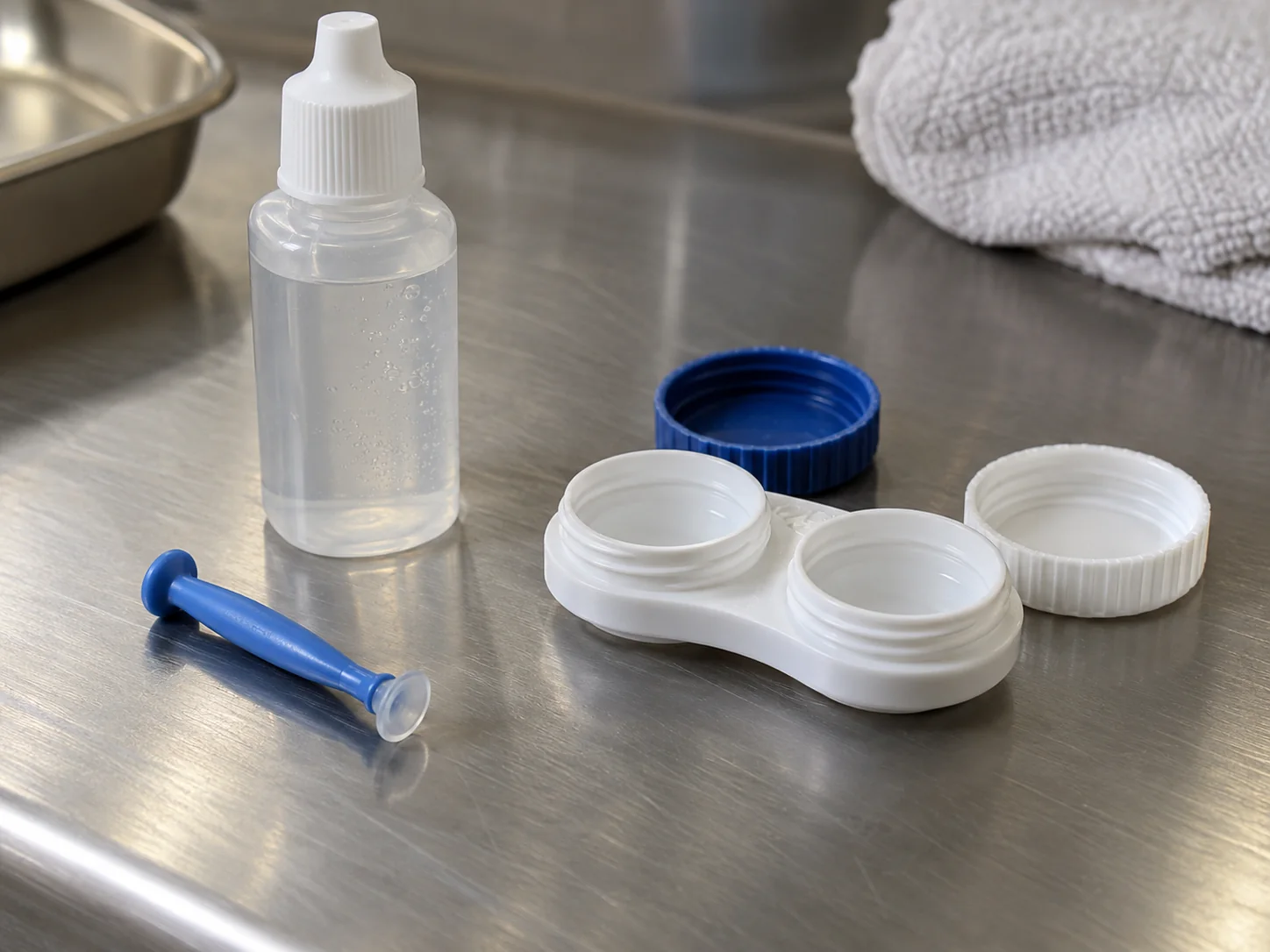
| Lens case | Not needed | Needed; replace it at least every three months |
| Complications such as infections | Fewer than on other replacement schedules | Kept down by careful cleaning and storage |
| Sleeping in them | No | No, unless the lens is approved and prescribed for overnight wear |
02
Are daily contacts safer than monthly contacts?
On average, yes. Dailies can reduce some of the risks of lens wear because a new pair is used each day. There is also no case to keep clean, and overusing a case can lead to significant eye infections from bacterial contamination.
Any contact lens can still cause trouble. Contact lens wear carries a risk of eye infections and corneal ulcers, open sores in the outer layer of the cornea (the clear front surface of the eye), and both can develop very quickly. Our page on keratitis covers the infections that lens habits can lead to.
With monthlies, the cleaning routine is what keeps that risk down:
- Rub and rinse the lenses as your eye doctor directs.
- Throw out all leftover solution after each use, and never top it off or reuse it.
- Keep lenses away from all water: tap, bottled, distilled, lake or ocean.
- Replace the lens case at least every 3 months, or as your eye doctor directs.
03
When should you replace daily and monthly contacts?
A daily disposable lasts one day. Reusable soft lenses last until the replacement date your eye doctor sets: the CDC puts planned replacement schedules at seven to 30 days, and some lenses are replaced quarterly.
Stretching either one can cause problems. Wearing daily disposables for more than one day may cause eye discomfort or other complications, and so can wearing reusable lenses past their recommended replacement schedule. If you're down to your last pair, call us: with a valid prescription, we can usually bridge you with trial lenses the same day while your order ships.
Dropped a lens on the floor? Rinsing it off isn't enough, and the only sure way to stay safe is a new lens, which is easy when you wear disposable soft lenses. With a reusable lens, wear your backup glasses until the lens has been through a full disinfection cycle.
The prescription has a time limit too. Contact lens prescriptions generally expire every year unless your eye doctor decides otherwise, and California requires a current prescription to dispense lenses, so book your contact lens exam before your supply runs out.
04
Can you sleep in daily contacts?
No. Daily disposables are meant to be thrown away at the end of each day and replaced with a new pair the next day, and sleeping in daily-wear lenses can increase the chances of a serious eye infection. Monthlies prescribed as planned replacement lenses are daily-wear lenses as well.
Some lenses are approved for overnight wear. Extended wear lenses can be worn continuously for one to six nights or up to 30 days, depending on the lens type and your eye care professional's evaluation of how your eyes tolerate overnight wear, and your eyes need at least one night without lenses after each scheduled removal. Only sleep in lenses that were prescribed for it.
If you'd like to wake up seeing clearly, ask us about Ortho-K, lenses designed to be worn overnight and removed when you wake up.
05
Which should you choose: daily or monthly contacts?
Your habits usually decide it.
- You wear contacts only some days. Dailies suit part-time wearers: they help keep costs down, and you never have to wonder how long a lens has been sitting in solution or whether the solution is past its discard date.
- You travel often. Daily disposables are highly portable and convenient, with no solution bottle or case to pack.
- Your lenses feel dry by afternoon. Contact lens wearers may be more likely to have dry eye. A fresh lens each morning often helps, and when it doesn't, we treat the dryness itself; see contact lens discomfort.
- You have astigmatism or need help seeing up close. Toric and multifocal contact lenses come as daily disposables as well as reusable lenses, and we fit both.
- You're happy with a nightly routine. Monthlies are a reasonable choice if you'll rub, rinse and store them in fresh solution every night and replace the case on schedule.
06
How we help you choose at Cohenmehr Optometry
At Cohenmehr Optometry, we fit all types of soft lenses, daily and monthly, torics and multifocals included. A contact lens exam is its own exam: we measure the curvature and diameter of your cornea, check the tear film the lens has to float on, and look at a trial lens on your eye with a slit lamp microscope before the prescription is final.
We keep thousands of trial lenses across the major brands, so the lens we prescribe is one you have already worn at the exam.
If a lens ever leaves your eye red, painful or sensitive to light, your vision blurs, or you see a white spot on the cornea, take it out, don't put it back in, and call 310-828-2010 right away. We see urgent eye problems the same day during office hours; when we're closed, go to an emergency room.
07
Questions patients ask
What are MiSight lenses?
MiSight 1 Day lenses are daily disposable soft contact lenses for nearsighted children. The FDA approved them in 2019 both to correct nearsightedness and to slow its progression in children with healthy eyes who are 8 to 12 years old when they start, with a spherical equivalent prescription (the sphere plus half the cylinder) between -0.75 and -4.00 diopters and no more than 0.75 diopters of astigmatism. Each lens is thrown away after it comes out. We fit MiSight 1 Day as part of our myopia control care.
What are multifocal contacts?
Multifocal contacts carry more than one power in the same lens. Adults wear them for presbyopia, the age-related change in the eye's lens that makes it hard to focus on close objects and usually becomes noticeable in the early to mid-40s; in children, related designs are used to slow nearsightedness, as our page on multifocal contacts for myopia explains. Monovision is the other contact lens approach for presbyopia: one eye wears a lens for near or intermediate vision and the other, if needed, a lens for distance. Multifocals come as dailies and monthlies; see multifocal contact lenses.
What are Ortho-K lenses?
Ortho-K lenses are specially designed rigid gas permeable lenses that change the curvature of the cornea to temporarily improve focus, mainly to correct nearsightedness. Overnight Ortho-K lenses are commonly worn while you sleep, for at least eight hours a night, and removed when you wake up. Because the effect is temporary, they're worn every night or on another prescribed schedule, and the FDA requires eye care professionals to be trained and certified before fitting them. We fit Ortho-K for children and adults.
How long can you wear contacts?
As long as the wearing schedule your eye doctor gives you allows, and no longer. Daily-wear lenses come out before you go to sleep or take a nap, and a daily disposable is worn for one day and then thrown away. Take your lenses out and call your eye doctor right away if your vision changes, your eyes turn red, hurt or itch, or they water a lot; when our office is closed, a painful, red or light-sensitive eye belongs in an emergency room.
08
Sources
- American Optometric Association: Contact lens care
- CDC: Preventing eye infections when wearing contacts
- FDA: Types of contact lenses
- American Optometric Association: Types of contact lenses
- FDA: What to know if your child wants contact lenses
- FDA: Contact lens risks
- CDC: About contact lens types
- FDA: Contact lens care
- American Optometric Association: Healthy vision and contact lenses
- National Eye Institute: Dry eye
- American Optometric Association: Presbyopia
- FDA: MiSight 1 Day premarket approval

Written by
Dr. Brandon Cohenmehr, OD
Specialty contact lenses, with a focus on Ortho-K, scleral lenses, and co-managing patients with keratoconus and other corneal disease. A graduate of SUNY College of Optometry.
About Dr. Brandon →