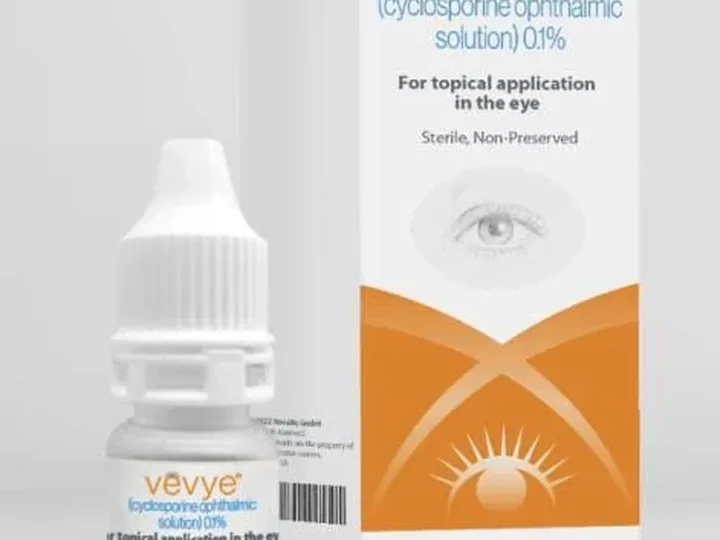
Cequa is a prescription eye drop with cyclosporine 0.09%, indicated to increase tear production in patients with keratoconjunctivitis sicca (dry eye). You use one drop of CEQUA twice daily (approximately 12 hours apart) into each eye, from single-use vials with no preservative. Its most common side effects in the studies were pain on instillation of drops (22%) and conjunctival hyperemia (6%), meaning stinging when the drop goes in and eye redness. It takes weeks: tear production rose in approximately 17% of CEQUA-treated patients versus approximately 9% of vehicle-treated patients at day 84. What you pay depends on your plan, and plans can require prior authorization first.
Key takeaways
- Cequa is a prescription drop with cyclosporine 0.09% that helps dry eyes make more of their own tears, used twice a day.
- Pain when the drop goes in and eye redness were the most common side effects in the studies.
- In two studies of 1,048 people, tear production rose more with Cequa than with an inactive drop by day 84.
- If a drop leaves your eye painful, increasingly red or blurry for more than a short while, call us right away, or go to an emergency room when we're closed.
01
What is Cequa used for?
Cequa treats dry eye by helping the eye make more of its own tears. Dry eye happens when your eyes don't make enough tears to stay wet, or when your tears don't work correctly, and Cequa is aimed at the first problem: its label says it is indicated to increase tear production in dry eye.
The symptoms it's meant to ease are the familiar ones: a scratchy feeling, like there's something in your eye, stinging or burning, red eyes, sensitivity to light and blurry vision. Treatment matters, because if severe dry eye isn't treated, it can sometimes damage your cornea. Cequa needs a prescription, and our page on prescription dry eye drops compares it with the other options.
02
How does Cequa work?
Its medicine, cyclosporine, works on the immune response; the label calls Cequa a topical calcineurin inhibitor immunosuppressant. In dry eye, inflammation on the eye's surface can hold down tear production. For that situation, the Restasis label describes cyclosporine as a medicine that is thought to act as a partial immunomodulator, easing the inflammation so the tear glands can do more of their work.
Cequa is a solution rather than an emulsion like Restasis. Its inactive ingredients include Polyoxyl 40 Hydrogenated Castor Oil, Octoxynol-40, polyvinylpyrrolidone, along with sodium chloride, water for injection and phosphate salts. Restasis and Vevye contain the same medicine at different strengths and in different liquids.
03
How long does it take for Cequa to work?
Plan on about three months. The two studies behind its approval treated 1,048 patients and measured tear production with a Schirmer test, a paper strip that shows how much the eye wets. The goal was an increase of 10 mm or more from baseline in Schirmer wetting, and it was measured compared to vehicle at Day 84, twelve weeks in.
That rise happened in approximately 17% of CEQUA-treated patients versus approximately 9% of vehicle-treated patients, the vehicle being the same drop without cyclosporine. Keep using it twice a day while you wait, along with any other treatment your eye doctor added, and keep your follow-up visit.
04
What are the side effects of Cequa?
Stinging when the drop goes in is the one most people notice. The label lists them this way:
| How often in the studies | Side effect |
|---|---|
| 22% of patients | Pain on instillation, the sting or ache right after the drop goes in |
| 6% of patients | Red eyes (conjunctival hyperemia) |
| 1% to 5% of patients | Blepharitis (eyelid inflammation), eye irritation, headache and urinary tract infection |
Tell us if the sting makes the drop hard to keep using; there are other prescription options.
If a drop leaves your eye painful, increasingly red or blurry for more than a short while, call us right away at 310-828-2010, or go to an emergency room when we're closed. Call 911 for sudden loss of vision, sudden double vision or any change in vision with face drooping, arm weakness or trouble speaking.
05
How do you use Cequa?
One vial per dose, for both eyes, twice a day. The label's steps:
- Put one drop of CEQUA twice daily (approximately 12 hours apart) into each eye.
- Take contact lenses out first: CEQUA should not be administered while wearing contact lenses.
- Using artificial tears too? CEQUA can be used concomitantly with artificial tears, allowing a 15 minute interval between products.
- Discard the vial immediately after using in both eyes.
Keep the tip clean: the label warns patients to not allow the tip of the vial to touch the eye or any surface, as this may contaminate the solution. Store it at room temperature, 20°C to 25°C (68°F to 77°F).
06
Cequa vs. Restasis: what's the difference?
Both contain cyclosporine and both come in preservative-free single-use vials. The differences are in strength, liquid and how the studies measured them:
| Cequa | Restasis | |
|---|---|---|
| Strength and form | Cyclosporine 0.09%, a solution | Cyclosporine 0.05%, a white opaque to slightly translucent homogeneous emulsion |
| Most common side effect in studies | Pain on instillation (22%) | Ocular burning (17%) |
| Main study result | Tear production up in about 17% vs. 9% at day 84 | Tear production up in about 15% vs. 5% at six months |
| Age on the label | Not established below 18 | Not established below 16 |
The studies were different, so the numbers don't rank one drop above the other. We choose between them, and Vevye, the newest cyclosporine drop, based on your eyes, what you've tried and what your plan covers. Our article on Vevye explains that one.
07
How much does Cequa cost, and does insurance cover it?
What you pay depends on your prescription plan, its drug list and its rules. Medicare explains the two you'll hear about most: prior authorization is approval based on a plan's specific requirements, and step therapy is a type of prior authorization that requires you first to try a certain, less expensive drug.
If a rule blocks the drop your eye doctor prescribed, you or your prescriber can contact your plan to ask for an exception. Medicare defines an exception as when a drug plan decides to cover a drug that's not on its drug list, or to waive a coverage rule. Our office submits prior authorizations for prescription dry eye drops, including Cequa, and files appeals when a plan says no. Our accepted insurance page lists the plans we work with.
08
How we use Cequa at Cohenmehr Optometry
Cequa is one of the cyclosporine drops our eye doctors in Los Angeles prescribe, along with Restasis and Vevye, and Xiidra is another anti-inflammatory option. We consider it when testing shows low tear production or inflammation on the eye's surface that lubricating drops haven't settled.
A drop is often one part of the plan. When the oil glands in the eyelids are involved, we treat them too, and our dry eye care page walks through the tests and treatments we use.
09
Questions patients ask
Is Cequa a steroid?
No. Cequa's medicine is cyclosporine, and the label calls Cequa a topical calcineurin inhibitor immunosuppressant, a different kind of medicine from corticosteroids. Steroid eye drops carry their own warnings, among them that prolonged use of corticosteroids may result in glaucoma. Cequa is meant for regular use under your eye doctor's care.
Does Cequa need to be refrigerated?
No. The label says to store at 20°C to 25°C (68°F to 77°F), which is room temperature and warmer than a refrigerator, so keep the vials out of the fridge. Each box holds 60 vials, sealed in pouches. If a box was left somewhere very hot or very cold, ask your pharmacist before using it.
Does Medicare cover Cequa?
It depends on your Part D or Medicare Advantage drug plan. Each plan has its own drug list and can set rules such as prior authorization, which Medicare describes as approval based on a plan's specific requirements. If your plan won't cover it as prescribed, you or your prescriber can contact your plan to ask for an exception, and our office handles that request for our patients.
Can teenagers use Cequa?
Not as a routine choice. The label says the safety and efficacy of CEQUA ophthalmic solution have not been established in pediatric patients below the age of 18. If a teenager has dry eye symptoms, our guide to dry eye in children and teens explains what we check first in younger patients.
10
Sources
- FDA label: Cequa (cyclosporine ophthalmic solution) 0.09%
- DailyMed: Cequa prescribing information
- FDA label: Restasis (cyclosporine ophthalmic emulsion) 0.05%
- DailyMed: Restasis prescribing information
- National Eye Institute: Dry eye
- Medicare: Drug plan rules
- FDA label: Omnipred (prednisolone acetate ophthalmic suspension) 1%
- American Stroke Association: Stroke symptoms

Written by
Dr. Bijan Cohenmehr, OD
Founder of Cohenmehr Optometry, in practice for over 40 years. He leads the practice’s dry eye care and myopia management. A graduate of SUNY College of Optometry.
About Dr. Bijan →