Keratoconus is uncommon. MedlinePlus Genetics, the National Library of Medicine's genetics reference, says it is estimated to affect 1 in 500 to 2,000 people worldwide, and the American Optometric Association calls it a relatively rare condition. Symptoms usually appear in the late teens or early 20s, and 1 in 10 people with keratoconus has a close relative who has it too. Whether you have it is a question for a corneal map, which we take at every keratoconus evaluation.
Key takeaways
- Keratoconus, in which the eye's clear front window thins into a cone, is uncommon, affecting an estimated 1 in 500 to 2,000 people worldwide.
- Symptoms usually start in the late teens or early 20s, and 1 in 10 people with keratoconus has a close family member who has it too.
- Glasses that work well don't rule it out, so ask for a corneal map if your prescription keeps changing or a parent, brother or sister has keratoconus.
- Sudden haze in an eye with keratoconus needs a same-day exam, so call us right away, or go to an emergency room when we're closed.
01
Is keratoconus rare?
It's uncommon. The AOA describes keratoconus as a relatively rare condition in which the cornea, the clear front window of the eye, becomes progressively thinner and cone-shaped.
The 1 in 500 to 2,000 figure from MedlinePlus Genetics is a worldwide estimate given as a range. MedlinePlus doesn't break it down by country, age, sex or ethnic background, so it gives no separate figure for the United States.
02
Who gets keratoconus?
It usually starts young. Symptoms usually appear in the late teens or early 20s, and MedlinePlus Genetics says the eye changes typically begin in adolescence and slowly worsen until mid-adulthood, when the shape of the cornea stays stable. In its 2016 review of the Photrexa cross-linking drugs, the FDA described onset as generally occurring during puberty or early adulthood.
The AOA lists these risk factors:
- A close family member with keratoconus. One in 10 people with keratoconus has one.
- Frequent eye rubbing, especially hard rubbing with the knuckles.
- A history of asthma or allergies.
- Ehlers-Danlos syndrome, Down syndrome or retinitis pigmentosa.
Family history raises the odds, but in most cases keratoconus isn't inherited and appears in people with no family history of it; relatives of someone with keratoconus do have a higher risk than people without one. When it does run in a family, it can be passed down in either a dominant or a recessive pattern. It can also be one feature of certain rare genetic syndromes, such as Leber congenital amaurosis.
About one-third of people with keratoconus have an allergic disorder, though it's unclear how allergies are related to it. If itchy eyes keep you rubbing, our page on eye rubbing and keratoconus has other ways to calm the itch. Parents will find what to watch for in our guide to keratoconus in teens.
03
Can you have keratoconus without knowing it?
Yes, especially early on. In its earliest stages keratoconus causes slight blurring and distortion of vision and more sensitivity to glare and light, and glasses or soft contact lenses can correct the mild nearsightedness and astigmatism of those early stages.
It can also start in one eye. Keratoconus may affect only one eye at first; eventually both corneas become misshapen, though not always to the same degree.
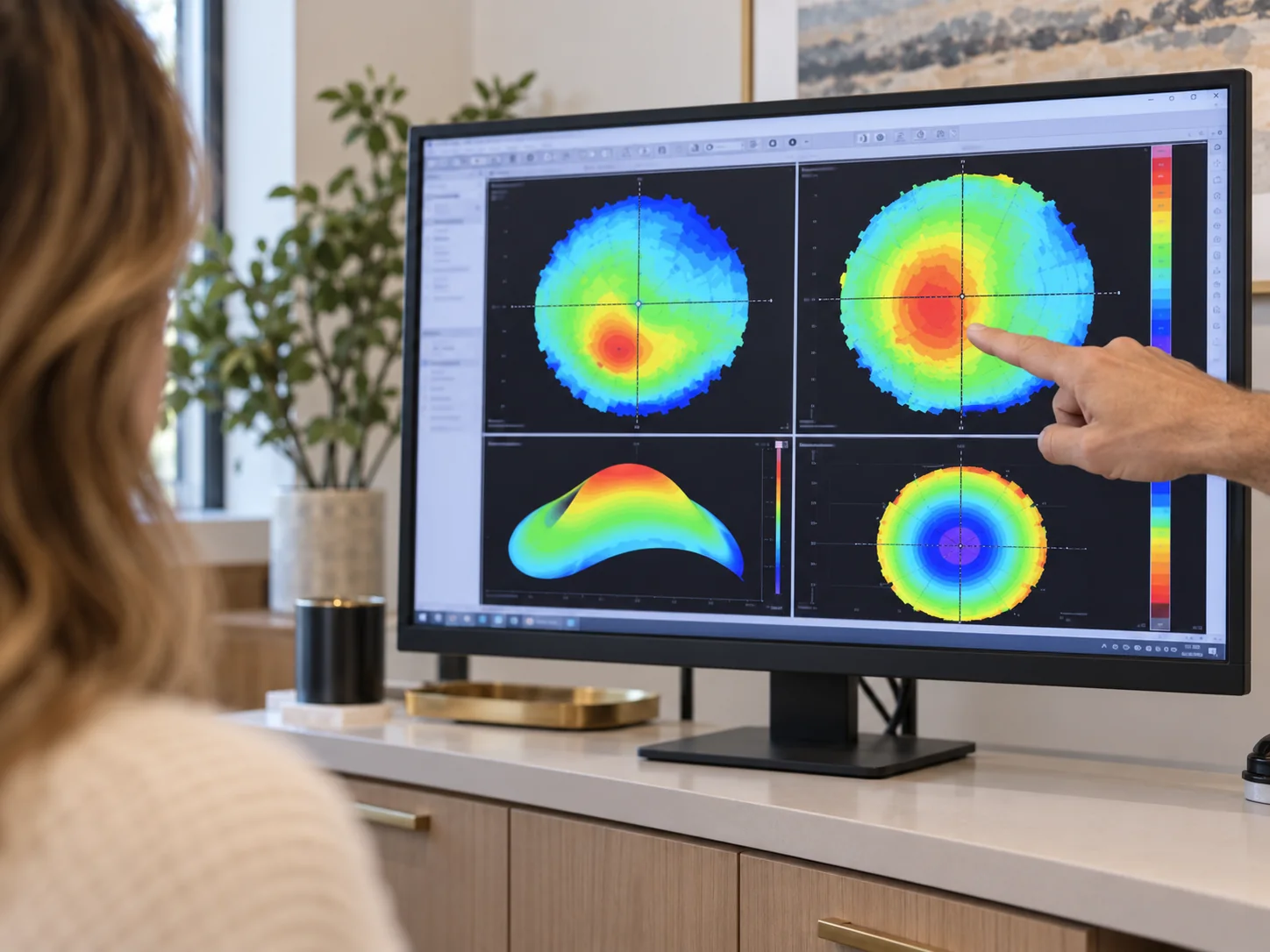
So new glasses that work well don't rule it out. The AOA advises seeing a doctor of optometry regularly for measurements of the cornea's curvature and tests for irregular astigmatism. On the color maps we take, steep or irregular areas of the cornea show up even in early keratoconus that may not be obvious on a basic exam.
Ask for a corneal map if your prescription keeps changing, if letters or lights have a shadow or a second image that new glasses don't fix, or if a parent, brother or sister has keratoconus. If double vision starts suddenly, call 911. Our keratoconus risk checker weighs the common risk factors in six questions.
04
What happens after a keratoconus diagnosis?
The first step is a baseline: a full set of corneal maps that later visits are compared against. Keratoconus may progress for 10 to 20 years and then slow, and each eye may be affected differently, so we compare each new map with that baseline.
If the maps show the cornea changing, the treatment to discuss is corneal cross-linking, which halts or slows progression; the AOA says it is indicated early after diagnosis, or later if the glasses prescription is still increasing. Photrexa, the riboflavin eye drop used in standard cross-linking, is FDA-approved for use with a UV light system to treat progressive keratoconus. A corneal surgeon performs the procedure, and we handle the cross-linking referral and follow-up.
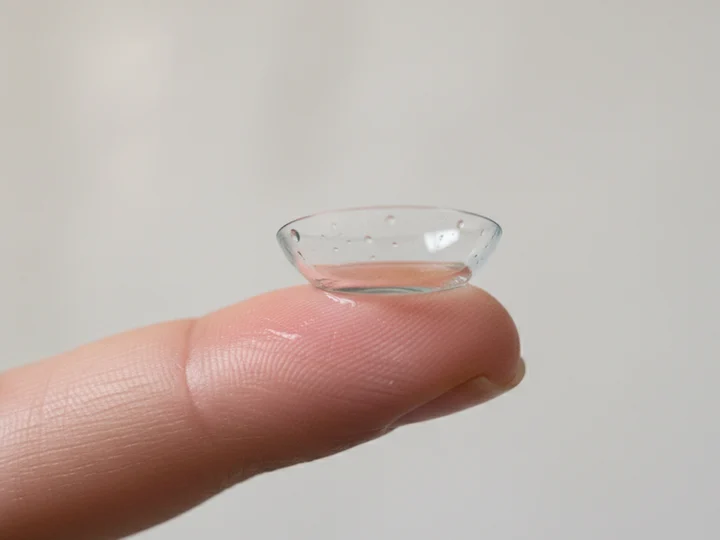
Lenses take care of vision. Glasses or soft lenses can work early on, and as the cornea keeps thinning and changing shape, rigid gas permeable lenses can be prescribed to correct vision adequately. For moderate to advanced keratoconus, the lens we fit most often is a scleral lens, which vaults over the cornea on a layer of saline.
If you're pregnant or planning a pregnancy, our page on keratoconus and pregnancy explains how we adjust monitoring during those months.
05
How we check for keratoconus at Cohenmehr Optometry
A keratoconus evaluation with our eye doctors in Los Angeles is built on maps of the cornea. Corneal topography charts the shape of its front surface, while tomography and pachymetry add a 3-D view and a thickness map that show where the cornea is thinning and help tell true keratoconus apart from ordinary high astigmatism. The topography scan takes minutes and doesn't touch the eye.
We also measure your vision with correction, the amount and direction of your astigmatism and how much your prescription has changed in recent years, then stage the keratoconus and set your baseline. Younger patients and fast-changing maps are seen more often; stable adults may move to yearly checks.
Family members are worth mapping too: brothers, sisters and children of people with keratoconus carry a higher risk, so we recommend corneal maps for them, since early keratoconus may not show up on a basic exam. Our office is also an Epioxa Keratoconus Certified Detection Center: the maps we take are what qualify a progressing cornea for cross-linking.
Dr. Brandon Cohenmehr personally oversees every keratoconus evaluation in our office. If a parent, brother or sister has keratoconus, mention it when you book.
06
Questions patients ask
What is acute corneal hydrops?
Acute corneal hydrops is a sudden swelling of the cornea in a small number of people with keratoconus. The strain of the cone opens a tiny crack, the cornea swells and vision drops suddenly; the swelling may last weeks or months while the crack heals and is replaced by scar tissue, and eye drops can give temporary relief. Sudden haze in a keratoconus eye needs a same-day exam: call us at 310-828-2010 right away, or go to an emergency room when we're closed. Sudden loss of vision at any hour is a 911 call.
What kind of doctor treats keratoconus?
Keratoconus care can involve two kinds of eye doctors. An optometrist can diagnose and monitor it with measurements of the cornea's curvature and tests for irregular astigmatism, and optometrists like ours fit the specialty contact lenses that correct the vision. A corneal surgeon performs cross-linking, or a corneal transplant in the few cases that need one. In our office, Dr. Brandon Cohenmehr, OD, oversees keratoconus care, and we co-manage cross-linking with corneal surgeons.
How do I find a keratoconus specialist near me?
Look for an eye doctor who maps the cornea and fits specialty lenses. Ask whether the office uses corneal topography or tomography and compares the maps at each visit, whether it fits scleral, rigid gas permeable and hybrid lenses, and whether it co-manages cross-linking with corneal surgeons. We do all three at 12222 Wilshire Blvd, on the Santa Monica border, and patients travel from across California for keratoconus and scleral lens care.
Can keratoconus be prevented?
There's no known way to prevent it for certain: MedlinePlus Genetics says the cause of keratoconus is unknown. The habit you can change is eye rubbing. Excessive, vigorous rubbing can injure the cornea and may thin it, though it's unclear whether rubbing leads to keratoconus or is a response to eye discomfort, and the AOA lists frequent rubbing, especially with the knuckles, as a risk factor. If keratoconus runs in your family, a baseline corneal map is how early change gets caught, and cross-linking can halt or slow progression.
07
Sources
- MedlinePlus Genetics: Keratoconus
- American Optometric Association: Keratoconus
- American Optometric Association: Astigmatism
- DailyMed: Photrexa cross-linking label
- FDA summary review: Photrexa, 2016

Written by
Dr. Brandon Cohenmehr, OD
Specialty contact lenses, with a focus on Ortho-K, scleral lenses, and co-managing patients with keratoconus and other corneal disease. A graduate of SUNY College of Optometry.
About Dr. Brandon →