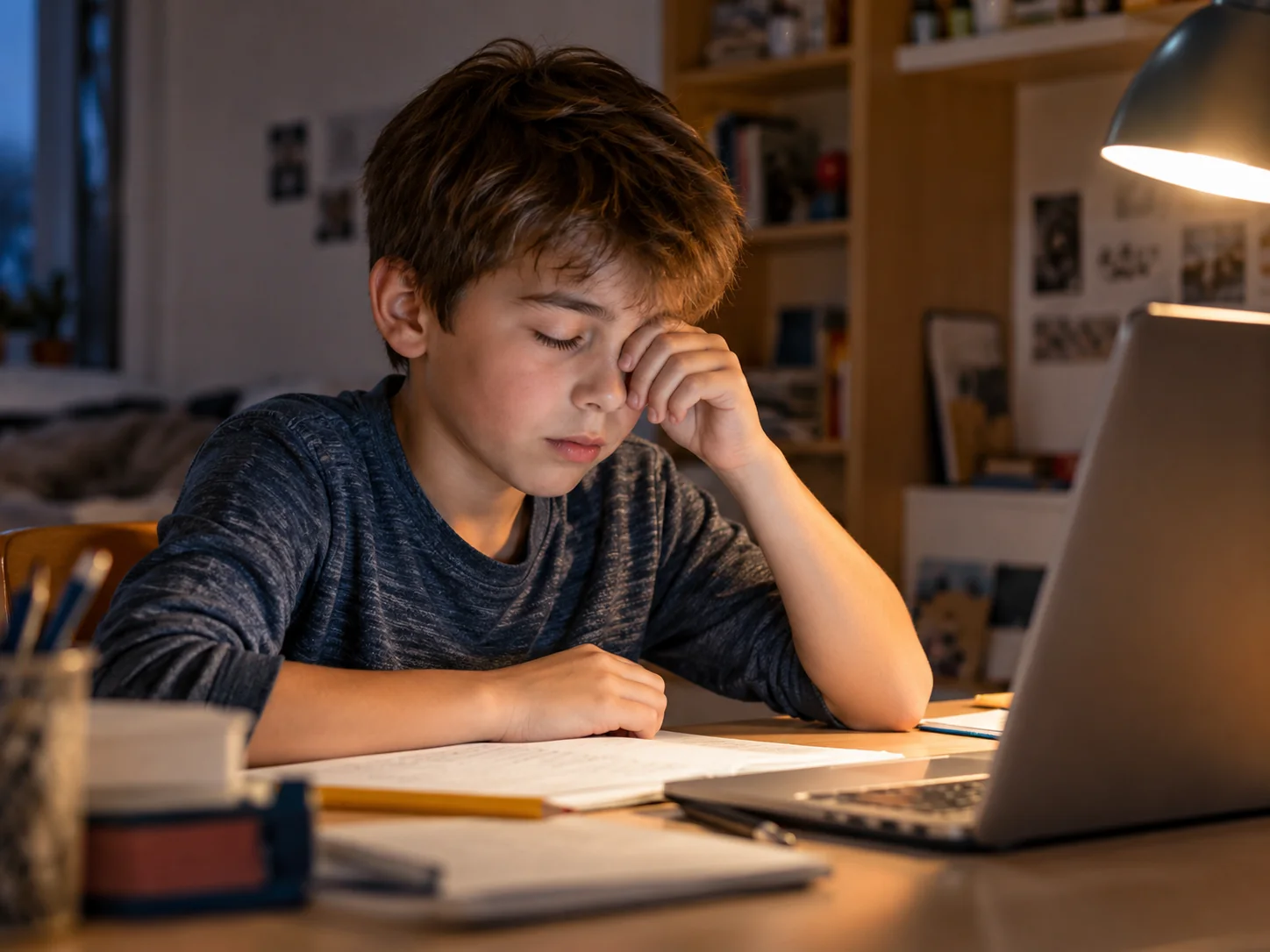
No. Reading in dim light isn't harmful to your eyes, the National Eye Institute (NEI) says; it may just make them feel tired. Sitting close to the TV gets the same answer: NEI says there's no scientific evidence that it's bad for your eyes. Some other things you may have heard as a child hold up only partly, and a few habits, like a child holding books close to the face, are a reason to book a comprehensive eye exam.
Key takeaways
- Reading in low light may leave your eyes feeling tired, but it doesn't harm them, and your eyes don't wear out.
- There's no scientific evidence that sitting close to the TV hurts your eyes, but a child holding books close to the face should get an eye exam.
- Children don't outgrow crossed eyes (strabismus), which may get worse without treatment such as glasses, prisms, vision therapy or eye muscle surgery.
- Sudden double vision at any age is a 911 call, even if it goes away.
01
Does reading in dim light damage your eyes?
No. NEI's list of eye myths puts it plainly: although reading in dim light makes your eyes feel tired, it is not harmful. The same list calls the idea that you can wear out your eyes a myth; eyes do not wear out.
Tired eyes are real, though. Staring at any one thing for too long can tire your eyes, and NEI suggests a simple break: every 20 minutes, look about 20 feet away for 20 seconds.
When trouble reading is worth an exam
Holding reading material at arm's length, or getting blurred vision, eye fatigue and headaches with close work, are among the signs of presbyopia, a change in the shape of the eye's lens that makes it hard to focus on close objects. It usually becomes noticeable in the early to mid-40s.
Cloudy or blurry vision, faded colors, and lamps or headlights that seem too bright are among the symptoms of a cataract, a cloudy area in the lens of the eye. Either one is a good reason for an eye exam.
02
Is sitting too close to the TV bad for your eyes?
No. NEI lists 'never sit too close to the TV' as a myth and says there is no scientific evidence that sitting too close to the TV is bad for your eyes.
Holding things close is worth noticing in a child, though. The American Optometric Association (AOA) lists holding reading materials close to the face among the signs of a possible vision problem in school-age children, along with covering one eye, tilting the head to one side and frequent eye rubbing, and it notes that a child may not tell you about a vision problem.
For phones and tablets, AOA suggests a distance of at least 13 to 20 inches and using the zoom feature for small print instead of bringing the device closer, which it says taxes the visual system.
03
Do screens damage children's eyes?
Eye strain from screens tends to be temporary, though the longer you spend in front of a screen, the longer it takes to go away. Long hours of close work are a separate question, because they're linked to nearsightedness.
Digital eye strain shows up as eyestrain, headaches, blurred vision, dry eyes and neck and shoulder pain, and AOA says many of these visual symptoms are only temporary and fade after you stop using the device, but some people's distance vision stays blurred afterward. People also tend to blink less while looking at a screen.
Nearsightedness, or myopia, makes far-away objects look blurry. AOA says people who spend a lot of time reading, working at a computer, playing video games or doing other intense close work may be more likely to develop it. A 2021 review of studies found that smart-device screen time was associated with about 26% higher odds of myopia, and about 77% higher odds when combined with computer use.
Time outside points the other way. Children who spend more time outdoors are less likely to be nearsighted, NEI says, though experts aren't sure why. Our page on outdoor time, screens and myopia has habits a family can keep, and if a child's prescription climbs every year, we talk about slowing it down. For the other beliefs parents hear about nearsightedness, see myopia myths.
04
Do carrots improve your eyesight?
They help as one part of good nutrition. NEI's myth list says the vitamin A in carrots helps eyes function well, but it is just one important factor for good eyesight.
Vitamin A is important for normal vision, and the most common sign of a deficiency is xerophthalmia, an inability to see in low light that can lead to blindness if it isn't treated. Deficiency is rare in the United States because most people get enough vitamin A from the foods they eat.
More isn't better. Too much preformed vitamin A, usually from supplements or certain medicines, can cause severe headache, blurred vision, nausea and dizziness. Our page on nutrition and eye health covers what food and supplements can and can't do for your eyes.
05
Will a child outgrow crossed eyes?
No. Strabismus, or crossed eyes, is a condition in which both eyes don't look at the same place at the same time. AOA says the belief that a child will outgrow it isn't true, and that strabismus may get worse without treatment.
It usually develops in infants and young children, most often by age 3, though older children and adults can develop it too. Treatment may include eyeglasses, prisms, vision therapy or eye muscle surgery. Our strabismus page explains how we treat eye turns at every age.
Eye exercises have a real place here. As part of vision therapy, AOA says, they can help problems with eye movement, eye focusing and eye teaming and reinforce the eye-brain connection. Dr. Kevin Cohenmehr leads our vision therapy for children.
Sudden double vision at any age is a 911 call, even if it goes away. The American Stroke Association lists double vision among sudden warning signs of stroke and says to call 911 even if the symptoms go away.
06
Do you need an eye exam if you see fine?
Yes. NEI counts 'there is no need to check your eyes until you are in your 40s and 50s' among its myths, because eye problems can affect people of all ages. Glaucoma, a group of eye diseases that can cause vision loss by damaging the optic nerve, doesn't usually cause symptoms at first, and the only way to find out if you have it is a comprehensive dilated eye exam.
Needing glasses doesn't by itself mean your eyes are unhealthy: NEI's myth list says wearing glasses reflects normal changes in parts of your eyes. Severe nearsightedness, also called high myopia, is an exception: people who have it may be at higher risk for other eye conditions, like retinal detachment, in which the retina pulls away from its normal position. That's one reason we track a child's prescription from year to year.
Children need exams too. AOA recommends an eye exam every year for school-age children and warns that a vision screening is not a comprehensive exam; even a child who passes a screening should get a comprehensive eye examination.
07
How we check your eyes at Cohenmehr Optometry
A comprehensive eye exam here covers more than the letter chart: your prescription, how your eyes work together, eye pressure, a slit-lamp look at the front of the eye, and a dilated or imaged view of the retina.
Our optometrists in Los Angeles check for glaucoma at every comprehensive exam with eye pressure and an optic nerve evaluation, adding OCT imaging and visual fields when indicated. For children, a pediatric eye exam also checks focusing and eye teaming, which school screenings miss.
08
Questions patients ask
How do you test for color blindness?
With a test at an eye exam. In the most common one, your eye doctor shows you a circle made of many colored dots with a shape inside it; the shape is easy to see with normal color vision and hard to see with color vision deficiency. Most people who have it are born with it, men have a much higher risk than women, and only in rare cases do people see no color at all. Color vision can also get worse with age, often because of cataracts, so mention any change at your exam.
Are OCT scans safe?
OCT (optical coherence tomography) works with light, and NIBIB, an NIH institute, describes optical imaging as much safer than techniques that require ionizing radiation, such as x-rays. Because it is safer, optical imaging can be repeated to follow a disease or the results of treatment. Ophthalmologists use OCT to get detailed images from within the retina. In our office, the scans take seconds and nothing touches the eye.
Is red light bad for your eyes?
It depends on the device and how long you look. A study reported by NEI evaluated two low-level red light devices used to treat nearsightedness in children. Both use Class I lasers, which are safe when viewed accidentally for brief periods, but the longer use the treatment requires may exceed safety limits for the eye and can put the retina at risk of damage from light and heat. Ask an eye doctor before using any light device aimed at the eyes.
Can a solar eclipse cause eye damage?
Yes. Looking directly at the sun can damage the light-sensitive cells in the retina, a condition called solar retinopathy, and it can cause permanent vision loss. Regular sunglasses, even very dark ones, can't protect you; NEI says to use solar filters certified to the ISO 12312-2 standard. Symptoms may not appear right away and can develop over hours or days, so if your vision changes after watching an eclipse, call us promptly at 310-828-2010; a new blind spot or shadow over part of your vision needs a same-day exam, or an emergency room when we're closed.
09
Sources
- National Eye Institute: NEI for Kids
- National Eye Institute: See All You Can See
- National Eye Institute: Healthy vision tips
- American Optometric Association: Presbyopia
- National Eye Institute: Cataracts
- American Optometric Association: School-aged vision
- American Optometric Association: Screen time guidance
- American Optometric Association: Computer vision syndrome
- National Eye Institute: Nearsightedness
- American Optometric Association: Myopia
- The Lancet Digital Health, 2021
- NIH Office of Dietary Supplements: Vitamin A
- American Optometric Association: Strabismus
- American Stroke Association: Stroke symptoms
- National Eye Institute: Glaucoma
- National Eye Institute: Color blindness
- National Eye Institute: Red light therapy and the retina
- National Eye Institute: How to watch an eclipse safely
- National Institute of Biomedical Imaging and Bioengineering: Optical imaging
Written by
Dr. Kevin Cohenmehr, OD
Medical eye care: glaucoma, diabetic eye exams, macular degeneration and eye infections, plus vision therapy for children. A graduate of UCLA and SUNY College of Optometry.
About Dr. Kevin →