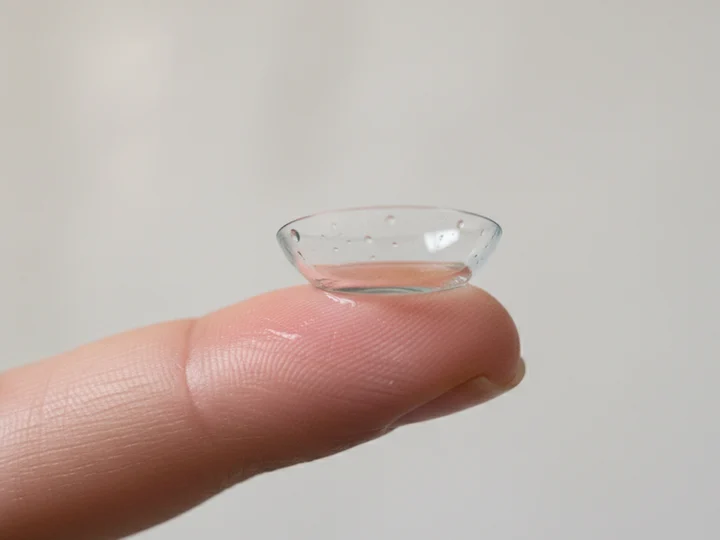
Epioxa is a riboflavin (vitamin B2) eye drop kit that the FDA approved on October 17, 2025, for epithelium-on ("epi-on") corneal cross-linking to treat keratoconus in adults and children 13 and older. It is used with a UV light device and goggles that supply oxygen. The cross-linking approved in 2016 begins by removing the epithelium, the cornea's thin surface layer; with Epioxa, that layer stays on. Both aim to stabilize the cornea and slow or halt keratoconus. A corneal surgeon performs the treatment. We find the progression that makes corneal cross-linking worth doing, help you weigh epi-on against epi-off and handle your follow-up.
Key takeaways
- Approved by the FDA in October 2025, Epioxa drops let a surgeon cross-link a keratoconus cornea without removing its surface layer, in patients 13 and older.
- Like the 2016 method that removes the surface layer, it aims to slow or halt keratoconus, and each was tested against a sham (placebo) procedure, not the other.
- In the trials, treated corneas flattened slightly on average while eyes given a sham (placebo) procedure steepened, and vision usually still comes from glasses or specialty lenses.
- Call your surgeon right away for sudden vision loss in the treated eye, even if it comes back, or 911 if unreachable, and 911 for the other eye or both.
01
What is Epioxa, and how does it work?
Epioxa is two riboflavin eye drop solutions used one after the other, Epioxa HD (0.239%) and Epioxa (0.177%). Riboflavin 5'-phosphate is a form of vitamin B2. Under ultraviolet A (UV-A) light it works as a photoenhancer and produces singlet oxygen, a reactive form of oxygen, which is what does the cross-linking.
In the procedure the label describes, the surgeon numbs the eye and wipes the mucin layer off the surface of the cornea without removing the epithelium, then applies the two solutions in sequence. You then wear goggles that deliver oxygen while a device called the O2n System shines UV-A light on the eye in pulses, 1 second on and 1 second off, for 11 minutes and 6 seconds, and a bandage contact lens goes on at the end.
02
What is epi-on cross-linking, and how is it different from epi-off?
The difference is the epithelium, the thin layer of cells on the surface of the cornea. In epi-off cross-linking, the version the FDA approved in 2016 as Photrexa drops with the KXL System, the surgeon numbs the eye and removes the epithelium over an area about 9 mm across before the riboflavin goes on. In epi-on cross-linking with Epioxa, the epithelium stays in place.
The two FDA labels also differ in who they cover and how the light is given:
| What differs | Epi-off: Photrexa with the KXL System | Epi-on: Epioxa with the O2n System |
|---|---|---|
| Approved for | Progressive keratoconus, and corneal ectasia after refractive surgery | Keratoconus |
| Ages | Safety and effectiveness not established under age 14 | Adults and children 13 and older |
| Epithelium | Removed before the drops | Left in place |
| UV-A light | 30 minutes of continuous light | 11 minutes 6 seconds of stronger, pulsed light, with oxygen goggles |
The Photrexa label and the Epioxa label don't rank one above the other. Each was tested against a sham procedure, not against the other method.
03
Who is Epioxa approved for?
Adults and children 13 and older with keratoconus. The FDA approval covers epi-on cross-linking for keratoconus in that age group, with the O2n System and the Boost Goggles. Epi-off cross-linking with Photrexa was approved for progressive keratoconus on April 15, 2016, and for corneal ectasia after refractive surgery such as LASIK on July 15, 2016. If your cornea started bulging after LASIK, our page on ectasia after LASIK explains the options.
The Epioxa label says it should not be used in:
- People allergic to benzalkonium chloride or to any ingredient in the drops
- People with aphakia, an eye with no natural lens and no lens implant
- People with a lens implant, as after cataract surgery, that doesn't block UV light
The label also says the light treatment should not be given if the cornea is thinner than 325 microns. If you've had herpes keratitis, a herpes infection of the cornea, cross-linking should be used with caution because it could reactivate the infection.
04
What did the Epioxa trials show?
In both trials behind the approval, eyes treated with Epioxa flattened slightly on average, while eyes given a sham (placebo) procedure steepened. The two randomized trials enrolled 201 and 208 patients with keratoconus.
They measured Kmax, the steepest curvature of the cornea, in diopters (D). A cone that is getting worse shows up as a rising Kmax, so a falling number means the cornea flattened slightly. In both trials, the main result was statistically significant.
| Trial | Time point | Epioxa-treated eyes | Sham-treated eyes |
|---|---|---|---|
| Study 1 (201 patients) | 6 months (main result) | 0.3 D flatter | 0.6 D steeper |
| Study 2 (208 patients) | 12 months (main result) | 0.5 D flatter | 0.4 D steeper |
Both trials also looked at results by age. In Study 1, at 6 months, treated eyes of patients younger than 29 flattened by 0.7 D while sham-treated eyes in that age group steepened by 1.3 D, and patients 29 and older showed no improvement in either group. In Study 2, at 12 months, treated eyes flattened by similar amounts in patients under 30 and those 30 and older (0.5 and 0.6 D), while sham-treated eyes steepened by 0.5 D in the younger group and didn't change (0.0 D) in the older one. That fits what we see on corneal maps: younger corneas are the ones most likely to keep changing.
The label gives the trial results as changes in corneal curvature; it doesn't report how much sharper people saw. Cross-linking is meant to hold the cornea steady, and vision usually still comes from glasses or specialty lenses.
05
What are the side effects of Epioxa?
The most common side effect in the trials was eye redness, in 31% of treated eyes. Each of these was reported in 5% to 25% of treated eyes:
- Corneal haze, a cloudy area in the cornea
- Light sensitivity, eye pain, eye irritation and watering
- Punctate keratitis (tiny spots of inflammation on the corneal surface) and corneal epithelium defects (small breaks in the surface layer)
- Eyelid swelling, corneal striae (fine lines in the cornea) and dry eye
- Reduced vision, and anterior chamber flare, a sign of inflammation inside the front of the eye
The label advises that the treated eye may be uncomfortable and that sunglasses can help with light sensitivity. It tells patients to contact their doctor immediately for severe pain in the treated eye or any sudden decrease in vision. For either one, call your surgeon right away, or go to an emergency room when their office is closed. If you suddenly lose vision in the eye that had surgery, even if it comes back, call your surgeon right away; if you can't reach the surgeon, call 911. Call 911 right away for sudden loss of vision in your other eye or both eyes, sudden double vision, or any change in vision with face drooping, arm weakness or trouble speaking.
06
When should keratoconus be treated with cross-linking?
Early, and whenever maps show the cornea is still changing. AOA notes that cross-linking is indicated early after diagnosis, or later in the disease if the glasses prescription is still increasing.
Age is part of the timing. Symptoms usually appear in the late teens or early 20s, and keratoconus may progress for 10 to 20 years before it slows. We typically consider a cross-linking referral when topography and tomography document progression, when the patient is young, when keratoconus runs in the family, or when eye rubbing or poorly controlled allergy keeps stressing the cornea.
Whether epi-on or epi-off suits your cornea is a decision you make with us and the surgeon. Our office is an Epioxa Keratoconus Certified Detection Center: the topography and tomography that document progression are done here, we counsel you on epi-on versus epi-off, and we refer you to the treating surgeon. For younger patients, our guide to keratoconus in teens explains how often maps are repeated.
07
What happens after cross-linking, and how do we help?
Cross-linking is meant to keep the cone from getting worse. It doesn't replace your lenses, and most of our patients still wear specialty lenses afterward for their sharpest vision.
After the procedure you come back to our eye doctors in Los Angeles for follow-up visits and imaging to confirm the cornea stays stable. Once it has healed enough, we work on your vision, usually with scleral lenses or other specialty lenses. Your surgeon gets complete imaging and clinical data from us before and after the treatment, and the surgeon's office checks your insurance benefits before scheduling.
Keep treating the itch, too. Rubbing still works against a thin cornea after cross-linking, and our page on eye rubbing and keratoconus has ways to break the habit. The rest of your keratoconus care, from monitoring to lens fitting, stays here.
08
Questions patients ask
How is keratoconus treated?
Treatment has two jobs: clear vision and a stable cornea. For vision, glasses or soft contact lenses can correct vision in early keratoconus, and as it progresses, rigid gas permeable lenses correct vision adequately in most cases; we fit custom scleral lenses for most moderate to advanced cases. Intacs, removable inserts placed in the cornea, also work on the vision side: they reshape it to reduce nearsightedness and astigmatism. For stability, cross-linking halts or slows progression. In a few cases, a corneal transplant is needed.
What causes keratoconus?
The cause is unknown. In most people with keratoconus, a combination of genetic and environmental factors is needed. Having a relative with keratoconus raises your risk, and more than a dozen genes have been associated with it. The environmental factors that may contribute are excessive eye rubbing and a tendency to allergies (atopy). Vigorous rubbing can injure the cornea and may thin it, and even where it doesn't start keratoconus, it likely makes it worse.
Is keratoconus serious?
It can be. Keratoconus may progress for 10 to 20 years, and as the cornea bulges more, vision may become more distorted. In a small number of cases, a tiny crack lets the cornea swell, causing a sudden, significant drop in vision that can last weeks or months. For a sudden white or gray haze on the cornea, a sign of corneal hydrops, call us at 310-828-2010 for a same-day exam, or go to an emergency room when we're closed; sudden loss of vision, even if it comes back, is a 911 call. Cross-linking halts or slows progression.
When does keratoconus need a corneal transplant?
In a few cases, according to AOA. A corneal surgeon may consider one when keratoconus, scarring or hydrops (sudden corneal swelling) has outrun lenses and cross-linking. Even after a transplant, glasses or contact lenses are often still needed to correct vision, and the year after surgery is shared between the surgeon's office and ours; our page on corneal transplant co-management explains that year.
09
Sources
- FDA: Epioxa approval letter, October 2025
- FDA: Photrexa prescribing information
- American Optometric Association: Keratoconus
- FDA: Epioxa prescribing information
- FDA: Photrexa approval letter, April 2016
- FDA: Photrexa approval letter, July 2016
- FDA: Intacs approval order, 2004
- MedlinePlus Genetics: Keratoconus

Written by
Dr. Brandon Cohenmehr, OD
Specialty contact lenses, with a focus on Ortho-K, scleral lenses, and co-managing patients with keratoconus and other corneal disease. A graduate of SUNY College of Optometry.
About Dr. Brandon →