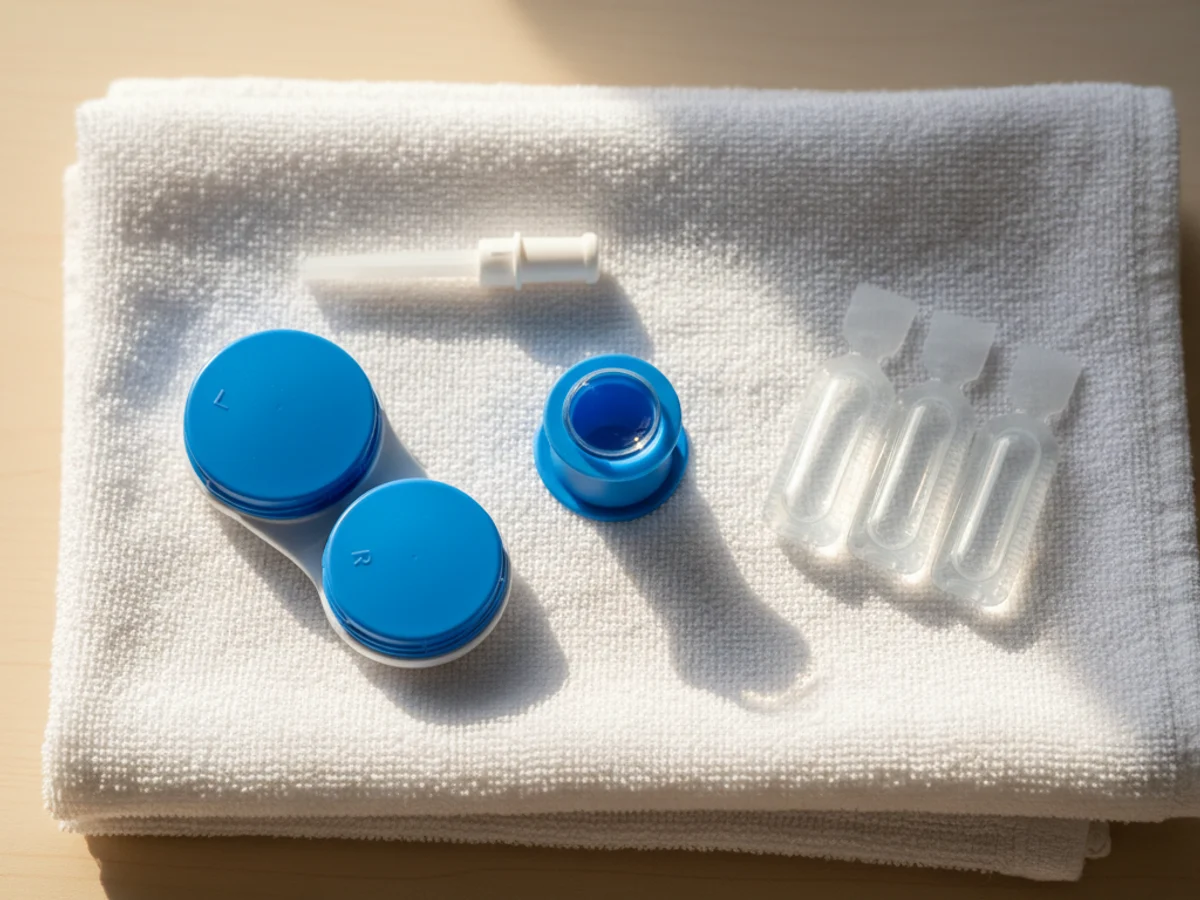
Hydrogen peroxide contact solution cleans and disinfects lenses and is generally preservative-free, which may make it a better choice if you're allergic or sensitive to the preservatives in multipurpose solutions. It has to be neutralized before your lenses go back in, either in the special case that comes with each new bottle or with a neutralizing tablet, because unneutralized peroxide stings, burns and can damage the cornea. Multipurpose solution is an all-in-one product that cleans, rinses, disinfects and stores soft lenses. Saline doesn't disinfect. The right contact lens solution is the one your eye doctor matched to your lenses, used exactly as the label directs.
Key takeaways
- Use the system your eye doctor chose for your lenses, and hydrogen peroxide, which is generally preservative-free, may suit you better if you're sensitive to preservatives.
- Peroxide has to finish neutralizing, in the new case that comes with each bottle or with a tablet, before your lenses go back in.
- Rub and rinse each lens, use fresh solution every time without topping off, and keep water and saliva away from your lenses.
- Take your lenses out right away for pain, redness, blurred vision or light sensitivity, and call us for a same-day visit, or an emergency room when we're closed.
01
What are the types of contact lens solution?
There are two main disinfecting systems, multipurpose and hydrogen peroxide. The other products on the shelf rinse or rewet lenses, or are made for rigid lenses. Saline solution and rewetting drops are not designed to disinfect lenses.
| Product | What it's for | Keep in mind |
|---|---|---|
| Multipurpose solution | Cleaning, rinsing, disinfecting and storing soft lenses | Rub and rinse each lens, and use fresh solution every time |
| Hydrogen peroxide solution (most have a red tip and cap) | Cleaning and disinfecting; generally preservative-free | Must be neutralized before the lens goes back in your eye |
| Sterile saline | Rinsing lenses; preservative-free saline also fills scleral lenses | Doesn't clean or disinfect |
| Rewetting or lubricating drops | Comfort while you wear your lenses | Doesn't disinfect; use only drops approved for contact lenses |
| Rigid lens (GP) solutions | Caring for rigid gas permeable lenses | One-step, two-step or peroxide systems, each with its own directions |
02
How does hydrogen peroxide contact solution work?
The peroxide disinfects the lens, then a neutralizer turns the peroxide into water and oxygen so the lens is safe to put on your eye.
Systems come in two types. A one-step system neutralizes during the disinfecting stage, using a lens case with a neutralization disc built in. A two-step system neutralizes after disinfecting, with a tablet you add to the solution.
To use it safely:
- Use the special case that comes with each new bottle, and never reuse an old case.
- Soak your lenses for the full time on the label, and let neutralizing finish before you put them in.
- Never rinse lenses with peroxide solution before you put them in, and never put it in your eyes.
- Check for the red tip and cap that most peroxide bottles carry, so you can tell them from other solutions.
03
What happens if hydrogen peroxide solution gets in your eye?
It stings right away. Putting the solution directly in your eye can cause irritation, stinging and burning and can damage your cornea. Poison Control says eye exposure to the 3% hydrogen peroxide in red-cap lens solutions can cause immediate stinging, irritation, tearing and blurred vision, though severe injury is unlikely.
If it happens, rinse first:
- Take out the contact lens if it's still in.
- Rinse the eye right away with plenty of room-temperature water for at least 15 to 20 minutes. Adults may find it easiest to stand in the shower and let the water hit the bridge of the nose and run gently into the eye.
- Call Poison Control at 1-800-222-1222, or use its online tool, and then call us right away at 310-828-2010, or go to an emergency room when the office is closed.
- If pain, redness, blurred vision, swelling or tearing is still there an hour after you started rinsing, you need an eye exam right away, at an emergency room unless we can see you immediately. If the symptoms are severe, don't wait the hour: go straight to an emergency room after rinsing. The FDA advises contacting your eye care provider if you think you've had a bad reaction to a peroxide solution.
If you suddenly lose vision in one or both eyes, even if it comes back, call 911.
04
Multipurpose or hydrogen peroxide: which should you use?
Use the system your eye doctor chose for you. A contact lens care system is selected to be compatible with your lens material and the way you wear your lenses.
Multipurpose solution is the simpler routine: rub, rinse and soak with one bottle. Soaking times vary by brand but are usually between four and eight hours.
Hydrogen peroxide takes an extra step and its own case. In exchange, you avoid the preservatives in multipurpose solutions, which matters if your eyes are sensitive to them.
If your eyes burn or feel gritty with every solution you try, the solution may not be the problem. Our guide to contact lens discomfort explains how testing the tear film and the fit sorts it out.
05
How do you use contact lens solution safely?
About 45 million people in the U.S. wear contact lenses, and the CDC says most of them don't practice proper lens hygiene. Follow these habits every time:
- Wash and dry your hands before you touch your lenses.
- Rub and rinse each lens every time you take it out, then store it in fresh solution. The AOA recommends rubbing and rinsing after wear for all contact lenses.
- Never top off. Mixing fresh solution with old solution in the case makes it disinfect less well, so empty the case each time.
- Keep water and saliva away from your lenses. Water exposure has been associated with Acanthamoeba keratitis, a corneal infection, and saliva isn't sterile.
- Use sterile saline to rinse lenses, and for scleral lenses to fill them, but never to clean or disinfect.
- Keep solution in its original bottle. Pouring it into small travel containers can affect its sterility and lead to an eye infection. Airport security treats contact lens solution as a medically necessary liquid, so you can bring a full-size bottle if you declare it at the checkpoint.
- After each use, rub and rinse the case with fresh solution, never water, then empty it, dry it with a clean tissue and store it upside down on a clean tissue with the caps off.
06
What do scleral, rigid and daily lenses need?
Rigid gas permeable (RGP) lenses need a more complex cleaning and disinfection process than soft lenses. Their solutions come as one-step multipurpose, two-step cleaning and soaking, or hydrogen peroxide systems, and each has its own directions.
Scleral lenses are filled with saline before they go in, and that fluid sits against your cornea all day. Our eye doctors in Los Angeles have patients fill them only with sterile preservative-free saline, never multipurpose solution or rewetting drops, and clean them with the system we dispense. Our scleral lens care page has the full routine.
Daily disposable lenses need no solution: they're thrown away each night, so no cleaning is required. They're our default recommendation for soft lenses, and a contact lens exam will show whether they suit your eyes.
07
When should you take your lenses out and call us?
Take your lenses out right away and keep them out if you notice discomfort, excess tearing or other discharge, unusual sensitivity to light, itching, burning or a gritty feeling, unusual redness, blurred vision, swelling or pain. Then contact your eye doctor immediately, and keep the lenses, since they may help find the cause.
Eye infections can get worse quickly, so we see them the same day during office hours, Monday 10 to 5 and Tuesday to Friday 8 to 5: call 310-828-2010 or see our same-day urgent eye care page. When the office is closed, go to an emergency room for pain, redness, blurred vision or light sensitivity. The National Eye Institute lists intense eye pain, blurry vision, a change in vision and very red, watery eyes among the reasons to get help right away from an eye doctor or an emergency room.
Our keratitis guide explains the corneal infections that lens habits such as tap water and old cases can cause.
08
Questions patients ask
Does contact lens solution expire after you open it?
Yes. Besides the expiration date on the package, which you should never go past, check the package insert for the discard date: the date to throw the solution out after opening, typically within 90 days, though it varies by manufacturer and solution type. Preservative-free solutions, such as single-use vials of saline, should be thrown away within 24 hours of opening. Stored lenses need fresh solution too: some multipurpose solutions keep them for up to a month in a tightly closed case, some hydrogen peroxide systems for seven days and others for only 24 hours.
Is generic contact lens solution safe to use?
It may not be right for your lenses. Generic or store-brand solutions may have been formulated for older lens materials, and newer materials have different chemical compositions that may not be compatible with them. Lens materials and solutions can interact in ways that affect disinfection. Before you switch to any different solution, check with your eye doctor that it's safe for the type of lenses you wear.
What causes itchy eyes with contacts?
It can be an allergic reaction: the AOA lists a reaction to contact lenses as a chronic cause of eye allergies, which cause itching, redness and swelling. One type, giant papillary conjunctivitis, is more likely with rigid lenses or soft lenses that aren't replaced often, and a doctor of optometry may suggest a different lens or disinfecting solution. Itching is also on the FDA's list of symptoms that mean taking your lenses out and contacting your eye doctor immediately.
How often should you replace your contact lens case?
Every one to three months. Overusing a case can lead to serious eye infections from bacterial contamination, and a new case usually comes with each new bottle of solution. Each morning, rinse the case with fresh solution and let it air-dry before you use it again. Never rinse it with tap water. If you use hydrogen peroxide solution, use the new case that comes with each bottle and never reuse an old one.
09
Sources
- FDA: Hydrogen peroxide solution
- FDA: Safe use of hydrogen peroxide solution
- Poison Control: Is hydrogen peroxide safe?
- Poison Control: Splashed a poison in your eye?
- CDC: Cleaning, disinfecting and storing contact lenses
- FDA: Contact lens solutions and products
- AOA: Contact lens care
- CDC: About contact lenses
- CDC: About contact lens types
- FDA: Contact lens risks
- AOA: Conjunctivitis (pink eye)
- AOA: Ocular allergies
- National Eye Institute: Corneal conditions

Written by
Dr. Brandon Cohenmehr, OD
Specialty contact lenses, with a focus on Ortho-K, scleral lenses, and co-managing patients with keratoconus and other corneal disease. A graduate of SUNY College of Optometry.
About Dr. Brandon →